<article>
<p>Long gaming sessions can become surprisingly difficult when your attention starts drifting. You may know exactly what you want to do, yet miss an important sound cue, make an unnecessary mistake, forget an objective, or lose track of the strategy you were using only a few minutes earlier.</p>
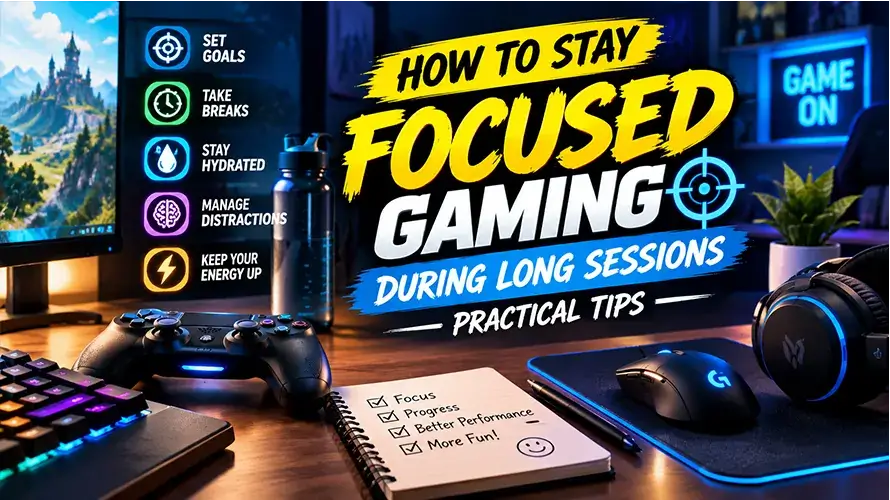
<p>Learning <strong>how to stay focused gaming</strong> is less about forcing yourself to concentrate for hours and more about managing the conditions that support concentration. Your game choice, session length, breaks, surroundings, physical comfort, and even the way you approach difficult moments can all affect how well you pay attention.</p>
<p>This guide focuses on practical changes that can make long sessions easier to manage without turning gaming into an exhausting endurance test.</p>
<section>
<h2>Start With a Clear Goal for the Session</h2>
<p>One of the easiest ways to lose focus is to begin playing without knowing what you actually want to accomplish. If you switch constantly between objectives, menus, matches, or games, your attention has more opportunities to wander.</p>
<p>Before starting, choose one main purpose for the session. It could be completing a particular level, practicing aim, improving at a strategy game, finishing a quest, or simply playing a few relaxed rounds.</p>
<p>A specific goal gives your attention a reference point. Instead of thinking, “I will play for a while,” you have something concrete to work toward.</p>
<ul>
<li><strong>Competitive session:</strong> Focus on practicing one skill rather than obsessing over every result.</li>
<li><strong>Story game:</strong> Choose a chapter, quest, or clear stopping point.</li>
<li><strong>Puzzle game:</strong> Work through a defined group of challenges.</li>
<li><strong>Casual gaming:</strong> Set a simple time boundary and enjoy the session without chasing endless progress.</li>
</ul>
<p>The goal does not need to be ambitious. A small, clearly defined objective can be more useful for concentration than an unrealistic plan to play for several hours.</p>
</section>
<section>
<h2>Remove the Distractions That Break Your Attention</h2>
<p>Gaming requires more attention when you are constantly interrupted. A phone notification, unrelated browser tab, message, video, or conversation can pull your mind away from the game even when the interruption lasts only a few seconds.</p>
<p>Before beginning a focused session, reduce the distractions that you can control. Put unnecessary notifications on silent, close unrelated applications, and keep only the devices or windows you actually need.</p>
<p>This is especially important in games where missing a short visual or audio cue can affect the outcome. In a strategy game, a few seconds of distraction may cause you to overlook an opponent’s move. In an action game, it may be enough to miss an attack or movement cue.</p>
<p>You do not need a completely silent environment. The useful question is whether the background activity is helping you relax or repeatedly demanding your attention.</p>
</section>
<section>
<h2>Use Breaks Before Your Focus Disappears</h2>
<p>Waiting until you are completely exhausted before taking a break usually makes the break less useful. Once concentration has already collapsed, continuing to play often produces frustration rather than meaningful practice or enjoyment.</p>
<p>Instead, treat breaks as part of the session. After a reasonable period of concentrated play, step away from the screen for a few minutes. Stand up, stretch, get some water, or simply look at something that is not your game.</p>
<p>The important part is to create a genuine mental pause rather than replacing gaming with another highly stimulating screen activity.</p>
<h3>What a useful gaming break can look like</h3>
<ul>
<li>Stand up and walk around for a few minutes.</li>
<li>Drink water.</li>
<li>Stretch your shoulders, wrists, neck, and legs.</li>
<li>Look away from the screen and allow your eyes to rest.</li>
<li>Take a few slow breaths before returning.</li>
<li>Decide whether you still want to continue before starting another round.</li>
</ul>
<p>A short break can also give you a natural stopping point. If you return and immediately feel tired or uninterested, that may be a sign that the session has already reached its useful limit.</p>
</section>
<section>
<h2>Pay Attention to the Difference Between Focus and Fatigue</h2>
<p>Not every concentration problem can be solved with better discipline. Sometimes the problem is simply fatigue.</p>
<p>When you are tired, you may notice slower reactions, repeated mistakes, difficulty remembering objectives, irritation over small setbacks, or a tendency to play without thinking carefully. These signs are useful because they tell you that continuing may not produce the experience you want.</p>
<p>Consider the difference between these two situations:</p>
<table>
<thead>
<tr>
<th>What you notice</th>
<th>Likely problem</th>
<th>Useful response</th>
</tr>
</thead>
<tbody>
<tr>
<td>You keep checking your phone</td>
<td>External distraction</td>
<td>Silence notifications and remove the phone from reach</td>
</tr>
<tr>
<td>You understand the game but keep making simple mistakes</td>
<td>Possible fatigue or loss of attention</td>
<td>Take a break before continuing</td>
</tr>
<tr>
<td>You become frustrated after every loss</td>
<td>Mental overload or competitive pressure</td>
<td>Pause, reset your goal, or switch to a lower-pressure activity</td>
</tr>
<tr>
<td>You lose interest even when the game is going well</td>
<td>The session may have gone on too long</td>
<td>Stop or take a longer break</td>
</tr>
<tr>
<td>You cannot remember what you were planning to do</td>
<td>Attention is becoming scattered</td>
<td>Write down the next objective and pause if necessary</td>
</tr>
</tbody>
</table>
<p>Recognizing fatigue early is particularly valuable during competitive gaming. Continuing purely because you have already invested time in the session can turn useful practice into repetitive mistakes.</p>
</section>
<section>
<h2>Make Your Gaming Setup Comfortable</h2>
<p>Physical discomfort can quietly consume attention. If your chair is uncomfortable, your wrists are strained, your screen position feels awkward, or you are constantly adjusting your posture, part of your attention is being spent on your surroundings instead of the game.</p>
<p>You do not need an expensive gaming setup to improve this. Start with basic adjustments. Position the screen comfortably, keep frequently used controls easy to reach, and avoid sitting in a position that becomes painful after a short period.</p>
<p>For keyboard and mouse gaming, pay attention to unnecessary tension in your hands and shoulders. If you notice yourself gripping the mouse or controller much harder during difficult moments, deliberately relax your hands during quieter parts of the game.</p>
<p>Comfort should support gaming rather than become another source of distraction.</p>
</section>
<section>
<h2>Choose the Right Type of Game for Your Energy Level</h2>
<p>Focus does not look the same across every genre. A fast competitive match can demand constant attention, while a casual puzzle game may allow a slower mental rhythm.</p>
<p>That means the best game for a particular session depends partly on your current energy level and what you want from gaming.</p>
<ul>
<li><strong>High energy:</strong> Fast action, competitive matches, demanding strategy, or games requiring quick reactions may feel easier to handle.</li>
<li><strong>Moderate energy:</strong> Adventure games, puzzles, simulation games, and less intense strategy can provide engagement without constant pressure.</li>
<li><strong>Low energy:</strong> Consider shorter sessions or relaxed games instead of forcing yourself through demanding competitive content.</li>
</ul>
<p>This does not mean one genre is inherently better for concentration. It means that matching the game’s demands to your current attention level can prevent unnecessary frustration.</p>
</section>
<section>
<h2>Use One Simple Technique When Your Mind Wanders</h2>
<p>When you notice your attention drifting, do not try to think about ten things at once. Bring your attention back to the immediate task.</p>
<p>For example, in a strategy game, ask yourself, <em>”What is the most important decision in front of me right now?”</em> In an action game, focus on positioning, the next objective, or the information you need to react to. In a puzzle game, identify the next piece of information you need rather than thinking about the entire solution.</p>
<p>This creates a smaller mental target. Instead of demanding perfect concentration for the rest of the session, you are simply returning your attention to the current decision.</p>
<h3>A quick reset when you lose focus</h3>
<ol>
<li>Pause if the game allows it.</li>
<li>Relax your hands and shoulders.</li>
<li>Take one slow breath.</li>
<li>Identify your immediate objective.</li>
<li>Ignore unrelated thoughts until the next natural stopping point.</li>
</ol>
<p>The technique is simple, but its value comes from noticing the distraction early instead of continuing to play on autopilot.</p>
</section>
<section>
<h2>Stop Playing on Autopilot</h2>
<p>Autopilot happens when you continue performing familiar actions without actively thinking about them. This can be harmless in easy sections of a game, but it becomes a problem when you are supposed to be learning, improving, or making important decisions.</p>
<p>One way to break the habit is to ask yourself a question at natural moments. After a round, for example, ask what caused the biggest mistake. Before an important decision, ask what information you are using. After completing an objective, decide what you should prioritize next.</p>
<p>These questions transform passive play into deliberate play. You are not required to analyze every action. A few intentional checkpoints are enough to keep your attention engaged.</p>
</section>
<section>
<h2>Separate Practice Sessions From Relaxed Sessions</h2>
<p>Trying to improve a skill while simultaneously expecting every session to be completely relaxing can create conflicting goals. A practice session benefits from attention and reflection, while a casual session can simply be about enjoying the game.</p>
<p>If you want to improve, decide when you are practicing. Keep the objective narrow and review what happened afterward. If you want to relax, remove the pressure to optimize every decision.</p>
<p>For example, an aim-training session might focus on accuracy and controlled movement. A separate gaming session can then be used for ordinary matches without constantly evaluating performance.</p>
<p>This separation can make it easier to concentrate because you know what the session is supposed to accomplish.</p>
</section>
<section>
<h2>Common Focus Mistakes During Long Gaming Sessions</h2>
<p>Some habits look like dedication but actually make sustained attention harder. Avoiding them can improve the quality of a session without requiring complicated techniques.</p>
<h3>Playing through repeated mistakes</h3>
<p>If the same mistake keeps happening, continuing immediately is not always the best form of practice. Pause and identify what is causing it. A short reset can be more productive than repeating the same sequence without reflection.</p>
<h3>Using every minute of available time</h3>
<p>A long session does not automatically provide more value than a shorter focused session. If your concentration has clearly declined, additional play may mainly add frustration and fatigue.</p>
<h3>Constantly switching games</h3>
<p>Moving between several games can feel refreshing, but frequent switching can also prevent you from settling into a focused rhythm. If concentration is your priority, give one game enough uninterrupted time to become fully engaged with it.</p>
<h3>Ignoring physical discomfort</h3>
<p>Minor discomfort can become a major distraction during a long session. Adjust your position when you notice tension instead of waiting until it becomes painful.</p>
<h3>Turning every mistake into a personal problem</h3>
<p>A missed shot, lost match, or failed puzzle is information about what happened in that moment. Treating every mistake as a reason to become angry adds mental noise that makes the next decision harder.</p>
</section>
<section>
<h2>A Simple Long-Session Focus Checklist</h2>
<p>If you want a quick routine before starting, use this checklist:</p>
<ul>
<li>Choose one main goal for the session.</li>
<li>Remove unnecessary notifications and distractions.</li>
<li>Make sure your seating and controls are comfortable.</li>
<li>Keep water nearby.</li>
<li>Decide where a natural break could occur.</li>
<li>Focus on the current objective rather than the entire session.</li>
<li>Notice repeated mistakes instead of automatically repeating them.</li>
<li>Take a real break when concentration begins to fall.</li>
<li>Stop when continuing no longer feels useful or enjoyable.</li>
</ul>
<p>You do not need to follow every point perfectly. The checklist is mainly a way to remove avoidable distractions before they interfere with your attention.</p>
</section>
<section>
<h2>When You Should End the Session</h2>
<p>One of the most useful concentration skills is recognizing when there is little benefit left in continuing.</p>
<p>If you are repeatedly making basic mistakes, becoming unusually frustrated, struggling to follow simple objectives, or playing without any real interest, consider stopping. You can always return later with a clearer mind.</p>
<p>For competitive players, this can be particularly important. A session that started as deliberate practice can eventually become a cycle of frustration, rushed decisions, and more mistakes. Ending the session is sometimes more productive than trying to recover your performance through sheer persistence.</p>
<p>Gaming is supposed to fit into your life, not require you to ignore every signal that you need a pause.</p>
</section>
<section>
<h2>Frequently Asked Questions</h2>
<h3>How can I stay focused gaming for several hours?</h3>
<p>Use a clear session goal, reduce distractions, take regular breaks, and monitor signs of fatigue. Long sessions are easier to manage when they are divided into focused periods rather than treated as one uninterrupted block.</p>
<h3>Why do I lose focus while playing games?</h3>
<p>Common reasons include fatigue, notifications, background distractions, repetitive gameplay, physical discomfort, frustration, and playing for longer than your current attention level supports.</p>
<h3>Do breaks make gaming performance better?</h3>
<p>A break can help when concentration has started to decline because it gives you time away from the immediate demands of the game. The most useful break is one that actually lets you step away rather than replacing the game with another demanding screen activity.</p>
<h3>Should I stop gaming when I keep making simple mistakes?</h3>
<p>It is worth considering a pause. Repeated simple mistakes can be a sign that attention or energy is declining. After a short break, you can decide whether you are ready to continue or whether the session has reached its natural end.</p>
<h3>Is background music good for gaming focus?</h3>
<p>It depends on the person and the game. Music may help create a consistent atmosphere during relaxed play, while games that rely heavily on audio cues may benefit from reducing competing sounds. Test what allows you to notice important game information without becoming distracted.</p>
<h3>Can changing games help when I lose concentration?</h3>
<p>Sometimes, but switching games is not always the solution. If the underlying problem is fatigue, another demanding game may only delay the problem. A genuine break or ending the session may be more appropriate.</p>
</section>
<section>
<h2>Final Thoughts</h2>
<p>Staying focused during long gaming sessions is mainly about managing attention rather than forcing it. A clear objective, fewer distractions, a comfortable setup, deliberate breaks, and awareness of fatigue can make your playing time more consistent and enjoyable.</p>
<p>Start with one or two changes instead of trying to redesign your entire routine. The most useful habit is learning to recognize the difference between a session where you are still engaged and one where you are simply continuing because you have not stopped yet.</p>
</section>
</article>