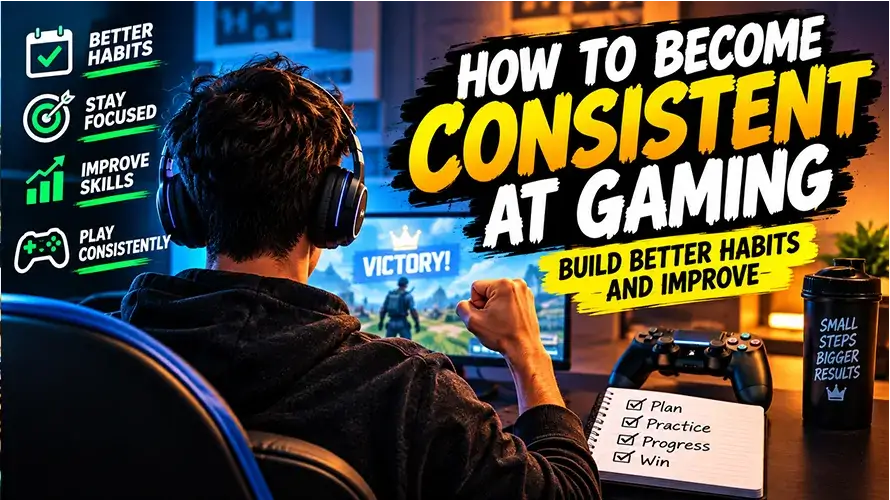
Playing well once is not the same as playing well consistently. You might have an excellent session on Monday, struggle on Tuesday, and then wonder why your performance seems impossible to predict. In many games, consistency comes less from suddenly gaining more skill and more from reducing the small mistakes, distractions, and habits that make your performance unstable.
If you want to learn how to become consistent at gaming, focus on creating repeatable conditions for good play. That means understanding your usual mistakes, practicing with a purpose, managing your attention, and knowing when to stop before poor decisions start affecting the rest of your session.
Consistency Is About Repeatable Performance
Consistency does not mean achieving your best possible result every time you play. Your performance will naturally change depending on the game, opponent, difficulty, fatigue, and situation. A more realistic goal is to reduce the gap between your strong sessions and your weak ones.
For example, imagine you normally make ten avoidable mistakes during a difficult match. Reducing that number to six may improve your results even if your aim, reaction speed, or mechanical skill has not changed dramatically. Consistency often comes from removing weaknesses rather than constantly adding new techniques.
This applies across many genres. In a puzzle game, consistency might mean recognizing patterns without rushing. In an arcade game, it may involve maintaining a reliable rhythm. In a strategy game, it could mean following a sound opening routine instead of changing your plan after every setback.
Start by Finding What Actually Changes Your Performance
Before changing your routine, identify why your performance varies. If you do not know what causes your bad sessions, you may spend time practicing something that is not responsible for the problem.
For your next several sessions, make a simple mental or written note after playing. You do not need complicated statistics. Record a few useful observations such as:
- How focused you felt during the session.
- Which mistakes happened repeatedly.
- Whether you were rushing decisions.
- Whether your performance declined after playing for a long time.
- Which situations caused the most trouble.
- Whether you were experimenting or following a familiar approach.
Patterns become easier to recognize when you compare several sessions rather than judging yourself from one unusually good or bad game.
Build a Short Warm-Up Instead of Jumping Straight Into Difficult Games
A warm-up can help you transition from ordinary daily activity into the type of attention your game requires. It does not need to be long. In many cases, five to fifteen focused minutes are enough.
The important part is matching the warm-up to the skill you actually use. If the game depends heavily on precise movement, practice movement. If it requires rapid pattern recognition, use a simple practice activity that challenges recognition. If the main challenge is decision-making, review a few common situations before starting a serious session.
A useful warm-up should leave you prepared rather than exhausted. If the warm-up becomes another full gaming session, it can consume the attention you wanted to preserve.
Practice One Weakness at a Time
Trying to improve everything simultaneously makes it difficult to identify what is working. Instead, choose one recurring weakness and give it most of your attention for a period of practice.
Suppose you frequently lose because you make decisions too quickly. Your practice goal could be to pause briefly before important decisions. You are not trying to improve every aspect of your gameplay at the same time. You are training yourself to recognize a specific situation and respond differently.
Once that behavior becomes more automatic, move to another weakness. This creates a progression where each improvement supports the next one.
Use mistakes as practice targets
A mistake is more useful when you can describe it precisely. Instead of saying, “I played badly,” identify what happened: “I attacked before checking the opponent’s position,” “I stopped paying attention to the timer,” or “I changed my strategy after one unsuccessful attempt.”
Specific problems create specific practice goals. Vague criticism usually does not.
Use a Reliable Game Plan Before Experimenting
Consistency becomes harder when every session is treated as an experiment. Trying different approaches can be useful for learning, but constantly changing your strategy also makes it difficult to determine whether a method actually works for you.
Develop a basic approach that you understand well. In a strategy game, this might be a familiar opening sequence. In an action game, it could be a preferred approach to common encounters. In a puzzle game, it may be a repeatable process for examining the board before committing to a move.
Your standard approach does not have to be perfect. Its purpose is to give you a dependable starting point so that you can focus your attention on the situations that genuinely require adaptation.
Separate Learning Sessions From Performance Sessions
One reason players feel inconsistent is that they expect every session to serve the same purpose. Learning and performance require different approaches.
During a learning session, experimentation is useful. You can test unfamiliar strategies, practice difficult mechanics, and deliberately put yourself into situations where you normally struggle.
During a performance-focused session, reducing unnecessary variables can be more useful. Use familiar settings, familiar strategies, and goals you already understand. This makes it easier to evaluate your actual performance instead of constantly adjusting to new conditions.
| Session Type | Main Goal | Useful Approach |
|---|---|---|
| Learning | Develop a specific skill | Experiment and repeat difficult situations |
| Performance | Apply established skills | Use familiar strategies and minimize distractions |
| Review | Understand mistakes | Identify patterns and choose the next practice target |
Make Your Gaming Environment Predictable
Small environmental changes can create unnecessary variation. If your controls, display settings, audio setup, or playing position change constantly, you may spend part of every session adapting instead of playing.
Once you find settings that are comfortable and suitable for the game, avoid changing them without a reason. This is particularly useful for games that depend on precise timing or repeated mechanical actions.
The same principle applies outside the game. A stable playing position, reasonable lighting, comfortable posture, and a distraction-free environment can make it easier to maintain attention during longer sessions.
Learn to Recognize the Point Where Your Performance Drops
Longer sessions are not automatically better practice. After enough time, concentration can decline, decisions can become rushed, and mistakes that normally feel obvious may start appearing repeatedly.
Watch for signs such as:
- Repeating the same mistake several times.
- Starting matches without thinking about your plan.
- Becoming unusually impatient after a setback.
- Making decisions simply because you want the round to end.
- Struggling to remember information that was easy to track earlier.
When these signs appear, taking a break can be more productive than immediately starting another game. The goal is not to maximize the number of hours played. It is to make the time you spend practicing useful.
Use a Simple Rule for Losing Streaks
A losing streak can create a cycle where each new game becomes an attempt to immediately recover the previous result. That mindset often encourages rushed decisions and unnecessary changes to a strategy that was working reasonably well.
Create a personal stopping rule before the session begins. For example, you might decide that after several frustrating games in a row, you will take a short break and review what went wrong rather than continuing automatically.
The exact number is less important than having a predetermined response. Making the decision before frustration builds removes some of the pressure from the moment.
Improve Decision-Making by Slowing Down at the Right Moments
Consistency does not require playing slowly. It requires recognizing when speed matters and when a short pause can prevent an avoidable mistake.
Fast decisions are often useful for routine situations. Important decisions deserve more attention, especially when the outcome can significantly change the rest of the game.
Try identifying the moments that deserve a deliberate pause. Ask yourself a quick question such as: “What information am I missing before I commit?” This habit can be useful in strategy, action, puzzle, and competitive games without requiring you to overthink every move.
Do Not Confuse More Difficulty With Better Practice
Increasing the difficulty can be valuable, but constantly playing situations that are far beyond your current ability may produce repeated errors without teaching you how to correct them.
A productive practice challenge should be difficult enough to expose weaknesses while still allowing you to understand why you succeeded or failed. If you cannot identify the reason behind an outcome, reduce the difficulty or isolate the specific mechanic before increasing the challenge again.
This creates a useful progression: understand the skill, practice it under manageable pressure, then gradually introduce more difficult conditions.
Track Progress Without Obsessing Over Results
Results can be useful, but they do not tell the whole story. A player can perform better in a difficult situation even when the final result does not improve immediately.
Alongside outcomes, track process-based improvements. You might notice that you make fewer rushed decisions, recover faster after mistakes, remember important information for longer, or execute a routine with fewer errors.
These smaller improvements often appear before a noticeable change in your overall results. They also give you something specific to work on during the next session.
A Practical Consistency Routine
You do not need an elaborate training schedule to become more reliable. A simple routine can provide enough structure for most players.
- Choose one goal. Decide what you want to improve before starting.
- Warm up briefly. Practice the mechanics or decisions most relevant to your goal.
- Play normally. Apply the skill without constantly stopping to analyze yourself.
- Notice repeated mistakes. Look for patterns rather than criticizing individual failures.
- Take a break when concentration falls. Avoid turning fatigue into additional practice.
- Review the session. Identify one thing that improved and one thing to practice next time.
The routine works because it gives each session a purpose. You are not simply accumulating playtime; you are creating repeated opportunities to practice the same useful behavior.
Common Habits That Make Players Less Consistent
Some habits create large swings in performance even when the player’s underlying skill has not changed.
Changing settings constantly
Frequent sensitivity, control, or display changes can prevent you from developing reliable muscle memory and familiarity. Change something when there is a clear reason, then give yourself time to adapt.
Practicing without a target
Playing for hours does not guarantee improvement. If every session has a different focus, it becomes difficult to determine what you are actually training.
Ignoring fatigue
When attention drops, additional games may reinforce poor habits instead of improving performance. A short break can be more valuable than another low-quality attempt.
Reacting emotionally to one mistake
One error does not necessarily require a complete change of strategy. Identify what caused it, correct the specific problem, and continue unless the situation genuinely requires a different approach.
Comparing every session with your personal best
Your best performance is an unusually strong reference point, not a realistic standard for every game. Compare recent sessions with each other and look for gradual improvement in repeatable behaviors.
How to Know Your Consistency Is Improving
Improvement is not limited to higher scores or more wins. Look for evidence that your performance is becoming more stable.
- You make fewer avoidable mistakes in familiar situations.
- You recover more quickly after making an error.
- You can explain why a decision worked or failed.
- Your performance remains reasonably stable across normal sessions.
- You need less time to get comfortable with your controls and routine.
- You can recognize when you need a break instead of continuing automatically.
These signs indicate that your gameplay is becoming more repeatable. Once that foundation is established, adding advanced techniques becomes easier because you are no longer rebuilding your approach every session.
Frequently Asked Questions
How long does it take to become consistent at gaming?
There is no universal timeline. It depends on the game, your current skill level, how often you practice, and the specific weakness you are addressing. Consistency usually develops through repeated practice of the same useful behaviors rather than simply playing for a certain number of hours.
Should I play every day to improve?
Daily practice can help some players, but quality matters more than a rigid schedule. Short, focused sessions can be more useful than long sessions played while distracted or fatigued.
Why am I good at a game sometimes but bad at it on other days?
Performance can vary because of concentration, fatigue, unfamiliar situations, distractions, changes in routine, and decision-making under pressure. Tracking your sessions can help reveal which factors affect you most.
Is practicing one skill better than playing normal games?
Both have a role. Focused practice isolates a weakness, while normal games teach you how to apply that skill when several demands compete for your attention. Combining the two can create a more useful practice cycle.
Should I stop playing after losing several games?
Not necessarily, but repeated losses combined with frustration or declining concentration are useful signals to pause. A short break or review can prevent you from turning a temporary problem into a longer unproductive session.
Final Thoughts
Becoming more consistent at gaming is less about finding one secret technique and more about creating a repeatable process. Identify your recurring mistakes, practice one weakness at a time, keep your setup stable, manage your attention, and give yourself enough recovery time to play with purpose.
The biggest change often comes when you stop judging every session by its final result and start looking at the behaviors that produced it. When those behaviors become more reliable, stronger performances have a much better chance of becoming your normal performances rather than occasional exceptions.