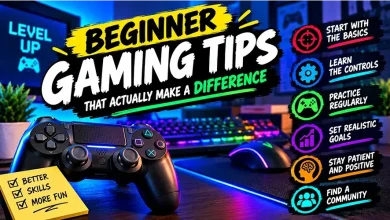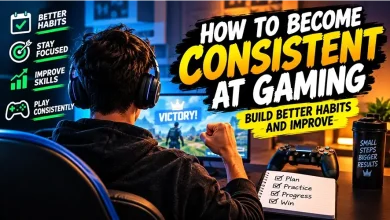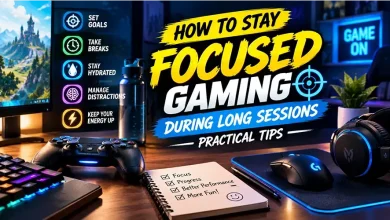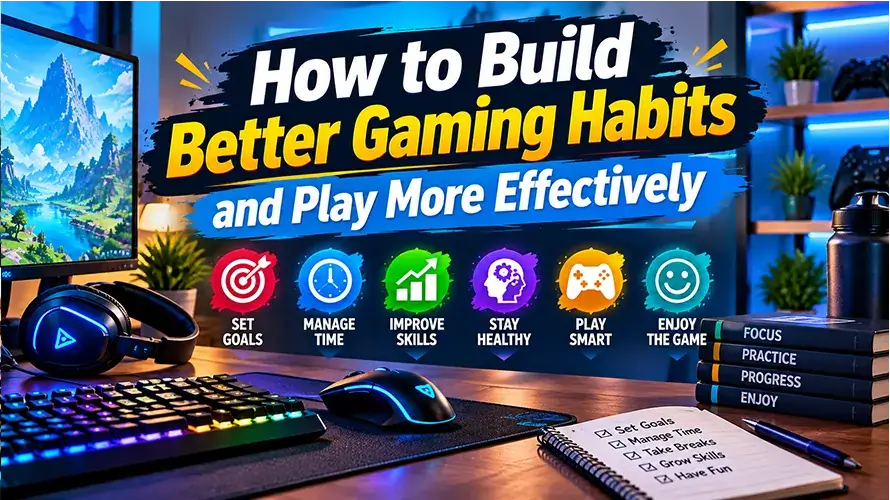
Good gaming habits are not about playing as little as possible or turning every session into serious training. They are about making your time in a game more intentional. A few simple changes to when you play, how you start a session, what you focus on, and when you stop can make gaming feel more enjoyable while helping you avoid common problems such as losing focus, playing on autopilot, or continuing long after the session has stopped being fun.
Building better gaming habits starts with understanding your own playing patterns. You do not need a complicated schedule or a collection of productivity apps. You need a routine that works with the kinds of games you enjoy and the amount of time you realistically have available.
Start by Defining What You Want From Gaming
Before changing your routine, decide what you want a typical gaming session to accomplish. Different goals require different habits. Someone playing a competitive action game may want to improve a particular skill, while someone playing a puzzle or casual game may simply want a relaxing break.
Choose one primary purpose for most of your sessions. It can be as simple as:
- Relaxing after work or study.
- Practicing a specific gaming skill.
- Finishing a particular challenge or level.
- Playing socially with friends.
- Exploring a new game without worrying about performance.
This small distinction matters because it changes how you judge a session. If your goal is relaxation, there is little reason to become frustrated because you did not improve your score. If your goal is practice, spending the entire session switching between games may not be useful.
Create a Simple Pre-Game Routine
A short routine before playing can prevent many sessions from becoming unfocused. Instead of opening a game automatically whenever you have a spare moment, take a few seconds to decide what you are about to do.
- Choose the game you actually want to play.
- Decide roughly how long you have available.
- Set one realistic objective for the session.
- Start playing without unnecessary distractions.
For example, if you have 45 minutes available, you might decide to play two or three focused matches rather than continuously jumping between different games. If you only have 15 minutes, a short browser or arcade game may be a better fit than starting a long campaign.
The goal is not to make gaming feel like work. The goal is to remove the uncertainty that often leads to unfocused play.
Use Session Goals Instead of Playing on Autopilot
One of the easiest habits to develop is choosing a small objective before you begin. The objective should be specific enough to influence your decisions but simple enough that you do not become obsessed with achieving it.
Instead of saying, “I need to get better,” choose something measurable within the session:
- Practice aiming while moving rather than standing still.
- Learn one new character or ability.
- Complete three puzzle levels without rushing.
- Experiment with a different strategy.
- Focus on making fewer unnecessary mistakes.
Afterward, briefly consider whether the goal was useful. If it was, keep using it. If it was not, change it next time. This creates a natural feedback loop without requiring detailed statistics or complicated performance tracking.
Match the Game to Your Available Time
A common source of frustration is choosing a game that does not fit the time available. A player with only 20 minutes may start a game that works better with long uninterrupted sessions and then feel rushed when it is time to stop.
| Available time | Useful approach |
|---|---|
| 10–20 minutes | Short arcade, puzzle, casual, or browser games |
| 20–45 minutes | A few focused rounds, missions, or challenges |
| 45–90 minutes | Longer sessions with a clear stopping point |
| 90+ minutes | Long-form games can work well, with breaks built into the session |
These are not strict rules. Some players can enjoy a long game in short sessions, while others prefer spending an entire evening on a single title. The useful principle is to make the game’s structure fit your available time rather than repeatedly fighting against it.
Build Better Break Habits
Taking a break does not mean you are wasting gaming time. A short pause can help you return with more attention, especially after repeated attempts at a difficult level or several competitive matches.
Use natural stopping points when possible. Finish a match, reach a checkpoint, complete a puzzle, or save your progress before stepping away.
During the break, actually leave the game for a few minutes. Stand up, get some water, stretch, or simply look away from the screen. The purpose is to create a genuine reset rather than switching from one screen to another.
If you notice that your decisions are becoming careless, your reactions feel slower, or you are repeatedly making mistakes you normally avoid, that can be a practical signal that continuing is no longer productive.
Learn to Recognize the Difference Between Practice and Frustration
Repeated attempts can be valuable when you are learning a difficult mechanic. However, there is a point where another attempt becomes repetition without useful adjustment.
Ask yourself one question after a failed attempt: What will I do differently next time?
If you have a clear answer, another attempt may provide useful practice. If you cannot identify anything to change and are simply repeating the same action because you want a different result, stepping away can be more productive.
This habit is particularly useful in competitive, action, and strategy games where frustration can gradually replace deliberate decision-making.
Reduce the Distractions That Break Your Focus
Better gaming habits do not require eliminating every distraction. Instead, identify the distractions that repeatedly interrupt the kind of session you want to have.
- Close unrelated browser tabs when you want a focused session.
- Silence nonessential notifications.
- Keep your gaming area reasonably organized.
- Avoid constantly switching between games.
- Keep guides or videos open only when they serve a specific purpose.
For casual gaming, you may not need this level of focus at all. If you are relaxing with a simple puzzle game, checking a message occasionally may not matter. The important point is to match your environment to your intention.
Separate Improvement Sessions From Relaxation Sessions
Trying to optimize every gaming session can remove much of the enjoyment. Not every session needs a goal, and not every game needs to be treated as a skill-building exercise.
Consider having two broad types of sessions:
Focused sessions
These are useful when you want to practice mechanics, test strategies, learn a difficult game system, or improve consistency. Keep the objective narrow and review what happened afterward.
Relaxed sessions
These are for exploration, casual play, story progression, experimentation, or simply having fun. There is no requirement to measure performance or maximize every decision.
Keeping these purposes separate can make both types of gaming more enjoyable. Improvement becomes more deliberate, while relaxation remains relaxing.
Make Your Gaming Setup Support Good Decisions
Your physical setup can influence how easy it is to maintain a consistent routine. You do not need expensive equipment to make useful improvements.
Start with basic comfort. Adjust your seating position, keep the screen at a comfortable height, and make sure your controls are easy to reach. If you regularly play for longer periods, avoid remaining in the same position indefinitely.
For browser and casual games, an uncluttered setup can also make it easier to switch into and out of gaming without turning every session into a major event.
The best setup is not necessarily the most expensive one. It is the one that allows you to concentrate on the game without unnecessary physical or environmental distractions.
Use a Weekly Check-In Instead of Tracking Everything
You do not need to record every match, every score, or every minute you play. A short weekly review is often enough to identify patterns.
Consider these four questions:
- Which games did I genuinely enjoy this week?
- When did I tend to lose focus?
- Did I stop when sessions stopped being enjoyable or useful?
- What is one habit I could change next week?
Keep the review short. The purpose is to notice patterns, not create another task around gaming.
Common Gaming Habits That Are Easy to Fix
Small problems can become routine simply because they happen repeatedly. Identifying them early makes them easier to change.
- Starting without a plan: Decide what type of session you want before launching the game.
- Playing through frustration: Take a break when repeated attempts stop producing useful learning.
- Switching games constantly: Give one game enough uninterrupted attention to determine whether you actually enjoy it.
- Chasing a perfect result: Treat mistakes as information rather than proof that a session was unsuccessful.
- Ignoring natural stopping points: Use completed matches, levels, or checkpoints as opportunities to reassess.
- Trying to improve everything at once: Choose one skill or behavior to work on during a focused session.
A Practical Seven-Day Habit Experiment
If you want to put these ideas into practice, avoid changing everything at once. Use one week as a simple experiment.
- Day 1: Notice how you currently start and finish gaming sessions.
- Day 2: Choose one objective before your main session.
- Day 3: Take a genuine break after reaching a natural stopping point.
- Day 4: Remove one distraction that regularly interrupts your focus.
- Day 5: Stop one session when you notice frustration replacing useful practice.
- Day 6: Have a completely relaxed session without trying to optimize your performance.
- Day 7: Review what changed and keep only the habits that actually helped.
This approach is deliberately small. A habit is more useful when you can maintain it without constantly thinking about it.
Frequently Asked Questions
How long should a gaming session be?
There is no universal ideal length. A useful session depends on the game, your available time, and how focused or relaxed you want to be. Natural stopping points are often more useful than following an arbitrary number of minutes.
How can I stop playing when I keep saying one more game?
Choose a stopping point before starting. It could be the end of a match, completion of a level, or a specific time. Having the decision made in advance reduces the temptation to renegotiate it after every round.
Should every gaming session have a goal?
No. Goals are useful for deliberate practice, but they are unnecessary for casual or relaxing sessions. Allowing yourself to play without performance targets can be part of a balanced gaming routine.
What should I do when I keep losing?
Look for one specific pattern instead of focusing only on the result. Identify what you can change in the next attempt. If you cannot identify a useful adjustment, take a break and return later.
Can better gaming habits help me improve?
They can make practice more deliberate by reducing distractions, encouraging focused objectives, and helping you recognize when additional attempts are no longer productive. Improvement still depends on the particular game and the skills you are practicing.
Final Thoughts
Better gaming habits are built from small decisions rather than complicated rules. Know why you are playing, choose games that fit the time you have, give focused sessions a clear purpose, take genuine breaks, and recognize when frustration has replaced useful practice.
You do not need to change your entire gaming routine overnight. Pick one habit that addresses a real problem in the way you currently play, use it consistently for a week, and keep it only if it makes your gaming experience better.