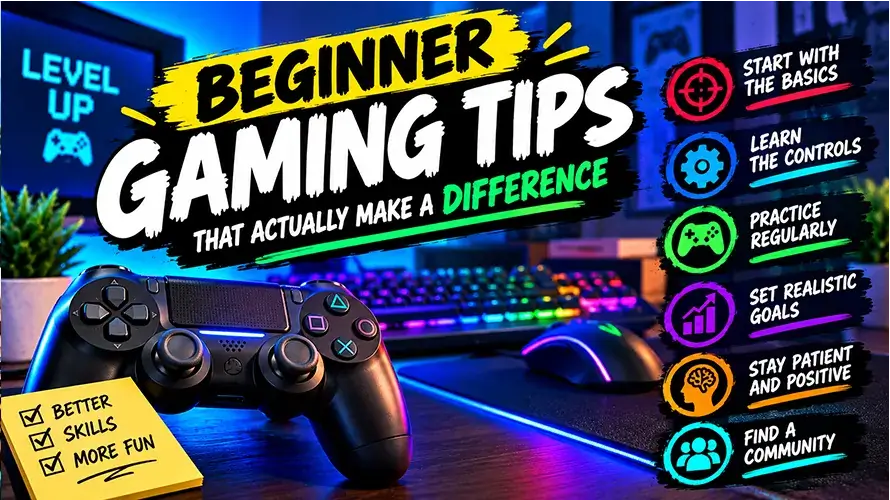
Starting a new game can feel harder than it needs to be. The controls may be unfamiliar, the menus can be confusing, and experienced players often seem to know exactly what to do before you have even worked out where to move.
The good news is that beginners do not need advanced techniques to make noticeable progress. A few better habits can improve how quickly you understand a game, how often you make avoidable mistakes, and how much you enjoy the learning process. These beginner gaming tips focus on practical habits that work across many types of games, from browser and puzzle games to action, arcade, casual, and strategy titles.
Start by Learning the Game, Not by Trying to Win
One of the most common beginner mistakes is treating the first few sessions as a test of skill. In reality, the early stage of a game is often a learning period. Your first goal should be understanding how the game works.
Pay attention to the controls, objectives, movement, scoring system, available resources, and consequences of failure. If the game introduces a mechanic through a tutorial, actually experiment with it instead of rushing through the instructions.
For example, if an action game gives you blocking, dodging, and attacking options, spend a few minutes learning when each one works. That small investment can be more useful than repeatedly restarting because you have not yet understood the basic combat rhythm.
Use the First Few Games as Practice
You do not have to perform well immediately. Early mistakes give you information about the game, especially when you pay attention to what caused them.
After losing a round or failing a level, ask one specific question: What happened just before I failed? Maybe you moved too quickly, ignored a warning, spent a resource too early, or misunderstood an objective.
Then change one thing during your next attempt. This creates a simple feedback loop: play, notice a problem, make one adjustment, and test it again. It is much more useful than changing five things at once and having no idea which adjustment helped.
Learn the Controls Until They Stop Getting in the Way
When controls require conscious thought, part of your attention is spent remembering buttons instead of reading the game. That is particularly noticeable in fast action games, but the same principle applies to many genres.
Spend a short practice session learning the controls before worrying about performance. Make sure you know the basic actions and understand which controls are most important for the situations you are likely to encounter.
- Learn movement and camera controls first.
- Identify your most important action or attack.
- Find the button used for defense, escape, or recovery if the game has one.
- Understand how to pause, restart, save, or return to a menu.
- Adjust sensitivity or control settings if the default setup feels uncomfortable.
If a control repeatedly feels awkward, changing a setting is not a failure. A comfortable control layout can remove unnecessary friction and let you concentrate on the actual game.
Choose Games That Match Your Current Skill Level
Not every game is a good starting point for every player. A title with complex systems, demanding timing, or several layers of strategy may be rewarding, but it can also overwhelm someone who is still learning basic gaming habits.
Look for games that let you understand their core mechanics without requiring mastery of everything at once. Adjustable difficulty, tutorials, practice modes, forgiving checkpoints, and clear objectives can all make the learning curve easier to manage.
| What you want to practice | Game features to look for |
|---|---|
| Basic controls | Simple movement, clear tutorials, forgiving early levels |
| Reaction and timing | Short rounds, repeatable challenges, predictable practice opportunities |
| Problem solving | Puzzles, clues, multiple solutions, gradual difficulty |
| Strategic thinking | Turn-based systems, manageable resource choices, clear objectives |
| Decision making | Games that provide meaningful choices without excessive complexity |
The goal is not to choose the easiest game available. It is to choose a game whose difficulty gives you room to learn without making every mistake feel overwhelming.
Stop Repeating the Same Mistake
Repeating an unsuccessful strategy without changing anything is one of the fastest ways to become frustrated. If the same situation keeps defeating you, treat it as a problem to solve rather than something you simply need to endure.
Suppose you keep losing because you attack too aggressively. Your next attempt could focus entirely on waiting for safer opportunities. If you repeatedly run out of resources, try conserving them during the early part of the level.
The important distinction is between practice and repetition. Practice involves deliberate adjustment. Repetition is doing the same thing again and hoping for a different result.
Slow Down When the Game Rewards Patience
Beginners sometimes assume that faster play automatically means better play. Many games punish unnecessary speed, especially when enemies, traps, puzzles, or strategic decisions require observation.
If you keep making rushed mistakes, deliberately slow your decision-making for a few sessions. Look at the environment, read the information on screen, and consider what the game is asking you to do before committing to an action.
This does not mean playing slowly forever. Once you understand the situation, speed can become useful. The objective is to develop accurate decisions first and then make those decisions faster.
Pay Attention to Patterns
Many games become easier when you stop treating every event as completely random. Enemies may follow recognizable attack patterns. Puzzle games often reuse certain logic. Strategy games may reward similar resource priorities in comparable situations.
When something happens more than once, ask whether there is a pattern behind it. Recognizing patterns turns an unfamiliar situation into something you can prepare for.
For example, if an opponent repeatedly attacks immediately after creating distance, you can stop reacting to the attack itself and start anticipating the sequence that comes before it.
Use Failure as Information
A failed attempt can tell you what the game expects you to learn. Instead of judging the attempt only by whether you won, identify the most useful piece of information you gained.
- Which action caused the problem?
- Was the mistake caused by timing, positioning, or decision-making?
- Did you misunderstand a rule or mechanic?
- Did you use an important resource too early?
- Could the situation have been avoided entirely?
You do not need a detailed notebook for every game. Even a quick mental review after a difficult attempt can prevent the same mistake from becoming a recurring habit.
Do Not Change Your Strategy Too Often
There is a useful middle ground between stubbornly repeating a bad strategy and constantly changing everything. Beginners sometimes switch approaches after every failure, which makes it difficult to determine what actually works.
Give a reasonable approach several attempts when the game allows it. Make one meaningful adjustment, observe the result, and then decide whether another change is necessary.
This is especially helpful in strategy and puzzle games. A method may look ineffective during one attempt because of a small execution error rather than because the underlying idea is wrong.
Manage Difficulty Instead of Treating It as a Test of Pride
If a game offers multiple difficulty levels, selecting an easier option can be a sensible way to learn its systems. Difficulty settings exist for different experiences, and using one does not prevent you from increasing the challenge later.
If the game feels completely effortless, increase the difficulty. If you are spending most of your time failing without understanding why, reduce it temporarily and focus on learning.
A useful difficulty level is one where mistakes teach you something and progress still feels possible.
Take Short Breaks When Your Decisions Get Worse
Long sessions can make simple mistakes feel surprisingly difficult to correct. If you notice yourself becoming impatient, rushing inputs, or repeating a mistake that you normally would recognize, a short break may be more productive than another attempt.
For casual and browser games, even stepping away for a few minutes can reset your attention. For longer sessions, changing games or doing something unrelated can prevent frustration from turning into poor decision-making.
The purpose of a break is not simply to rest. It gives you a chance to return with a clearer view of the problem.
Keep Your Improvement Focused on One Skill
Trying to improve everything at once creates unnecessary complexity. Instead, choose one skill that has the biggest effect on your current problem.
That might mean working on movement for an action game, resource management for a strategy game, pattern recognition for a puzzle game, or timing for an arcade title.
Once that skill becomes more reliable, move to the next weakness. This creates measurable progress without turning every gaming session into a training exercise.
A Simple Beginner Practice Routine
You can apply these ideas without creating an elaborate training schedule. A short routine is enough for most casual players.
- Spend a few minutes learning. Review the controls and understand the main objective.
- Play normally. Do not worry about perfect performance during the first attempts.
- Identify one recurring mistake. Focus on the problem that appears most often.
- Change one behavior. Test a different approach during the next attempt.
- Review the result. Decide whether the adjustment helped.
- Repeat or move on. Continue practicing that skill or choose another area to improve.
This approach works particularly well because it keeps improvement practical. You are not trying to become better at gaming in some vague sense; you are solving the specific problem that is currently preventing progress.
Common Beginner Mistakes to Avoid
Some habits make games unnecessarily difficult even when the player understands the basic controls. Watch for these common problems:
- Skipping tutorials: important mechanics may be explained only once.
- Playing too aggressively: constant attacking can create avoidable risks.
- Ignoring the interface: health, stamina, objectives, timers, or resources often provide important information.
- Blaming difficulty immediately: sometimes the real problem is an unfamiliar mechanic or poor positioning.
- Changing everything after one failure: one unsuccessful attempt does not necessarily prove that your overall approach is wrong.
- Comparing your progress with experienced players: someone who has spent hundreds of hours on a game naturally has more familiarity with its systems.
- Continuing while frustrated: tired or irritated decision-making can reinforce bad habits.
How to Know When You Are Actually Improving
Improvement is not always visible through a score or win rate. Look for smaller signs that your understanding is developing.
You may start recognizing situations earlier, needing fewer attempts to solve familiar problems, remembering controls without thinking about them, or recovering more effectively after making a mistake.
Another useful sign is consistency. If you can perform a task successfully several times rather than doing it correctly by accident once, the skill is becoming more reliable.
Frequently Asked Questions
What are the most important beginner gaming tips?
Learn the controls, understand the main objective, pay attention to repeated mistakes, and practice one skill at a time. These habits are more useful than trying to master advanced techniques immediately.
Should beginners always play on easy difficulty?
No. Choose a difficulty that allows you to learn while still providing a meaningful challenge. You can increase or decrease it as your understanding of the game changes.
How long does it take to get better at gaming?
It varies by game and by player. Progress can be noticeable quickly when you deliberately identify mistakes and adjust your approach, but more complex games naturally require more practice.
Why do I keep making the same mistake in games?
The problem may be that you are repeating the same behavior without testing an alternative. Identify what happens immediately before the mistake and deliberately change one part of your approach.
Is watching gaming guides useful for beginners?
It can be, particularly when you are confused about a mechanic or strategy. However, practical experience still matters because understanding an explanation and successfully applying it are different skills.
Final Thoughts
Getting better at games does not require turning every session into serious training. The biggest gains often come from simple habits: understand the rules, notice patterns, learn from failed attempts, and make deliberate adjustments instead of repeating the same behavior.
Once those habits become natural, unfamiliar games become easier to approach because you have a reliable way to learn them. The goal is not to eliminate mistakes, but to make each mistake useful.