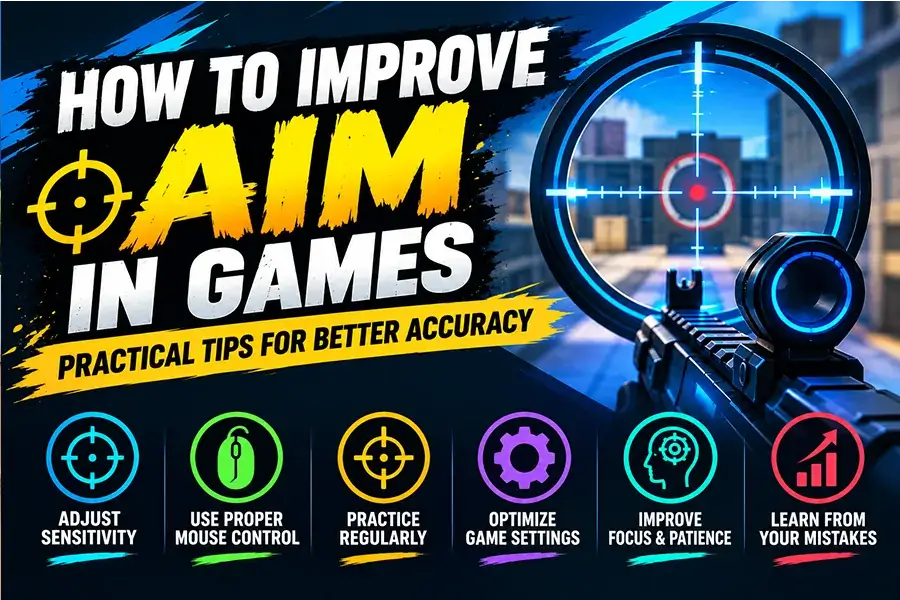
Missing easy shots is rarely just a matter of having slow reactions. In action games, accuracy depends on several skills working together: mouse or controller control, crosshair placement, movement, visual tracking, timing, and the ability to stay consistent under pressure. If you want to improve aim in games, the goal is not simply to move faster. It is to make your movements more controlled and repeatable.
The good news is that aim can be practiced systematically. Small changes to your settings, a better understanding of crosshair positioning, and short focused practice sessions can make your gameplay more consistent without requiring hours of repetitive training.
Start by Making Your Controls Predictable
Before working on advanced aiming techniques, make sure your controls are comfortable. Constantly changing sensitivity, key bindings, or controller settings makes it difficult to develop reliable muscle memory because the same physical movement produces a different result from one session to the next.
Choose a sensitivity that lets you make both small corrections and larger turns without feeling uncomfortable. There is no universal setting that works for every player, because desk space, mouse size, controller preference, game mechanics, and personal comfort all affect the ideal setup.
Once you find a setting that feels reasonably natural, keep it consistent for a while. Give yourself enough sessions to adapt before deciding that the setting is wrong.
Crosshair Placement Matters More Than Constant Flicking
One of the simplest ways to become more accurate is to place your crosshair where an opponent is likely to appear before you actually see them. This reduces the amount of movement required when a target enters your view.
For example, when moving around a corner in a game with human opponents, avoid pointing toward the floor or the wall beside the expected position. Keep the crosshair around the height where a target is likely to appear. When the opponent enters your field of view, only a small adjustment may be necessary.
Good crosshair placement can make an average sensitivity feel much more effective because you are starting closer to the target instead of correcting a large mistake.
Separate Your Aim Into Three Different Skills
A useful way to practice is to stop thinking of aim as one ability. Different situations require different forms of control, and identifying them makes practice more focused.
Precision
Precision is your ability to make small movements and place the crosshair exactly where you want it. It becomes important when a target is already near your crosshair and only a small correction is required.
Tracking
Tracking means keeping your crosshair on a moving target. Instead of repeatedly flicking toward the target, you make controlled movements that follow its direction.
Target Switching
Target switching involves moving quickly from one target to another. The important part is not maximum speed. A fast movement followed by a large correction can be less effective than a slightly slower movement that stops accurately.
Use a Simple Practice Routine
Long practice sessions are not automatically better. A short routine with a clear purpose can make it easier to notice weaknesses and avoid practicing mistakes repeatedly.
- Warm up with controlled movements. Spend a few minutes moving your crosshair between stationary targets without trying to maximize speed.
- Practice small corrections. Work on stopping your crosshair precisely on targets that are close together.
- Practice tracking. Follow moving targets smoothly rather than trying to predict every movement.
- Practice target switching. Move between several targets while concentrating on accuracy first.
- Finish with normal gameplay. Apply the same skills in actual matches where movement, positioning, and pressure are involved.
The final step is important because controlled practice does not perfectly reproduce a real match. Actual games add distractions, unpredictable movement, sound cues, positioning decisions, and time pressure.
Stop Chasing Speed When Accuracy Is the Real Problem
A common mistake is trying to make every aiming movement faster. Speed can be useful, but speed without control often creates overshooting. If you frequently move past the target and then correct backward, your first movement may simply be too aggressive.
Try deliberately slowing down during practice. Focus on reaching the target cleanly and stopping your movement at the intended point. Once that becomes consistent, gradually increase your pace.
This approach gives you a useful progression: control first, consistency second, speed third.
Improve Your Aim by Watching Your Mistakes
Instead of judging your performance only by how many shots you hit, pay attention to how you miss. Different misses can point toward different problems.
| What happens | Possible issue | What to practice |
|---|---|---|
| You repeatedly stop short of the target | Movement may be too cautious | Practice slightly larger controlled adjustments |
| You frequently move past the target | Your corrections may be too aggressive | Practice stopping smoothly and reducing sensitivity if necessary |
| You lose moving targets | Tracking control may need work | Follow targets continuously instead of making repeated flicks |
| You aim well in practice but struggle in matches | Pressure or movement may affect execution | Practice while moving and during realistic gameplay situations |
| Your aim feels inconsistent from day to day | Settings or technique may be changing frequently | Keep your setup stable and focus on repeatable movements |
Pay Attention to Movement and Aiming Together
In many action games, aiming cannot be separated from movement. Your own movement changes the way targets appear on screen, while your aiming decisions affect how effectively you can respond.
Practice keeping your crosshair positioned correctly while moving rather than learning to aim only from a stationary position. This is especially useful in games where strafing, jumping, dodging, or rapid repositioning is part of normal combat.
Another useful habit is to avoid unnecessary movement while making a precise shot. If your character is constantly changing direction while you are also making a difficult aiming adjustment, you are asking yourself to control several variables at once.
Do Not Ignore Visual Comfort
Accurate aiming becomes harder when you are struggling to see targets clearly. Excessive visual effects, an uncomfortable field of view, poor contrast, or a distracting crosshair can make target recognition more difficult.
Where a game provides visual settings, choose options that make important gameplay information easy for you to distinguish. The best choice is personal and depends on the game, display, and your vision, so avoid copying another player’s setup simply because it is popular.
Comfort also matters. If your eyes feel strained or your posture becomes uncomfortable, take a break instead of trying to compensate by forcing longer practice sessions.
Common Aim Training Mistakes
Changing sensitivity every session
Frequent changes make it difficult to build consistency. Test adjustments deliberately rather than changing settings after every poor match.
Only practicing when frustrated
Practice is most useful when you can pay attention to technique. If every missed shot causes you to change your settings or rush your movements, frustration can reinforce bad habits.
Focusing only on flick shots
Fast flicks look impressive, but real matches can require tracking, crosshair placement, controlled corrections, and positioning. Train the situations you actually encounter.
Ignoring positioning
Sometimes the problem is not aim at all. Taking an unnecessary fight from a difficult position can make an easy target much harder to hit. Better positioning can reduce the amount of precision required.
Practicing for too long without a goal
Repeating the same activity for a long period does not guarantee improvement. Choose one skill to work on and stop or change exercises when your concentration drops significantly.
A Practical Progression From Beginner to More Consistent Aim
If you are unsure where to begin, use a simple progression rather than trying to improve everything simultaneously.
- Stabilize your settings. Choose comfortable controls and avoid unnecessary changes.
- Fix crosshair placement. Start placing your crosshair near likely target positions.
- Build precision. Practice small, controlled corrections.
- Add tracking. Learn to maintain contact with moving targets.
- Introduce target switching. Practice moving accurately between targets.
- Apply the skills in real matches. Focus on making good decisions rather than chasing perfect accuracy.
- Review recurring mistakes. Identify whether your misses come from control, positioning, movement, or decision-making.
This progression is useful because each stage supports the next. There is little value in trying to make extremely fast target switches if your basic crosshair placement is still inconsistent.
How Long Should You Practice?
There is no fixed number of minutes that guarantees better aim. A short, focused session can be more useful than a much longer session performed without concentration.
A practical approach is to spend a few minutes warming up, focus on one specific skill, and then play normal matches while applying it. If your movements become increasingly careless, take a break and return later.
Track progress over several sessions rather than judging yourself from one unusually good or bad game. Consistency is a better indication of improvement than a single impressive performance.
Frequently Asked Questions
Can I improve my aim without special training software?
Yes. You can practice precision, tracking, crosshair placement, and target switching directly in games that provide suitable practice modes or low-pressure gameplay. Dedicated training tools are optional rather than essential.
Should I use high or low sensitivity?
Neither is universally correct. The useful setting is one that allows comfortable control and reliable corrections for your hardware, game, and playing style. Consistency is generally more important than copying another player’s sensitivity.
Why is my aim good in practice but worse during matches?
Real matches add movement, pressure, unpredictable targets, positioning decisions, and distractions. Include realistic gameplay in your practice so that your aiming skills are tested under conditions closer to actual matches.
How can I stop overshooting targets?
Practice slowing your initial movement and concentrating on where the crosshair should stop. If the problem remains across different situations, experiment carefully with a slightly lower sensitivity rather than making large changes.
Does better aim always mean better performance?
No. Positioning, timing, movement, game knowledge, decision-making, and awareness can all affect performance. Better aim is useful, but it is only one part of playing action games effectively.
Final Thoughts
Improving aim is less about finding a magical sensitivity or performing the fastest possible flick. Reliable accuracy comes from repeatable control, sensible crosshair placement, purposeful practice, and learning from the way you miss.
Choose one weakness at a time, keep your controls stable, and test your improvements in real gameplay. Over time, those small adjustments can turn rushed and inconsistent movements into more deliberate aiming.