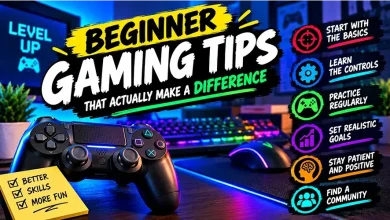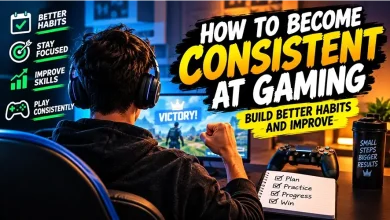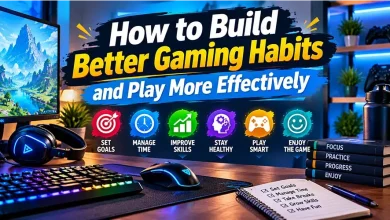
Getting better at games is not always about playing for more hours. If you keep repeating the same mistakes, another ten hours can simply make those habits harder to change. The more useful approach is to make each session more deliberate: identify what is holding you back, practice one specific skill, and pay attention to what happens when you change your approach.
These gaming tricks are designed to work across different genres, from browser and arcade games to action, puzzle, strategy, and competitive online games. You do not need expensive equipment or complicated training software. Most of the techniques are about how you practice, how you make decisions, and how you respond when something goes wrong.
1. Stop Trying to Improve Everything at Once
One of the fastest ways to make practice ineffective is to focus on too many weaknesses simultaneously. You might want better aim, faster reactions, smarter positioning, stronger game knowledge, and better decision-making, but trying to fix all of them during one session makes it difficult to know what actually improved.
Choose one skill that has the biggest effect on your current performance. For example, if you frequently lose because you rush into difficult situations, spend a session concentrating on patience and positioning rather than trying to improve your reaction speed at the same time.
Once that skill becomes more consistent, move to the next weakness. This creates a much clearer improvement path.
2. Use Short, Focused Practice Sessions
Long sessions are not automatically better practice. Concentration often drops after extended periods, especially when you repeatedly make the same mistakes or become frustrated by losses.
Try dividing your practice into smaller blocks. A focused session might look like this:
- Spend a few minutes warming up with simple tasks.
- Choose one skill to practice.
- Play while deliberately applying that skill.
- Pause briefly and identify what worked and what did not.
- Return to normal gameplay and see whether the change carries over.
The goal is not to watch the clock. The goal is to make the time you spend playing more purposeful.
3. Learn to Recognize Patterns
Many games become easier once you stop treating every situation as completely new. Enemies follow patterns, levels introduce recurring obstacles, opponents prefer certain strategies, and puzzles often reuse familiar ideas.
Instead of asking only, “How do I beat this situation?” ask, “What keeps happening before I fail?” You may notice that an enemy attacks after a particular animation, that a puzzle always gives a certain type of clue, or that you regularly make the same decision when under pressure.
Pattern recognition reduces the amount of information you need to process in the moment. That can make difficult situations feel much more manageable.
4. Slow Down When Speed Is Causing Mistakes
Fast reactions are useful, but speed without control can create unnecessary errors. This is particularly common when players panic and start making decisions before they have properly read the situation.
When you repeatedly fail at the same point, deliberately slow your decision-making. Look at the available options, identify the immediate threat, and choose the simplest safe action.
Once the correct response becomes familiar, speed usually becomes easier to add without sacrificing accuracy.
5. Watch What Happens Immediately Before a Mistake
Players often remember the mistake itself but overlook the decision that caused it. For example, missing a target may not be the real problem if the previous mistake was poor positioning that forced an awkward shot.
After a failure, rewind your thinking by a few seconds. Ask yourself:
- Where was I positioned?
- What information did I have?
- What did I expect to happen?
- What actually happened?
- Was there a safer or simpler option?
This turns failure into useful information instead of simply labeling the result as bad luck.
6. Practice Accuracy Before Chasing Speed
Speed is impressive, but reliable accuracy usually provides a stronger foundation. If you constantly rush actions, inputs, attacks, or decisions, you may reinforce sloppy habits.
Try performing the same task slowly enough to maintain a high level of control. Once the movement or decision becomes consistent, gradually increase the pace.
This principle applies beyond aiming. It can help with rapid platforming, typing-based games, puzzle solving, strategy decisions, and memorizing combinations of actions.
7. Change One Setting at a Time
Adjusting several controls or visual settings simultaneously makes it difficult to determine which change actually helped. If your controls feel uncomfortable, experiment systematically.
Change one setting, play enough to form a reasonable impression, and then decide whether to keep it. If you change sensitivity, key bindings, display options, and other controls at the same time, you may spend more time adapting to the settings than improving your underlying skills.
Consistency matters because your hands and attention need time to develop reliable responses.
8. Learn the Rules Before Trying Advanced Strategies
Advanced techniques are much less useful when the basic mechanics are unclear. Before copying complicated strategies from experienced players, make sure you understand movement, objectives, scoring, resources, timing, and the consequences of your main actions.
For a strategy game, that could mean understanding resource generation before attempting complex openings. In an action game, it might mean learning enemy behavior before trying advanced combat techniques.
A strong foundation also makes advanced advice easier to understand because you can connect the technique to a mechanic you already know.
9. Use Losses as Diagnostic Information
A loss can tell you something even when the result feels frustrating. Instead of simply asking whether you won or lost, classify the reason for the result.
| What happened | What to investigate |
|---|---|
| You reacted too slowly | Practice recognition and response timing |
| You made repeated positioning errors | Study safer locations and movement patterns |
| You ran out of resources | Review how and when resources were spent |
| You misunderstood the objective | Review the rules and win conditions |
| You panicked under pressure | Practice the same situation at a slower pace |
This approach is more useful than simply deciding that you need to “play better.” A specific problem can be practiced. A vague problem cannot.
10. Make the Game Harder in a Controlled Way
Once a basic task becomes comfortable, introduce a small additional challenge. The change should be difficult enough to demand attention without making success nearly impossible.
For example, you could attempt a level with fewer mistakes, solve puzzles under a reasonable time limit, practice without relying on a familiar shortcut, or try a different strategy from your usual approach.
Controlled difficulty forces you to adapt while still giving you enough room to recognize what you are doing wrong.
11. Take Breaks Before Frustration Takes Over
When frustration builds, players often become more impulsive. They rush decisions, ignore information, repeat unsuccessful strategies, and become increasingly focused on recovering the previous loss.
A short break can interrupt that cycle. Step away from the game, reset your attention, and return when you can evaluate situations calmly.
A break is especially useful when you notice that you are no longer experimenting or learning and are simply repeating the same attempt with increasing frustration.
12. Study Better Players for Decisions, Not Just Tricks
Watching experienced gameplay can help, but copying individual moves is not enough. Pay attention to why the player makes a decision.
Look for things such as where they position themselves, when they choose to attack, what information they prioritize, when they retreat, and how they react when their original plan stops working.
This helps you understand the principles behind a technique rather than memorizing a sequence that may only work in one situation.
13. Build a Reliable Default Strategy
Having a basic plan reduces hesitation when you are learning a game. Your default strategy does not need to be perfect. It simply gives you a sensible starting point.
For example, in a puzzle game your default might be to inspect the entire board before committing to a move. In a strategy game, you might prioritize establishing a stable economy before taking unnecessary risks.
When the situation changes, adapt. The purpose of a default strategy is to give you a foundation, not to prevent experimentation.
14. Practice Under the Same Conditions You Actually Play In
A skill learned in one environment does not always transfer perfectly to another. If you normally play with a particular control method, screen setup, or pace, practicing under dramatically different conditions may not prepare you for normal gameplay.
Use practice conditions that resemble your real sessions whenever possible. If you play short browser games during breaks, for example, practicing with a completely different control setup may not address the challenges you encounter during ordinary play.
The closer the practice environment is to the situation you care about, the easier it is to recognize whether the skill is transferring.
15. Keep a Simple Improvement Log
You do not need detailed statistics to track progress. A few notes after a session can reveal patterns that are difficult to notice while playing.
Record three things: what you were practicing, what repeatedly went wrong, and what you will change next time. After several sessions, review the notes and look for recurring problems.
You may discover that your biggest issue is not the one you originally assumed. That information can help you spend future practice time where it has the greatest practical value.
How to Turn These Tricks Into a Practical Routine
You do not need to use all 15 techniques during every gaming session. A better approach is to build a simple cycle around the skill you currently need most.
- Identify one weakness: Choose a problem you can describe clearly.
- Pick one technique: Select the method that directly addresses that weakness.
- Practice deliberately: Give the skill your attention instead of playing on autopilot.
- Test it during normal play: Check whether the improvement works outside practice.
- Review the result: Keep the change if it helps and adjust it if it does not.
For instance, if you frequently lose because you make rushed decisions, start by slowing down and recognizing patterns. If your decisions are reasonable but your execution is inconsistent, accuracy-focused practice may be more appropriate.
Which Gaming Trick Should You Try First?
The right starting point depends on the type of problem you are experiencing. If you are new to a game, learning the basic mechanics and recognizing patterns will usually be more useful than attempting advanced techniques. If you understand the game but perform inconsistently, focused practice and reviewing mistakes may provide more useful information.
If frustration is affecting your sessions, improving your practice routine may matter more than another mechanical technique. The key is to match the method to the actual reason you are struggling.
Improvement becomes easier to measure when you can clearly explain what you are trying to change.
Frequently Asked Questions
Can gaming tricks really help me improve faster?
They can make practice more effective by helping you focus on specific weaknesses instead of simply accumulating more playtime. Results vary by game and player, but deliberate practice generally gives you more useful feedback than repeating the same habits without reflection.
How long should I practice gaming skills each day?
There is no universal amount of time that works for everyone. A shorter focused session can be more useful than a long session where concentration has already dropped. Choose a duration that allows you to remain attentive and review what you are learning.
Should I focus on speed or accuracy first?
For most skills, building reliable accuracy and control first gives you a stronger foundation. Once the correct actions become consistent, gradually increasing speed can help you perform them more efficiently.
Why do I sometimes play worse after practicing?
Changing a familiar habit can temporarily make your performance feel less comfortable. This does not necessarily mean the new approach is ineffective. Give a change enough practice time to determine whether it actually improves your decisions or consistency.
Is watching skilled players useful for improvement?
Yes, particularly when you study their decision-making rather than simply copying individual moves. Pay attention to positioning, timing, risk management, and how they respond when circumstances change.
Final Thoughts
Improving at games is less about finding one secret technique and more about making your practice intentional. Identify a specific weakness, work on it under controlled conditions, learn from mistakes, and give new habits enough time to become reliable.
The most useful gaming tricks are the ones that change how you practice rather than simply adding more hours to your schedule. Once you know exactly what you are trying to improve, every session can give you clearer feedback and a better reason for playing.