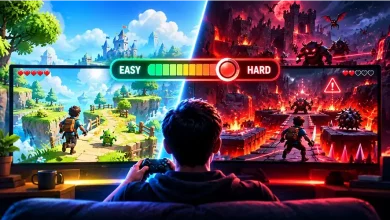
If you have ever played a game built around quick reactions, simple controls, short sessions, and the challenge of beating a high score, you have already encountered the core idea behind arcade gaming. But what is an arcade game, exactly? The answer goes beyond the old coin-operated machines found in arcades.
Arcade games are generally designed around immediately understandable gameplay, repeated attempts, and skill-based challenges. The format began with dedicated machines in public entertainment spaces, but its design principles have continued into console games, mobile titles, PC releases, and browser games.
Understanding the history of arcade games also makes it easier to recognize why certain modern games feel so easy to start but surprisingly difficult to master.
The Core Idea Behind an Arcade Game
An arcade game is typically built around a straightforward gameplay loop that the player can understand quickly. Instead of requiring a long tutorial or a large collection of systems before the game becomes enjoyable, arcade-style games often put the main challenge in front of the player almost immediately.
Classic arcade machines commonly focused on actions such as moving, shooting, dodging, racing, jumping, or matching objects. The challenge usually increased as the player progressed, creating a natural reason to try again after losing.
Several characteristics commonly appear in arcade-style games:
- Simple controls: The basic actions can often be learned within seconds.
- Immediate gameplay: Players can usually start interacting with the game quickly.
- Increasing difficulty: Challenges often become faster, more complex, or less forgiving.
- Short gameplay loops: Individual attempts can be relatively brief.
- Score-based progression: Points, combos, times, or other performance measurements can encourage replay.
- Skill-driven improvement: Repeated play can help players learn patterns, timing, movement, and decision-making.
Not every game containing these features is strictly classified as an arcade game. Modern genres frequently borrow arcade mechanics and combine them with role-playing, strategy, platforming, simulation, or other systems.
Where Arcade Games Came From
The arcade game format developed alongside the rise of electronic entertainment machines in public spaces. Early machines were designed to attract attention and give players a simple interactive experience without requiring a home console or personal computer.
One important early milestone was Computer Space, released in 1971. It is widely recognized as one of the first commercially produced arcade video games. Players controlled a spacecraft while attempting to survive and score points in a space-combat setting.
In 1972, Pong helped demonstrate how a very simple concept could become an engaging arcade experience. Its basic two-player table-tennis-inspired gameplay required little explanation, yet positioning and timing created room for competition.
The success of games like these helped establish the arcade as an important part of video game culture. Machines could be placed in dedicated arcades as well as other public entertainment locations, where players competed for high scores and repeatedly attempted to improve their performance.
The Golden Age of Arcade Gaming
The late 1970s and early 1980s are often associated with the rapid growth of arcade video games. Developers experimented with different concepts while improving visual presentation, sound, controls, and gameplay systems.
Space Invaders, released in 1978, became an influential example of the arcade shooting format. Its advancing enemy formations and progressively intense gameplay demonstrated how a relatively simple ruleset could produce a demanding challenge.
Pac-Man, released in 1980, introduced a different style of arcade challenge. Instead of focusing primarily on shooting, it combined maze navigation, enemy avoidance, scoring, and strategic movement. The game’s recognizable characters and accessible concept also helped arcade gaming reach a broader audience.
Other successful arcade games explored platforming, racing, fighting, sports, shooting, puzzle mechanics, and many other formats. The result was a diverse arcade culture in which players could quickly move from one style of challenge to another.
Why Arcade Games Were Designed for Short Sessions
The original arcade environment influenced how these games were designed. Players generally interacted with a machine for a limited period, so the game needed to communicate its rules quickly and provide an engaging challenge without requiring hours of preparation.
This encouraged a design philosophy based on easy-to-understand actions and difficult-to-master execution.
A player might understand the objective immediately, yet still need dozens of attempts to improve. A racing game could have simple steering controls while demanding precise cornering. A platform game could use only movement and jumping while requiring careful timing. A shooter could have a small number of buttons while filling the screen with increasingly difficult threats.
This approach created a powerful gameplay loop:
- Learn the basic controls.
- Attempt the challenge.
- Make mistakes or reach a difficult section.
- Restart and apply what was learned.
- Improve the score, time, distance, or progress.
That loop remains one of the most recognizable foundations of arcade-style game design.
Arcade Games vs. Other Video Game Genres
The word “arcade” can describe a genre, a design philosophy, or a style of gameplay. This is why an arcade game does not always fit neatly into a single category.
| Style | Typical Focus | Common Player Experience |
|---|---|---|
| Arcade | Fast action, score, reflexes, repeated attempts | Quick to learn with emphasis on improving performance |
| Role-playing | Characters, progression, exploration, abilities | Longer-term development and story or world exploration |
| Strategy | Planning, resources, positioning, decision-making | Success often depends on managing several variables |
| Puzzle | Problem solving and pattern recognition | Progress comes from finding solutions to structured challenges |
| Simulation | Recreating systems or activities | Players interact with mechanics designed to model a particular activity |
These categories can overlap. A game can be an arcade racing game, an arcade shooter, an arcade sports title, or a puzzle game with strong arcade mechanics.
What Makes an Arcade Game Fun to Replay?
Replayability is one of the defining strengths of arcade design. A game does not necessarily need a huge world or hundreds of quests to encourage another attempt. Sometimes a small improvement is enough.
Mastering the Controls
Players often become more efficient as they learn exactly how movement, attacks, jumps, turns, or other actions behave. Controls that initially feel difficult can become almost automatic with practice.
Recognizing Patterns
Many arcade challenges reward players for remembering enemy movements, obstacle locations, attack patterns, level layouts, or timing windows. Knowledge becomes another form of skill.
Chasing Better Scores
A score provides a clear measurement of performance. Even when a player has already completed a level, there can still be a reason to return and attempt a cleaner or faster run.
Improving Through Failure
Failure in an arcade game is often useful because it reveals something about the challenge. The player may discover that a particular obstacle requires earlier movement, a different route, or better timing.
Classic Arcade Examples
Several games from arcade history remain useful examples of different approaches to the genre.
- Pong: Demonstrates how extremely simple rules can create competitive gameplay.
- Space Invaders: Shows how escalating pressure can transform a basic shooting concept into a demanding challenge.
- Pac-Man: Combines navigation, enemy avoidance, scoring, and route planning.
- Donkey Kong: Helped establish a recognizable platform-based arcade format built around movement and timing.
- Galaga: Builds an arcade shooter around enemy formations, positioning, and increasingly demanding attacks.
These games differ significantly from one another, but they share an important principle: the player can understand the central objective quickly, while mastery takes considerably longer.
How Arcade Design Survived the Move to Home Gaming
As home consoles and personal computers became increasingly important, players no longer needed to visit an arcade to play video games. That changed the environment, but it did not eliminate arcade-style design.
Home games could offer longer levels, save systems, larger worlds, richer stories, and more complex progression. At the same time, developers continued using arcade mechanics because quick controls, escalating challenges, and score-based competition remained effective.
Arcade influences became especially visible in racing games, fighting games, shooters, platformers, sports games, and puzzle titles. Some games recreated the feel of an arcade machine directly, while others incorporated only selected mechanics.
Modern Examples of Arcade-Style Gaming
Modern gaming uses the term “arcade” more broadly than it did during the coin-operated era. A contemporary game may be distributed digitally and still use the same basic principles that made classic arcade games effective.
Geometry Dash
Geometry Dash is an example of a modern game centered heavily on timing and repeated attempts. Players learn obstacle patterns and refine their inputs as they try to progress through increasingly demanding sections.
Crossy Road
Crossy Road uses a simple objective and easy-to-understand controls while gradually testing the player’s timing and decision-making. Its structure demonstrates how an accessible concept can support repeated short sessions.
Vampire Survivors
Vampire Survivors combines automatic attacks, enemy waves, character progression, and survival-based challenges. It is not a traditional arcade machine game, but its emphasis on immediate action, escalating pressure, and repeated runs reflects several arcade design principles.
These examples show why arcade gaming is better understood as a set of design ideas rather than a requirement that a game literally be played on an arcade cabinet.
Arcade Games in Browser Gaming
Browser games are particularly well suited to arcade-style experiences because many players want something they can understand and play without a long setup process.
A browser arcade game might focus on a single mechanic such as avoiding obstacles, hitting targets, matching objects, navigating a maze, or surviving waves of enemies. The strongest examples usually make the objective obvious and allow the player to understand the main interaction quickly.
For players choosing an arcade game in a browser, useful questions include:
- Can I understand the objective without a lengthy tutorial?
- Are the controls responsive and easy to learn?
- Does the game provide meaningful progression through skill?
- Are individual sessions appropriate for the amount of time I have?
- Does the challenge increase in a way that feels understandable rather than random?
Arcade Game Mechanics Worth Learning
If you are new to arcade-style games, learning a few common mechanics can make unfamiliar titles easier to understand.
Reaction Time
Many arcade games test how quickly you can respond to an incoming threat or changing situation. Instead of reacting only when something is already dangerous, experienced players often learn to anticipate what is about to happen.
Positioning
Where your character, vehicle, cursor, or object is located can matter as much as the action you take. Good positioning can reduce the number of difficult reactions required later.
Rhythm and Timing
Some arcade challenges become easier when actions are performed according to a consistent rhythm. Learning the timing of jumps, attacks, turns, or movements can turn apparently chaotic gameplay into a predictable sequence.
Risk Management
Chasing a larger score can sometimes create additional danger. Arcade games often reward players who recognize when to take a risk and when to choose a safer action.
Are Arcade Games Only for Quick Players?
Not necessarily. Fast reactions can be useful, but arcade gaming also rewards observation, memory, pattern recognition, positioning, and decision-making.
A player who initially struggles with a game can improve by identifying why they are failing. If the problem is poor timing, practice can focus on timing. If the problem is positioning, the player can experiment with safer routes. If enemy patterns are causing mistakes, learning those patterns can reduce the need for pure reaction speed.
This is one reason arcade games can remain engaging after the initial novelty disappears: improvement is often visible from one attempt to the next.
How to Choose an Arcade Game
The best arcade experience depends on what kind of challenge you want. Before starting a game, consider the type of interaction you find enjoyable rather than choosing only by its visual style.
- Want fast reactions? Look for action, shooting, rhythm, or obstacle-based gameplay.
- Prefer planning? Try arcade games involving positioning, route selection, or tactical decisions.
- Enjoy competition? Score-based games and time trials can provide a clear performance target.
- Have only a few minutes? Look for games built around short runs or quick rounds.
- Like gradual mastery? Choose games where learning patterns and improving execution are central to progression.
There is no single formula that defines a good arcade game. The important question is whether its core mechanic creates a challenge that is clear, responsive, and satisfying to improve at.
Arcade Games Then and Now
The technology surrounding arcade games has changed dramatically, but several fundamental ideas have remained surprisingly stable.
| Classic Arcade Approach | Modern Equivalent |
|---|---|
| High-score competition | Leaderboards, personal records, and online rankings |
| Short play sessions | Quick rounds, runs, and browser or mobile sessions |
| Simple controls | Minimal-input gameplay and accessible control schemes |
| Increasing difficulty | Progressive levels, enemy waves, or escalating challenges |
| Repeated attempts | Run-based progression and retry-focused gameplay loops |
| Public competition | Online scores and multiplayer competition |
The presentation may now involve high-resolution graphics, online features, procedural systems, or persistent progression, but the basic appeal can remain the same: understand the challenge, attempt it, learn from mistakes, and try to perform better.
Frequently Asked Questions
What is an arcade game?
An arcade game is generally a game built around accessible controls, immediate action, repeatable challenges, and skill-based improvement. The term originally referred strongly to coin-operated video games but is now also used for games that adopt similar design principles on modern platforms.
What was the first arcade video game?
Computer Space, released in 1971, is widely recognized as one of the first commercially produced arcade video games. It was followed by influential early titles including Pong.
Are arcade games still popular today?
Arcade-style gameplay remains common across modern platforms, including PCs, consoles, mobile devices, and browsers. Many contemporary games use short sessions, high-score systems, quick reactions, repeated runs, or escalating difficulty inspired by classic arcade design.
What makes an arcade game different from a normal video game?
Arcade games tend to emphasize immediate interaction, straightforward objectives, repeatable challenges, and mastery through practice. However, arcade mechanics can appear inside many other genres, so the distinction is not always strict.
Can a browser game be an arcade game?
Yes. A browser game can be arcade-style if it focuses on quick gameplay, accessible controls, repeated attempts, score or performance goals, and skill-based challenges. The platform does not determine whether a game’s design is arcade-inspired.
Final Thoughts
So, what is an arcade game? At its core, it is a style of gaming built around immediate interaction, understandable rules, escalating challenges, and the satisfaction of improving through repeated play.
The classic arcade cabinet may no longer be the center of gaming culture, but its design philosophy remains visible in modern action games, browser games, mobile titles, racing experiences, puzzle challenges, and score-based competitions. If you enjoy games that are easy to start but rewarding to master, arcade design offers a useful explanation for why those experiences can be so difficult to put down.