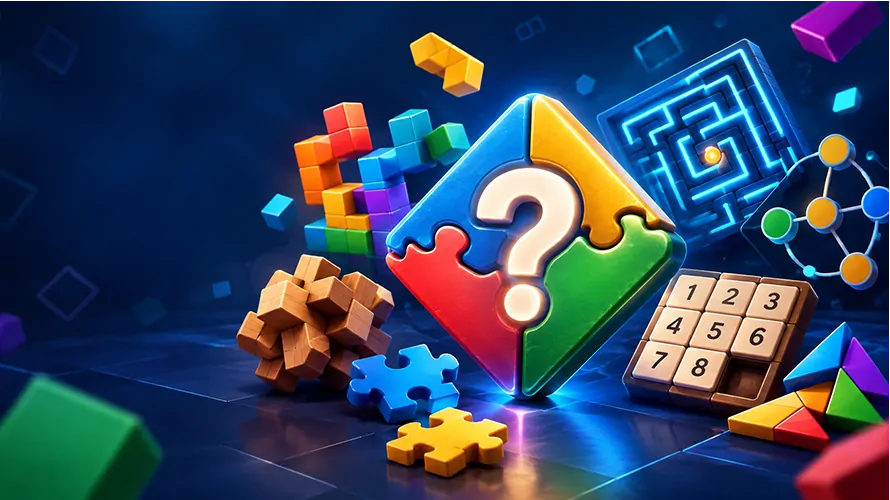
What is a puzzle game? At its simplest, a puzzle game is a game built around solving problems. Instead of relying mainly on reflexes, combat, or exploration, the player is usually asked to recognize patterns, make decisions, manipulate objects, remember information, or discover a solution.
That definition covers a surprisingly large range of games. A quick round of Sudoku, arranging falling blocks in Tetris, connecting matching objects in a casual browser game, and solving environmental challenges in a game such as Portal can all be considered puzzle experiences, even though they play very differently.
This guide explains the mechanics that make a puzzle game work, the major types you are likely to encounter, and how different examples use puzzles to create challenge without relying entirely on traditional action gameplay.
What Defines a Puzzle Game?
A puzzle game presents the player with a problem and gives them a set of rules, objects, information, or actions that can be used to solve it. The challenge comes from finding an effective solution rather than simply completing a sequence of predetermined actions.
The problem might be small, such as deciding where to place one piece, or much more complex, such as understanding a room’s rules and using them to reach an otherwise inaccessible location.
Most puzzle games have three important ingredients:
- A problem: The player needs to achieve a particular objective or overcome an obstacle.
- A rule set: The game establishes what the player can and cannot do.
- A solution: The player must discover a useful combination of actions, observations, or decisions.
The best puzzle design often makes the rules understandable while keeping the solution challenging. Players should ideally feel that the answer was discoverable rather than completely random.
The Core Mechanics Behind Puzzle Games
Puzzle games can look completely different on the surface, but many rely on a small collection of recurring mechanics. Understanding these mechanics makes it easier to recognize why one puzzle feels satisfying while another feels frustrating.
Pattern Recognition
Pattern recognition asks players to notice relationships between objects, symbols, movements, colors, numbers, or sequences. Matching games, tile puzzles, and many logic challenges use this mechanic because humans naturally look for repeated structures.
A simple example is identifying which pieces belong together. More advanced versions may hide the pattern until the player experiments with the available information.
Spatial Reasoning
Spatial puzzles require players to understand positions, movement, distance, orientation, or the relationship between objects in an environment. Block arrangement games and many physics-based puzzles depend heavily on this skill.
The difficulty can increase when a game prevents direct movement and forces the player to think several steps ahead.
Logic and Deduction
Logic puzzles give players information that can be combined to eliminate incorrect possibilities and identify a solution. Sudoku is a familiar example, while many adventure and mystery games use logic puzzles as part of a larger experience.
The important element is that the solution follows the game’s rules. Guessing may occasionally work, but understanding the available information is usually more reliable.
Resource Management
Some puzzles are built around limited resources. A player might have only a certain number of moves, pieces, tools, turns, or opportunities to complete an objective.
These restrictions add another layer of decision-making because a move that looks useful immediately may create a problem later.
Timing and Sequencing
Not every puzzle is completely static. Some require actions to happen in the correct order or at the right moment. Timing puzzles can appear in platform games, physics games, rhythm-based challenges, and action-puzzle hybrids.
The challenge is often less about performing a difficult action and more about understanding when that action belongs in the solution.
Experimentation
Some puzzle games deliberately allow players to test ideas. The player tries an action, observes what happens, and uses the result to improve the next attempt.
This design works particularly well when failure is inexpensive. If restarting a puzzle takes only a few seconds, players can experiment without feeling heavily punished for an incorrect idea.
Major Types of Puzzle Games
There is no single universal classification for puzzle games, but several categories appear frequently across browser games, mobile games, consoles, and PCs.
Logic Puzzle Games
Logic games focus on deduction and structured reasoning. Sudoku, nonogram puzzles, and many grid-based challenges belong to this broad category.
These games often work well for players who enjoy solving problems systematically. They can also be designed around different difficulty levels by changing the amount of information available or increasing the complexity of the solution.
Match-Three and Matching Games
Match-three games ask players to create groups of matching objects, often by swapping, moving, or combining pieces. Their basic rule is easy to understand, but additional objectives can make later levels considerably more complex.
For example, a level might require the player to clear specific objects while working within a limited number of moves. This turns a simple matching mechanic into a planning challenge.
Tile and Block Puzzles
Tile puzzles involve arranging, moving, rotating, or combining pieces according to a particular rule. Tetris is one of the best-known examples of block-based puzzle design.
The appeal of this category often comes from balancing immediate decisions with future consequences. A placement that solves a short-term problem may make the board harder to manage later.
Word Puzzles
Word puzzle games use vocabulary, spelling, definitions, letters, or word relationships as their primary challenge. Crosswords, word searches, anagrams, and letter-arrangement games all fit within this broad group.
These games can test both language knowledge and problem-solving ability. The difficulty can come from obscure words, limited attempts, unusual letter combinations, or clues that require lateral thinking.
Physics-Based Puzzles
Physics puzzle games use concepts such as gravity, momentum, weight, balance, and collision to create problems. Players may need to move objects, build structures, or trigger a chain of events.
The interesting part is that the solution may depend on predicting what will happen after an object is moved rather than simply selecting the correct answer from a menu.
Environmental and Spatial Puzzles
These puzzles are integrated into a game world. Instead of presenting a separate puzzle screen, the environment itself contains the clues and obstacles.
Portal, for example, combines movement and environmental problem-solving with a portal mechanic. The player has to understand how the game’s movement rules interact with the surrounding space.
Hidden-Object Games
Hidden-object games ask players to locate specific items within a detailed scene. They rely heavily on observation and visual attention.
The challenge is not necessarily understanding a complicated rule system. Instead, the player must inspect the environment carefully and distinguish relevant objects from visual clutter.
Jigsaw and Assembly Puzzles
Jigsaw-style games focus on assembling pieces into a complete image, structure, or arrangement. Digital versions can add features such as rotation, different piece shapes, time limits, or multiple difficulty settings.
These games are particularly accessible because the basic objective is immediately understandable: determine how separate pieces fit together.
How Puzzle Games Create Difficulty
A puzzle does not need complicated rules to be difficult. In fact, many effective puzzles begin with very simple mechanics and increase difficulty by combining them in more demanding ways.
One common approach is to introduce a mechanic gradually. The player first learns what an object does, then encounters a problem requiring that knowledge, and eventually has to combine the mechanic with other rules.
Another approach is to increase the number of possible decisions. A puzzle with two possible actions can be easy to reason about. A puzzle with several interacting objects may require players to consider multiple outcomes before committing to a move.
Limited resources can also increase difficulty. A puzzle may become harder when players have fewer moves, less time, restricted tools, or fewer opportunities to make mistakes.
Good difficulty generally comes from meaningful decisions rather than arbitrary obstacles. When players understand why they failed, the next attempt can become part of the learning process.
Examples of Well-Known Puzzle Games
Looking at different games helps show how broad the puzzle genre really is.
| Game | Puzzle Approach | What the Player Practices |
|---|---|---|
| Tetris | Falling blocks and spatial arrangement | Spatial planning, pattern recognition, timing |
| Sudoku | Number-based logic grids | Deduction and elimination |
| Portal | Environmental puzzles using portals | Spatial reasoning and experimentation |
| Monument Valley | Perspective and optical-illusion puzzles | Spatial observation and creative thinking |
| The Witness | Environmental line puzzles | Pattern recognition and rule discovery |
These examples demonstrate why the term “puzzle game” is so broad. One game can focus almost entirely on abstract logic, while another can combine puzzles with exploration, storytelling, physics, or platforming.
Puzzle Games Compared With Other Genres
Puzzle mechanics frequently overlap with other genres, so the boundaries are not always clear. A game can contain puzzles without being primarily classified as a puzzle game.
| Genre | Main Challenge | Where Puzzle Mechanics May Appear |
|---|---|---|
| Puzzle | Solving problems under specific rules | Core gameplay |
| Action | Movement, combat, and quick reactions | Environmental obstacles or timed challenges |
| Strategy | Planning and managing decisions | Resource and tactical puzzles |
| Adventure | Exploration and progression | Item combinations, clues, and environmental puzzles |
| Platformer | Movement and navigation | Timing, switches, physics, and route puzzles |
The distinction usually comes down to what the game asks the player to spend most of their time doing. If solving problems is the central activity, puzzle is likely an appropriate genre description. If puzzles are only one component, the game may belong primarily to another genre.
Why Some Puzzle Games Feel Satisfying
The satisfaction of solving a puzzle often comes from the transition between confusion and understanding. At first, the available information may seem disconnected. After the player recognizes an important relationship, the problem can suddenly become much clearer.
Good puzzle design also gives players enough information to reason about the problem. If the answer depends on information that could not reasonably be discovered, failure can feel arbitrary rather than rewarding.
Another important factor is feedback. Players should be able to understand whether an action had the expected effect. Clear feedback helps them refine their mental model of the game’s rules.
This is one reason simple mechanics can remain engaging for a long time. A small set of rules can create many interesting problems when those rules interact in different ways.
How to Choose the Right Puzzle Game
Not every puzzle game appeals to the same type of player. Before choosing one, consider what kind of thinking you actually enjoy.
- Prefer numbers and deduction? Try logic-grid, Sudoku, or mathematical puzzle games.
- Enjoy visual patterns? Matching and tile-based games may be a better fit.
- Like experimentation? Look for physics or environmental puzzle games.
- Enjoy language? Word games and crosswords provide vocabulary-focused challenges.
- Want puzzles with exploration? Adventure and environmental puzzle games combine problem-solving with discovery.
- Prefer short sessions? Browser-friendly puzzle games often work well because individual challenges can be completed quickly.
Difficulty is also worth considering. A game described as a puzzle game can range from relaxing and highly accessible to extremely demanding. Checking the basic mechanic and expected session length can help you find something that matches your preferred style.
Common Puzzle Game Design Mistakes
Understanding poor puzzle design can also explain why some challenges become frustrating.
Unclear Rules
If players cannot determine what an object does or what actions are possible, they may be unable to form a reasonable strategy. A game can keep its solution difficult while still making its basic rules understandable.
Solutions Based on Guessing
A puzzle becomes less satisfying when the player must randomly try combinations without meaningful clues. Trial and error can be useful, but successful attempts should ideally teach the player something about the underlying system.
Difficulty Spikes
A sudden jump from simple challenges to an extremely complex puzzle can interrupt the learning process. Strong progression usually introduces new concepts before expecting players to combine them.
Too Much Repetition
Repeating exactly the same type of problem can make even a good mechanic feel predictable. Puzzle games can maintain interest by changing the context, introducing new constraints, or combining familiar mechanics in unexpected ways.
Tips for Getting Better at Puzzle Games
You do not always need faster reactions to improve at puzzle games. In many cases, changing how you approach the problem is more useful.
- Identify the objective first. Make sure you understand exactly what the puzzle requires before making unnecessary moves.
- Learn the rules. Test what different objects or actions do when experimentation is safe.
- Look for constraints. Limited spaces, blocked routes, move counts, and fixed positions often provide clues to the intended solution.
- Think one step further. Before making a move, consider what it will change afterward.
- Use failed attempts as information. A failed solution can reveal which assumption was incorrect.
- Take a break when necessary. Returning to a difficult puzzle later can make a solution easier to see because you are approaching the problem with a fresh perspective.
Frequently Asked Questions
What is a puzzle game?
A puzzle game is a game in which solving problems is a central part of the gameplay. Players may use logic, pattern recognition, spatial reasoning, observation, planning, timing, or experimentation to reach a solution.
Are puzzle games only about logic?
No. Puzzle games can involve logic, but they can also focus on spatial reasoning, words, physics, visual patterns, memory, timing, or combinations of several mechanics.
Is Tetris a puzzle game?
Yes. Tetris is widely recognized as a puzzle game because its central challenge involves arranging falling pieces efficiently according to the game’s rules.
Can an action game contain puzzle mechanics?
Yes. Many action, adventure, and platform games include puzzles as secondary mechanics. A game does not need to be exclusively puzzle-focused to use problem-solving challenges.
What makes a puzzle game difficult?
Difficulty can come from more possible decisions, limited resources, complex rule interactions, hidden patterns, time pressure, or the need to plan several moves ahead. Good difficulty generally remains understandable even when the solution is challenging.
Final Thoughts
The answer to what is a puzzle game is broader than a simple definition suggests. Puzzle games are united by problem-solving, but they can express that idea through numbers, words, blocks, physics, environments, patterns, or entirely original mechanics.
Whether you prefer a quick browser puzzle or a deeper game built around exploration and discovery, understanding the underlying mechanics can make it easier to find challenges that match your interests. The most memorable puzzle games do more than make players search for an answer; they make the process of discovering how the answer works part of the fun.