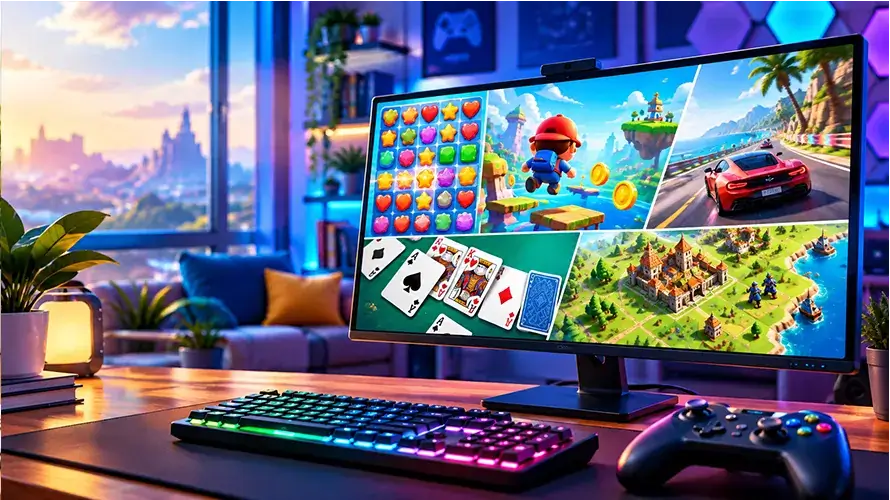
Not every gaming session needs a long tutorial, a complicated build system, or several hours of uninterrupted play. Sometimes you simply want a game that loads quickly, explains its rules in seconds, and gives you something enjoyable to do for five or ten minutes.
That is where casual games online are particularly useful. The category covers far more than simple puzzle games, including arcade challenges, card games, strategy titles, sports games, word games, and short action experiences. The best choice depends less on graphics or complexity and more on what kind of session you want.
Start With the Kind of Gaming Session You Want
A useful way to choose a casual game is to decide how much attention and time you want to spend before choosing a title. A game that works perfectly during a short break may feel frustrating if you are looking for a longer, more focused session.
| What you want | Good game types to try | Why they work |
|---|---|---|
| A five-minute break | Arcade, puzzle, endless-runner | Simple objectives and quick rounds |
| Relaxed solo play | Word, card, simulation, puzzle | Usually easy to learn and play at your own pace |
| A little competition | Multiplayer arcade, sports, strategy | Short matches can create a clear goal without a long commitment |
| Something more thoughtful | Logic, tactics, management | Simple controls can still support meaningful decisions |
| Replayable entertainment | Arcade, roguelite-inspired, puzzle | Changing challenges encourage repeated attempts |
This approach also prevents a common mistake: choosing a game because it is popular when its style does not match the time or attention you actually have available.
Casual Games Worth Exploring
1. Classic Puzzle Games
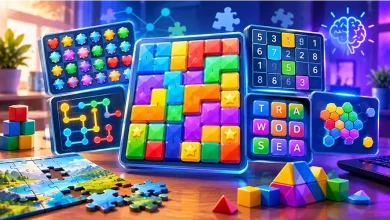
Puzzle games are among the easiest choices when you want a compact gaming experience. Matching shapes, arranging objects, solving patterns, and clearing a board can provide a complete challenge without requiring a large amount of explanation.
Look for puzzles with short levels if you regularly play during breaks. If you prefer deeper challenges, choose games where later stages introduce new rules rather than simply increasing the speed or number of objects.
2. Arcade Games
Arcade games focus on immediate interaction. You may need to avoid obstacles, collect items, survive for as long as possible, or achieve a high score. The controls are often straightforward, but mastering timing and movement can take considerably longer.
They are especially suitable when you do not want to spend the first ten minutes learning a complicated interface. A good arcade game should make its basic objective obvious almost immediately.
3. Casual Strategy Games
Strategy does not always mean a lengthy campaign or a complicated technology tree. Casual strategy games can reduce the genre to a handful of meaningful decisions, such as where to place a unit, which resource to use, or which objective to prioritize.
These games are a good middle ground when you want something more mentally engaging than a reflex-based arcade game but do not want a major time commitment.
4. Word and Trivia Games
Word games are useful when you want a slower experience that still keeps your attention active. Crossword-style challenges, word searches, spelling games, and trivia formats can all work well for short sessions.
They also provide natural stopping points. Completing a puzzle or round gives you a clear reason to put the game down rather than leaving an unfinished match running in the background.
5. Card and Board-Inspired Games
Online versions of familiar card and board concepts can be surprisingly effective casual games. Their rules are often easier to understand because the basic mechanics are already familiar, while digital versions can make setup and matchmaking much faster.
When choosing one, pay attention to whether it supports quick rounds. A game can be technically casual while still requiring a significant amount of time to finish each session.
6. Simple Sports Games
Sports games can also fit the casual category when they focus on a single mechanic instead of trying to reproduce an entire professional sports simulation. Examples include penalty challenges, shooting contests, racing events, and short arcade-style matches.
These games are particularly useful when you want an objective that is immediately understandable: score more points, beat a target, finish first, or complete a challenge.
How to Tell if a Casual Game Is Actually a Good Fit
The word “casual” describes accessibility and commitment more than quality. A casual game can still be repetitive, poorly designed, or frustrating. Before spending time with one, consider a few practical characteristics.
Does it explain the objective quickly?
You should understand what you are trying to accomplish without reading a long manual. Good casual design usually introduces mechanics through the first few interactions rather than overwhelming the player with information.
Can you stop without losing meaningful progress?
This matters when you are playing between other activities. Games with short rounds, checkpoints, or automatically saved progress are generally more convenient than experiences that require long uninterrupted sessions.
Does the challenge grow naturally?
A game should give you a reason to keep improving. Increasing difficulty, new mechanics, different objectives, or score-based challenges can provide progression without turning the experience into a complicated system.
Are the controls comfortable?
Browser games are often played on different devices, so control simplicity matters. A game that feels natural with a keyboard and mouse may not work equally well on a touchscreen. Check the control requirements before committing to a particular style of play.
Choosing Between Relaxed and Competitive Casual Games
Not everyone wants the same kind of casual experience. Some players want something they can play without pressure, while others enjoy the immediate feedback of competing against another player or chasing a high score.
Relaxed games are generally better when you want to unwind. Puzzle, word, simulation, and solo strategy games can let you experiment without worrying about another player’s decisions.
Competitive games are better when your goal is short bursts of excitement. Multiplayer arcade matches, sports challenges, and score-based games can provide a stronger sense of urgency, but they may also demand more concentration.
If you are tired or distracted, a competitive game may feel unnecessarily demanding. If you are looking for a challenge, however, a simple multiplayer game can turn an otherwise ordinary ten-minute break into a focused session.
Making Short Gaming Sessions More Enjoyable
- Choose the right session length: Pick games with rounds that fit the amount of free time you actually have.
- Learn one mechanic at a time: Games with clear controls are easier to enjoy when you do not want a lengthy learning period.
- Use difficulty as a filter: If a game becomes frustrating immediately, try another style rather than assuming every casual game works the same way.
- Look for replay value: Score chasing, changing levels, procedural challenges, or different strategies can keep a simple game interesting.
- Consider the device: Make sure the controls and interface suit the browser and device you are using.
- Do not confuse simplicity with repetition: A good casual game should offer some variation or meaningful challenge instead of repeating exactly the same task.
Common Mistakes When Choosing Online Casual Games
Picking a game only because it looks attractive
Visual presentation can make a game interesting at first glance, but attractive graphics do not guarantee satisfying gameplay. Check the basic mechanics and session format before deciding whether it suits you.
Ignoring the time required for a round
A game can be easy to learn but still have long matches. If you are specifically looking for something to play during a short break, session length should be one of your first considerations.
Choosing complexity when you want relaxation
Management systems, upgrades, inventories, and detailed tutorials can be enjoyable, but they are not always appropriate when you simply want a quick distraction. Match the game’s complexity to your mood.
Stopping after the first unsuccessful attempt
Some casual games are built around learning through repetition. If the controls are clear and the challenge feels fair, a second or third attempt may reveal mechanics that were not obvious during the first round.
A Simple Way to Build Your Personal Casual Game List
Instead of searching for one universally perfect game, create a small collection for different situations. This makes it easier to find something appropriate without repeatedly browsing through unfamiliar titles.
- Pick one very short game for five-minute breaks.
- Keep one puzzle or word game for slower sessions that require concentration.
- Add one competitive option when you want faster action or multiplayer interaction.
- Choose one strategy or management game for occasions when you have more time to think.
- Replace games that stop being enjoyable rather than continuing simply because you have already spent time learning them.
This approach turns casual gaming into a flexible activity rather than a search for a single “best” title. Your ideal choice can change depending on your available time, energy, device, and preferred level of challenge.
Frequently Asked Questions
What are casual games online?
Casual games online are games designed around accessible mechanics and relatively low barriers to entry. They can include puzzles, arcade games, word games, sports challenges, card games, strategy titles, and many other formats.
Are casual games suitable for short breaks?
Many are, particularly games built around short rounds or individual levels. Always check the expected session length because some games with simple mechanics can still have longer matches.
Can casual games still be challenging?
Yes. Simple controls do not necessarily mean simple gameplay. High-score systems, increasing difficulty, tactical decisions, time limits, and multiplayer competition can create substantial challenges.
Which casual games are good for playing alone?
Puzzle, word, card, arcade, simulation, and solo strategy games are common choices for single-player sessions. The best option depends on whether you prefer relaxation, problem-solving, competition against your previous score, or gradual progression.
Do casual games always require fast reflexes?
No. The category includes many slower games based on logic, planning, vocabulary, memory, or decision-making. If fast reactions are not your preference, puzzle and strategy-oriented casual games may be more suitable.
Final Thoughts
The best casual game is not necessarily the most popular or the most visually impressive. It is the one that fits the session you actually want: a quick arcade challenge, a quiet puzzle, a competitive round, or a simple strategy problem.
Start with your available time and preferred level of attention, then choose a game type that matches both. With that approach, finding enjoyable casual games online becomes much easier and far less dependent on trial and error.