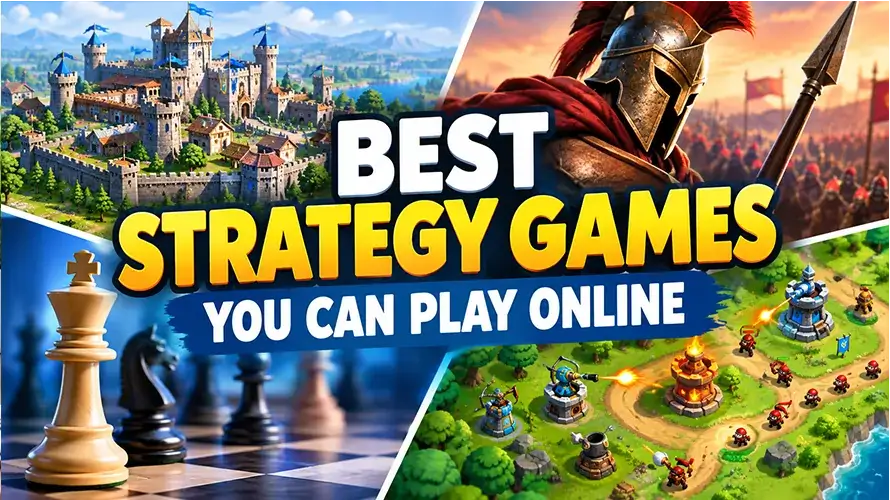
The best strategy games online do more than ask you to react quickly. They give you a problem, a limited set of resources, and several possible ways to reach your goal. Sometimes that means planning several moves ahead in a board game. In other games, it means managing an economy, defending a base, controlling territory, or deciding when to take a calculated risk.
Online strategy games also cover a surprisingly wide range of experiences. Some can be understood in a few minutes and played during a short break, while others reward careful planning over much longer sessions. The right choice depends less on finding a universally “best” game and more on finding a strategy system that matches the way you like to think and play.
What Makes an Online Strategy Game Worth Playing?
Strategy is a broad genre, so two games can both be described as strategy titles while offering completely different experiences. A good starting point is to look at what decisions actually matter.
In a strong strategy game, your choices should have meaningful consequences. Spending resources in one area may leave another area weaker. Attacking too early can create an opening for an opponent, while waiting too long can allow them to become stronger. These trade-offs are what make strategic decisions interesting.
Accessibility matters too. An online game does not necessarily need dozens of systems to be engaging. A simple ruleset can produce enormous strategic depth when the available choices interact in interesting ways.
- Meaningful decisions: Your choices should affect what happens next.
- Clear rules: You should be able to understand why an action succeeded or failed.
- Room for improvement: Better planning should produce better results over time.
- Replayability: Different opponents, situations, or decisions should keep sessions from feeling identical.
- Appropriate pacing: The game should fit the amount of time you actually want to spend playing.
Different Types of Strategy Games Online
Before choosing a game, it helps to identify the type of strategy you enjoy. A player who likes quick tactical decisions may have very different preferences from someone who enjoys slowly developing a virtual civilization.
Turn-Based Strategy
Turn-based games give you time to consider your options before committing to an action. This makes them particularly appealing if you enjoy analyzing positions rather than relying on rapid reactions.
Chess is the classic example. Its rules are relatively easy to learn, but the number of possible positions creates enormous strategic depth. Online chess platforms also make it easy to choose different time controls, allowing the experience to range from fast games to much more deliberate matches.
Real-Time Strategy
Real-time strategy games require planning while the game continues to move. Resource collection, positioning, production, expansion, and combat may all happen simultaneously.
This creates a different type of challenge from turn-based strategy. You are not only deciding what to do but also when to do it. Prioritizing becomes essential because you rarely have enough time to handle every possible task at once.
Tower Defense
Tower defense games simplify the strategy formula by giving you a clearly defined defensive problem. Enemies follow routes or attack in waves, while you decide where to place and upgrade defensive units.
These games are often easier to start than larger strategy titles, but good tower defense design can still create difficult choices. A powerful defensive unit may be excellent against one type of threat while being inefficient against another.
City-Building and Management Strategy
City-building and management games focus more on planning systems than direct combat. You may need to balance income, construction, production, population needs, or expansion.
These games are a good fit for players who enjoy building something gradually and solving problems caused by their own previous decisions. They can also provide a more relaxed alternative to competitive strategy games.
Multiplayer Board and Card Strategy
Online versions of board and card games provide another route into strategy. They often use relatively simple rules while creating complicated decisions through positioning, probability, resource management, or opponent prediction.
Strategy Games Worth Exploring
There is no single game that fits every strategy player. Instead, the following examples represent different approaches to online strategy and can help you identify the style that suits you.
| Game or Style | Best For | Strategic Focus | Typical Pace |
|---|---|---|---|
| Online Chess | Players who enjoy pure tactical and positional thinking | Planning, calculation, positioning, timing | Fast to deliberate |
| Bloons TD-style games | Players who enjoy defensive planning | Placement, upgrades, resource efficiency | Moderate |
| Forge of Empires-style games | Players who enjoy long-term development | Expansion, resources, city management | Long-term |
| Browser strategy games | Players who prefer accessible sessions | Varies by game | Short to long |
| Online strategy board games | Players who enjoy structured competitive decisions | Positioning, probability, resource management | Varies |
The examples above should be treated as different strategy formats rather than a ranking. The important question is what kind of decisions you want to make while playing.
How to Choose the Right Strategy Game
If you open a large collection of online games without knowing what you want, it is easy to spend more time browsing than playing. A few simple questions can narrow the options considerably.
How Much Time Do You Have?
If you only have a few minutes, a short tactical game or compact puzzle-like strategy experience may be a better fit than a persistent world that expects regular attention.
Players with more time may prefer games where decisions build on one another across a longer session. The important distinction is not whether one format is better, but whether its pacing matches your schedule.
Do You Prefer Competition or Relaxation?
Competitive strategy games put your decisions directly against those of another player. That can make every move feel meaningful, but it can also create a more demanding experience.
Single-player strategy and management games offer more freedom to experiment. You can often test an unusual approach without worrying about another player immediately exploiting your mistakes.
Do You Enjoy Numbers and Resources?
If you like comparing costs, optimizing production, and planning around limited resources, management and strategy games with economic systems may appeal to you.
If you would rather focus on positioning and predicting an opponent, a game with a smaller number of resources may be more satisfying.
Do You Want Fast Decisions?
Real-time games and fast online matches reward players who can prioritize quickly. Turn-based games provide more room for analysis and can be preferable when you want to think through several possibilities before acting.
How to Get Better at Strategy Games
Improvement usually comes from learning how to evaluate decisions rather than simply playing more matches. A useful habit is to ask what information you had before making an important move and whether you used that information effectively.
Think About Your Next Two Decisions
Instead of trying to predict an entire game, consider what your current action is likely to create next. A move that looks strong immediately may become less useful if it leaves you with poor options afterward.
Protect Your Resources
New players often spend resources simply because they are available. Stronger strategic play usually involves asking whether the resource can create greater value if saved for a more important moment.
Learn From Losing Positions
A loss becomes more useful when you can identify the decision that caused your position to deteriorate. Look for patterns: expanding too early, ignoring defense, using an important ability at the wrong time, or failing to anticipate the opponent’s most obvious response.
Change One Thing at a Time
If you change your entire approach after every loss, it becomes difficult to understand what actually improved your results. Experiment with one adjustment, then observe how it changes your decisions.
Learn the Rules Before Chasing Advanced Tactics
Advanced strategies depend on a strong understanding of the basic systems. Knowing how resources work, what units can do, and what conditions lead to victory is often more valuable than memorizing complicated tactics.
Common Mistakes New Strategy Players Make
Trying to Do Everything
Strategy games frequently give players more possible actions than they can use effectively. Building, attacking, defending, upgrading, exploring, and gathering resources may all be possible, but attempting all of them at once can weaken your overall position.
Choose a clear priority and make your other decisions support it.
Ignoring the Opponent
A strong plan can still fail if it assumes the other player will simply allow you to execute it. In multiplayer games, regularly check what your opponent is building, protecting, or preparing.
Spending Without a Plan
Resources are most valuable when they support a specific objective. Before making a major purchase or upgrade, consider what problem it solves and whether there is a more immediate use for the same resources.
Playing Too Predictably
Consistency is useful, but predictable behavior can become a weakness in competitive games. If an opponent can easily anticipate your next action, they can prepare for it before you gain an advantage.
Blaming the Game Instead of Reviewing the Decision
Sometimes a game contains randomness or an unfavorable situation. Even then, reviewing your choices can reveal whether an earlier decision made the position more difficult than necessary. Focus on the parts of the outcome that you could control.
Making Strategy Games More Enjoyable
Improvement should not turn every session into a test. One of the advantages of online strategy games is the range of available difficulty and pacing, so you can change the type of experience when you want something different.
- Choose shorter matches when you want quick decision-making.
- Try slower formats when you want more time to analyze.
- Use beginner-friendly modes to learn unfamiliar mechanics.
- Experiment with different strategies instead of repeating one approach every session.
- Take a break after several frustrating losses rather than playing automatically.
- Try a different strategy genre if the current one feels repetitive.
There is also value in alternating between competitive and relaxed games. A demanding multiplayer match can sharpen decision-making, while a slower management game can provide a different kind of strategic challenge.
Free Browser Strategy Games vs. Larger Online Games
Browser-based strategy games have an important advantage: convenience. When a game runs directly in a supported browser, there is often less setup between deciding to play and actually reaching the game.
Larger online strategy games can offer more sophisticated systems, persistent progression, or deeper multiplayer features. However, they may require more time and commitment. Neither approach is automatically better; the best option depends on how much complexity you want.
For casual sessions, prioritize accessibility and clear gameplay. For longer sessions, look for systems that provide enough strategic depth to keep your decisions interesting after the initial learning period.
A Simple Checklist Before You Start
If you are choosing a new strategy game, use this quick checklist:
- Can I understand the basic objective without a long tutorial?
- Does the game offer the type of strategy I actually enjoy?
- Does its typical session length fit my available time?
- Do my decisions meaningfully affect the outcome?
- Is the difficulty appropriate for my current experience?
- Can I improve through learning rather than relying entirely on luck?
- Does the game give me enough variety to remain interesting?
If most of the answers are yes, the game is probably worth trying. You do not need to find the most complicated strategy title available. A well-designed game with clear decisions can provide plenty of depth without overwhelming you.
Frequently Asked Questions
What are strategy games online?
Strategy games online are games where planning, decision-making, resource management, positioning, or predicting opponents plays a major role in determining the outcome. They include chess, tower defense, management games, real-time strategy, turn-based games, and many browser-based experiences.
Are strategy games difficult for beginners?
Some are, but many strategy games are designed around simple introductory rules. Starting with a game that has a clear objective and limited systems can make it easier to learn the basic principles before moving to more complex titles.
Can I play strategy games in a browser?
Yes. Many strategy experiences are available through web browsers, although requirements and availability vary by game. Browser games range from simple tactical challenges to longer-running strategy experiences.
What is the best strategy game for short sessions?
Look for games with short matches, compact levels, or turn-based systems that allow you to stop naturally. Online chess with an appropriate time control and short tower defense sessions are examples of formats that can work well for limited playtime.
How can I improve at strategy games?
Learn the rules, identify the purpose behind your actions, protect important resources, watch what your opponent is doing, and review significant mistakes after a loss. Consistent decision-making usually matters more than memorizing a large number of tactics.
Final Thoughts
The appeal of strategy games comes from having meaningful choices rather than simply moving through a fixed sequence of actions. Whether you prefer chess-like calculation, tower defense, resource management, or competitive multiplayer, there is a strategy format that can match your preferred pace and level of complexity.
Start with the type of decision-making you enjoy most, choose a game that fits your available time, and give yourself room to learn from mistakes. The most rewarding strategy game is often the one that makes you curious about what you could have done differently on the next turn.