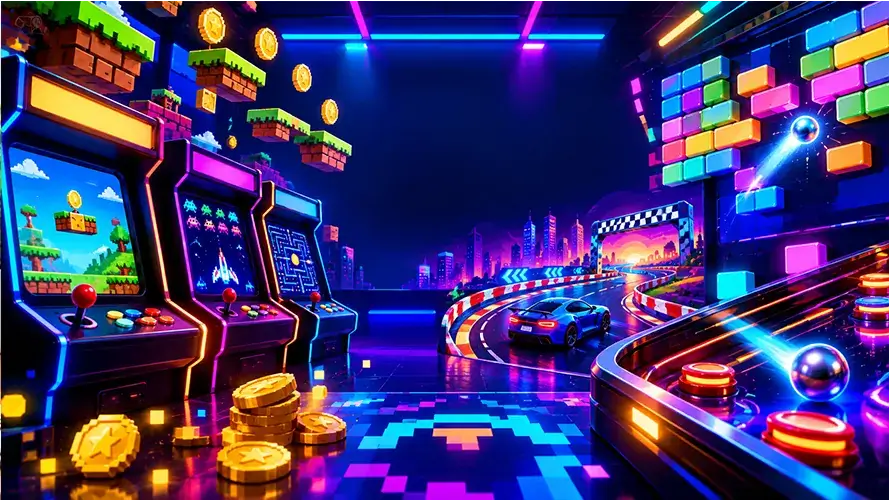
Looking for arcade games online that are easy to start but still give you a reason to play another round? The best arcade experiences usually do not require a long tutorial, a complicated character build, or hours of preparation. You can understand the basic objective quickly, make a few mistakes, and immediately try again with a better approach.
That simple loop is what makes arcade gaming so appealing. Some games test reaction speed, others reward careful movement, and classic score-based titles challenge you to survive longer or improve your previous result. This guide explains the different types of online arcade games, what makes each style enjoyable, and how to choose a game that fits the amount of time and attention you have available.
What Makes a Good Online Arcade Game?
An arcade game works particularly well online when its core idea is easy to understand but difficult to master. You should be able to begin playing without studying a large rulebook, while still having enough challenge to make another attempt worthwhile.
Good arcade design often combines a few important elements:
- Immediate gameplay: You can understand the main objective within a short time.
- Responsive controls: Movement, aiming, jumping, matching, or tapping should feel predictable.
- Short play sessions: A single attempt can often be completed in minutes rather than requiring a long commitment.
- Clear goals: Survive, score, match, avoid obstacles, reach a target, or beat a previous result.
- Increasing challenge: The game introduces pressure gradually instead of becoming difficult without warning.
- Replay value: Improving your own performance gives you a reason to return.
These qualities are especially useful in browser gaming because many players want something they can start quickly during a short break. A strong arcade game respects that limited time while still offering enough depth for longer sessions.
Choose Your Arcade Style Before You Start
There is no single arcade experience that suits everyone. If you enjoy fast reactions, a puzzle-focused arcade game may feel too slow. If you prefer planning your moves, a game based entirely on rapid reflexes may become frustrating.
| Arcade style | Best for | What to expect |
|---|---|---|
| Classic score-chasing | Players who enjoy improving personal records | Simple rules, repeated attempts, and score-focused gameplay |
| Reflex and reaction | Players who like fast decisions | Quick movement, timing challenges, and increasing pressure |
| Arcade puzzle | Players who enjoy thinking while playing | Pattern recognition, matching, timing, or spatial decisions |
| Platform arcade | Players who enjoy movement challenges | Jumping, avoiding hazards, collecting items, and reaching goals |
| Arcade action | Players looking for constant activity | Enemies, obstacles, rapid decisions, and short challenge cycles |
| Classic-inspired | Players who enjoy retro-style design | Simple mechanics inspired by traditional arcade gameplay |
Classic Arcade Games Still Work for a Reason
Some of the most recognizable arcade concepts remain enjoyable because their rules are immediately understandable. Pac-Man, for example, is built around movement, maze navigation, collecting items, and avoiding threats. Breakout reduces its idea to controlling a paddle and keeping a ball in play while clearing blocks.
Other classic concepts focus on survival and increasingly demanding situations. Games inspired by Asteroids emphasize movement and shooting while managing threats from multiple directions. Snake uses an even simpler concept: control movement, collect objects, and avoid running into obstacles or yourself.
These games demonstrate an important arcade principle: a small number of mechanics can create considerable replay value when timing, positioning, and decision-making matter.
Fast Arcade Games for Short Breaks
If you only have a few minutes, choose an arcade game with a compact gameplay loop. You do not want to spend most of your available time learning controls or waiting for a long session to end.
Good choices for short sessions usually have one or more of these characteristics:
- The objective is visible immediately.
- A round can end quickly after a mistake.
- Controls require only a few inputs.
- There is little setup before gameplay begins.
- Your progress can be measured through a score, distance, level, or completed challenge.
Score-chasing games are particularly suitable for this situation. You can play one attempt, stop, and return later without needing to remember a complicated storyline or progression system.
Arcade Games for Players Who Enjoy High-Speed Challenges
Reaction-based arcade games are built around making correct decisions under pressure. The challenge may involve avoiding moving objects, responding to changing patterns, hitting targets at the right moment, or controlling a character through increasingly demanding sections.
The biggest mistake in these games is reacting to everything as quickly as possible. Speed matters, but predictable timing and controlled movement often matter more. Watch how obstacles behave, identify repeating patterns, and avoid making unnecessary movements.
If a game repeatedly defeats you at the same point, treat that section as a specific problem rather than simply trying to play the entire level faster. Learning one difficult sequence at a time can make improvement much more consistent.
Arcade Puzzle Games for a More Thoughtful Challenge
Arcade and puzzle mechanics can work surprisingly well together. These games may look simple because their controls are straightforward, but the player still has to recognize patterns, plan short sequences, or make decisions before the available options disappear.
Matching games, tile-based challenges, falling-block concepts, and timing puzzles can all fit this category. They are useful when you want something more mentally engaging than a pure reflex test without committing to a large strategy game.
A useful approach is to avoid making every decision immediately. When the game gives you time to examine the board or upcoming options, use that information. A few seconds of planning can prevent a mistake that would otherwise end the round.
Platform-Style Arcade Games: What to Look For
Platform arcade games combine movement with timing. The objective may be to reach the end of a short stage, collect objects, avoid hazards, or survive as long as possible.
When choosing one, pay attention to how the controls are designed. A good platform game should make it reasonably clear why a missed jump happened. If movement feels unpredictable, difficulty can become frustrating rather than rewarding.
For beginners, games with generous early sections are often easier to learn because they let you understand jumping, momentum, and obstacle timing before introducing more demanding sequences.
How to Find an Arcade Game You Will Actually Enjoy
Instead of opening random games and leaving after a few seconds, start with the type of experience you want. Your available time and preferred challenge level can narrow the choices considerably.
- Decide how long you want to play. Choose short-round games if you only have a few minutes.
- Identify your preferred challenge. Pick reflex games for speed, puzzle arcade games for decision-making, or platform games for timing.
- Check the controls. Simple keyboard, mouse, or touch controls are usually easier to learn quickly.
- Look for a clear objective. You should understand what you are trying to accomplish without unnecessary complexity.
- Test the first few minutes. If the core mechanic feels satisfying, the game is more likely to hold your attention.
- Consider replay value. Personal scores, increasingly difficult stages, or changing challenges can make a simple game last much longer.
How to Improve at Score-Based Arcade Games
High scores are rarely about pressing buttons faster from the beginning. Improvement usually comes from recognizing patterns and reducing avoidable mistakes.
Learn the safest routes
If a game allows multiple paths through an obstacle section, identify which route gives you more space or more time to react. The fastest route is not always the most reliable one.
Separate mistakes from bad luck
After losing, ask what actually caused the failure. If the same mistake happens repeatedly, it is probably something you can change. If an unexpected event caused the problem, focus on improving your response rather than trying to eliminate something outside your control.
Practice one mechanic at a time
When a game combines movement, timing, enemies, and collectibles, trying to master everything simultaneously can slow your progress. Focus first on staying alive, then improve movement efficiency, and finally work on optional objectives or higher scores.
Stop when concentration drops
Arcade games often reward attention. If repeated attempts are becoming careless rather than productive, taking a short break can be more useful than immediately starting another round.
Common Mistakes When Choosing Online Arcade Games
Choosing difficulty instead of enjoyment
A game does not need to be extremely difficult to be rewarding. If you want a relaxed session, there is nothing wrong with selecting a simpler arcade experience. Difficulty should support the type of session you want, not determine it.
Ignoring control quality
A clever game concept can become unpleasant when its controls are confusing or inconsistent. Give the controls a few minutes before deciding whether the gameplay itself is the problem.
Expecting every arcade game to have long-term progression
Arcade games often focus on the quality of individual attempts rather than permanent character development. If you want equipment systems, extensive stories, or long progression trees, an action RPG or strategy game may better match those expectations.
Playing only for the highest score
Score chasing can be motivating, but it is not the only way to enjoy an arcade game. You can also play to learn a mechanic, complete a difficult stage, discover a better route, or simply enjoy a short session.
What Makes an Arcade Game Replayable?
Replayability does not necessarily require dozens of levels. A well-designed core mechanic can create variety through changing obstacles, faster speeds, different layouts, limited resources, or increasingly difficult decisions.
Personal improvement is another powerful source of replay value. A game that takes only two minutes to play can remain interesting if the difference between an average attempt and an excellent attempt depends on timing, positioning, and careful decisions.
This is one reason classic arcade concepts continue to influence browser games. Their simplicity makes the objective easy to understand, while the pursuit of better execution provides a reason to keep playing.
FAQ About Arcade Games Online
What are arcade games online?
Arcade games online are games designed around quick, accessible gameplay loops such as scoring points, avoiding obstacles, defeating enemies, solving short challenges, or surviving for as long as possible. Many emphasize immediate controls and replayable rounds.
Are arcade games suitable for beginners?
Yes. Many arcade games use simple controls and introduce their main mechanic quickly. Beginners can start with games that have slower pacing, forgiving early stages, or straightforward objectives before moving to faster challenges.
What type of arcade game is best for a short break?
Score-based, reaction, and simple puzzle arcade games are often convenient for short sessions because they can deliver a complete gameplay experience without requiring a long commitment.
How can I get better at arcade games?
Focus on learning patterns, improving timing, reducing unnecessary movements, and identifying the specific reason behind each mistake. Repeated attempts are more useful when each attempt teaches you something.
Do arcade games always require fast reactions?
No. Although many arcade games emphasize speed, others rely more heavily on planning, pattern recognition, positioning, or puzzle solving. The arcade genre includes a wide range of gameplay styles.
Final Thoughts
The best arcade game for you depends less on a universal definition of quality and more on the type of session you want. A fast reaction challenge can be ideal for a short break, while an arcade puzzle or platform game may provide a more deliberate challenge.
Start with the mechanic that sounds enjoyable, learn its controls, and give yourself a few attempts before deciding whether it fits. The strongest arcade experiences make that process simple: understand the goal, play a round, learn from the result, and feel tempted to try once more.