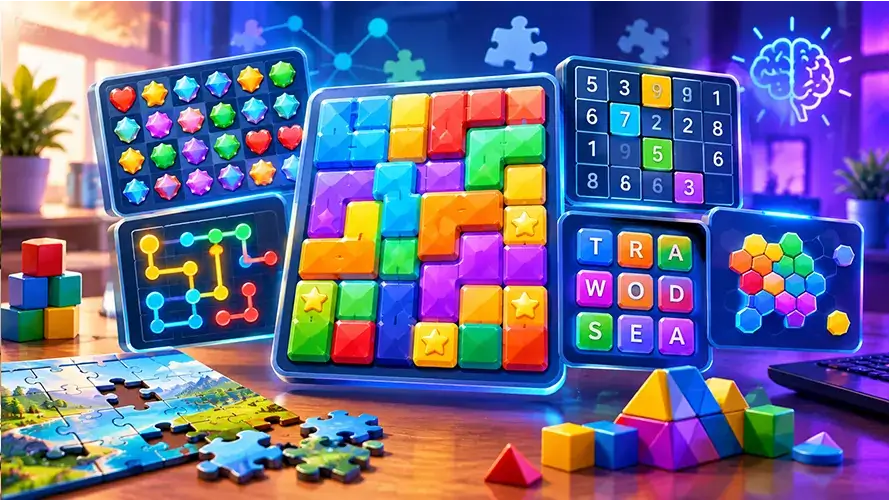
Finding a good puzzle game online is easy. Finding one that matches your mood, attention span, and preferred level of challenge is much harder. Some puzzle games are ideal for a five-minute break, while others reward careful planning and can keep you thinking about a solution long after you stop playing.
This guide explores different types of puzzle games online and explains what makes each type enjoyable. Instead of treating every puzzle as the same, you will find practical ways to choose a game based on difficulty, pace, mechanics, and the kind of thinking you want to use.
Choosing a Puzzle Game Based on Your Mood
The best puzzle for one situation may be frustrating in another. If you have only a few minutes, a slow strategy puzzle may not be the right choice. If you want something that requires concentration, however, a simple matching game might feel too predictable.
A useful starting point is to decide what kind of experience you want before choosing a game.
| What You Want | Puzzle Type to Try | Why It Fits |
|---|---|---|
| A quick break | Match and merge puzzles | Simple rules make it easy to start immediately |
| Logical thinking | Number and deduction puzzles | Progress depends on reasoning rather than speed |
| Pattern recognition | Tile and matching puzzles | Players look for relationships between shapes, colors, or symbols |
| Planning | Grid and strategy puzzles | Actions often affect several later moves |
| Relaxed play | Word and visual puzzles | They can provide mental activity without requiring constant action |
| A challenge | Logic and problem-solving games | Solutions may require several steps and careful experimentation |
Popular Types of Online Puzzle Games
Match-and-Merge Puzzles
Match-and-merge games are among the easiest puzzle formats to understand. The player normally combines identical or related pieces to create new pieces, clear spaces, or achieve a specific objective.
The appeal comes from the balance between immediate feedback and longer-term decisions. A move may look useful because it creates a match, but making that move too early can sometimes remove options that would have been more valuable later.
These games work particularly well when you want something accessible without completely switching off your brain.
Number Puzzles
Number-based puzzles turn simple mathematical relationships into gameplay. The challenge can involve arranging values, combining tiles, finding sequences, or reaching a target through limited moves.
You do not necessarily need advanced mathematics to enjoy them. In many cases, the important skill is recognizing patterns and thinking about what a move will create several turns later.
Word Puzzles
Word games offer a different type of mental challenge. Instead of manipulating objects on a board, you may need to identify words, rearrange letters, complete patterns, or connect related terms.
They can be especially useful for players who enjoy language-based challenges. Difficulty can also vary significantly depending on vocabulary, clues, time limits, and the number of possible answers.
Logic and Deduction Puzzles
Logic puzzles are designed around reasoning. The solution often depends on eliminating possibilities, identifying relationships, or following a set of rules.
These games tend to become more satisfying as the difficulty increases because the player can often understand exactly why a solution works. They are a good choice when you want a puzzle that rewards patience rather than rapid reactions.
Tile and Pattern Puzzles
Tile-based puzzles ask you to recognize patterns, arrange objects, or manipulate a board until a particular condition is met. Some rely heavily on visual recognition, while others require you to predict how one movement will change the entire board.
A useful habit is to look at the complete board before making the first move. In many puzzle systems, the strongest move is not always the one that produces an immediate result.
Physics-Based Puzzles
Physics puzzles add movement and environmental interactions to traditional problem solving. You may need to remove an object, redirect something, control momentum, or arrange pieces so that a chain of events produces the desired result.
Trial and error is often part of the experience. The important distinction is that useful experimentation should teach you something about the puzzle’s rules rather than simply repeating the same action.
What Makes a Puzzle Game Worth Playing?
A strong puzzle game usually has rules that are easy to understand but decisions that become increasingly interesting. The player should know what actions are available without necessarily knowing the correct solution.
Clear feedback is another important quality. When a move succeeds or fails, the game should make the result understandable. Good feedback allows players to adjust their approach instead of guessing blindly.
Meaningful difficulty matters as well. A puzzle should become harder because the problem becomes more demanding, not because the rules suddenly become confusing or the game withholds information unnecessarily.
Finally, good puzzles give players a reason to think. If the optimal solution is always obvious, the experience can quickly become repetitive. If every solution depends on luck, the player may feel that careful reasoning does not matter.
How to Pick the Right Difficulty
Difficulty is personal. A puzzle that feels relaxing to one player may be demanding to another, so choosing a game based only on labels such as easy, medium, or hard is not always reliable.
Instead, consider how much concentration you want to use.
- For casual sessions: choose games with simple rules and short rounds.
- For regular practice: look for puzzles that gradually introduce new mechanics.
- For serious challenges: choose games where planning several moves ahead is important.
- For beginners: start with familiar mechanics and increase complexity gradually.
- For experienced puzzle players: look for unusual mechanics or restrictions that force a different approach.
If you repeatedly solve a game without thinking about your decisions, it may be time to increase the difficulty. On the other hand, if you are stuck immediately and cannot determine why your moves fail, a slightly easier puzzle may provide a better learning experience.
Simple Strategies That Improve Puzzle Performance
Understand the Rules Before Chasing the Solution
Spend the first few moves learning how the puzzle behaves. Pay attention to what changes after each action and which elements interact with one another.
This is particularly important in unfamiliar games. A player who understands the mechanics can often solve a difficult puzzle more efficiently than someone who simply makes moves quickly.
Look for Forced Moves
Some puzzles contain situations where only one move can reasonably work. Identifying these moments reduces the number of possibilities you need to consider.
Instead of asking, “What move looks good?” ask, “Which moves are actually possible or safe?” This small change in thinking can make deduction puzzles much easier to manage.
Think About the Next Position
Do not judge a move only by what happens immediately. Consider the position it creates and the options that remain afterward.
For example, clearing one area of a board may appear useful, but if doing so blocks access to another important section, the immediate gain may not be worth it.
Use Mistakes as Information
When a move fails, identify what the failure tells you. Did you misunderstand a rule? Did you move too early? Did you create an unwanted obstacle?
Treating mistakes as information turns trial and error into a structured process rather than a cycle of random attempts.
Reset When the Position Is Clearly Lost
Continuing a puzzle after the useful options have disappeared can waste time. If the game allows a restart and you already understand what caused the problem, starting again with that knowledge can be more productive.
Common Mistakes When Playing Online Puzzles
One common mistake is focusing entirely on speed. Some puzzle games include timers, but playing quickly is not always the same as playing well. Rushing can cause players to overlook patterns or make moves that create unnecessary problems.
Another mistake is committing to the first strategy that appears to work. Puzzle boards often contain multiple possible approaches, and an attractive early move may make later decisions more difficult.
Players also sometimes restart too quickly. If you are only a few moves into a puzzle, restarting may prevent you from discovering why the current position became difficult. Take a moment to identify the mistake before beginning again.
Finally, avoid assuming that a difficult puzzle requires a complicated solution. Many well-designed puzzles are solved by noticing one simple relationship that was easy to overlook.
Browser Puzzle Games and Convenience
Browser-based puzzle games can be convenient because they remove much of the setup associated with larger games. When a puzzle loads quickly and its controls are straightforward, it can fit naturally into a short break.
For the best experience, consider the device you are using. A game designed around precise mouse movement may feel less comfortable on a phone, while a touch-friendly puzzle can work particularly well on a smaller screen.
It is also worth checking whether the game saves progress when that matters to you. Short-session games can be enjoyed without saving, but longer puzzle experiences become more frustrating if progress cannot be retained.
A Quick Checklist Before Starting a New Puzzle
- Are the rules clear within the first few minutes?
- Does the difficulty match the amount of concentration you want to use?
- Can you understand why a move succeeded or failed?
- Does the game reward planning rather than random guessing?
- Does it work comfortably on your device?
- Is the session length appropriate for your available time?
- Does the game offer enough variety to remain interesting?
You do not need every answer to be yes. The checklist is simply a quick way to identify whether a particular puzzle matches what you are looking for at that moment.
Frequently Asked Questions
What are puzzle games online?
Puzzle games online are digital games built around problem solving, pattern recognition, deduction, matching, words, numbers, spatial reasoning, or other forms of mental challenge. They range from very simple short-session games to complex puzzles that require extended planning.
Are online puzzle games good for beginners?
Yes. Many puzzle games use simple mechanics that can be understood quickly. Beginners can start with familiar formats such as matching, basic number puzzles, or straightforward logic challenges before moving to more complex systems.
What type of puzzle game is best for a short break?
Games with short rounds and simple restart options are usually the most convenient. Match, merge, word, and lightweight logic puzzles can work well because you can begin playing without spending much time learning complicated systems.
How can I get better at difficult puzzle games?
Focus on understanding the rules, identifying forced moves, considering the consequences of each action, and learning from failed attempts. Progress usually comes from recognizing patterns rather than simply making moves faster.
Can puzzle games be played on a phone?
Many puzzle games work well on mobile devices, particularly games designed around tapping, dragging, or simple touch controls. For browser games, check that the controls and layout are comfortable on your screen before committing to a longer session.
Final Thoughts
The best online puzzle experience depends less on a universal list of winners and more on finding the right type of challenge for the moment. Quick matching games can provide an easy break, while logic, number, word, and strategy puzzles can offer deeper challenges when you want to concentrate.
Start with mechanics you understand, choose a difficulty that keeps you engaged without becoming frustrating, and treat mistakes as clues. With the right approach, a simple puzzle can become a surprisingly satisfying test of observation, planning, and problem solving.