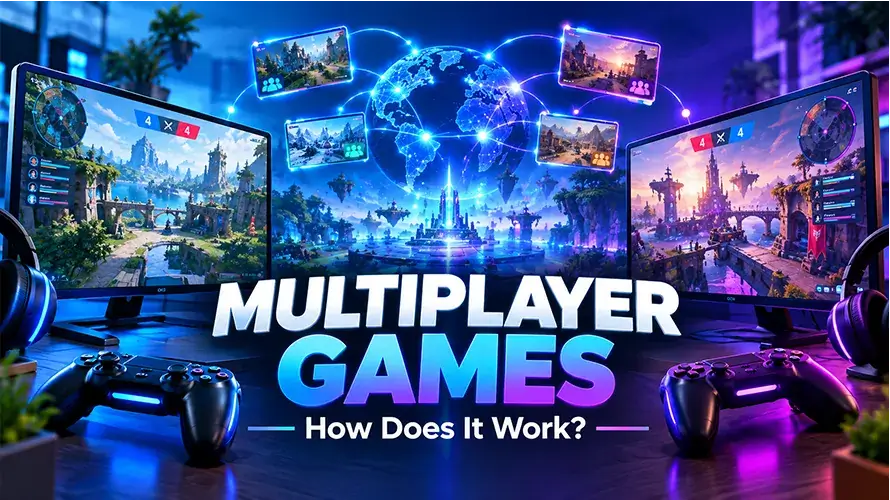
If you have ever played a game against another person, joined friends in a cooperative match, or competed with strangers online, you have already experienced multiplayer gaming. But what is a multiplayer game exactly, and what happens behind the scenes when several players share the same game?
A multiplayer game is designed to allow two or more people to participate in the same gaming experience. Depending on the title, players may cooperate toward a common goal, compete against one another, or take part in a larger game world where both cooperation and competition are possible.
This guide explains the basic mechanics of multiplayer games, the different ways players connect, the main types of multiplayer experiences, and the practical factors that can affect how enjoyable a multiplayer game feels.
The Basic Idea Behind Multiplayer Gaming
The defining feature of multiplayer gaming is interaction between multiple players within the same game experience. Instead of the game responding only to one person’s actions, it must also account for actions made by other participants.
For example, in a cooperative puzzle game, one player might activate a switch while another moves an object into position. In a competitive action game, one player’s movement or attack can directly affect another player’s chances of winning.
That interaction creates an important difference between multiplayer and single-player games. A single-player game can largely control the experience through programmed opponents and predefined events, while a multiplayer game must continuously respond to human decisions made by multiple participants.
How Does a Multiplayer Game Work?
Although the technical details vary between games, multiplayer experiences generally depend on communication between the players’ devices and the systems running the game.
When you perform an action, such as moving your character, collecting an item, or attacking an opponent, information about that action needs to reach the other participants. The game then updates the shared state of the session so everyone receives a consistent representation of what is happening.
The Role of the Game Server
Many online multiplayer games use dedicated servers to coordinate sessions. A server can act as a central point that receives information from players, processes important game events, and sends updated information back to connected devices.
Consider a simple racing game. Your computer may display your car locally, but information about your position and movement can also be communicated to the multiplayer system. The same process happens for the other racers, allowing each participant to see a shared version of the race.
Peer-to-Peer Connections
Not every multiplayer game relies on a dedicated server. Some games can use a peer-to-peer model in which participating devices communicate more directly with one another.
The choice between different networking approaches depends on the game’s design, number of players, technical requirements, security considerations, and the type of interaction taking place.
Why Latency Matters
Latency describes the delay involved when information travels between your device and another part of the multiplayer system. Low latency is particularly important in fast games where a fraction of a second can affect movement, aiming, timing, or defensive reactions.
A player with a stable connection and low latency will generally experience multiplayer interactions more immediately than someone dealing with severe network delays. This is one reason a game can feel responsive in one match but noticeably delayed in another.
Common Types of Multiplayer Games
Multiplayer is not a single genre. It describes how people participate in a game, which means multiplayer features can appear in action, strategy, puzzle, sports, racing, arcade, adventure, and many other types of games.
Cooperative Multiplayer
Cooperative games, often called co-op games, allow players to work together rather than directly compete. Players may share objectives, solve puzzles, defeat enemies, complete missions, or manage resources as a team.
Co-op can be especially useful for players who want social interaction without the pressure of competing against their friends.
Competitive Multiplayer
Competitive multiplayer places players or teams against one another. The objective might involve reaching a score, defeating an opposing team, finishing a race first, or achieving another measurable goal.
Competitive games often require players to understand both their own abilities and the behavior of opponents.
Local Multiplayer
Local multiplayer allows multiple people to play on the same physical device or within the same local environment. Depending on the game, players might share a screen, use multiple controllers, or connect devices through a local network.
This type of multiplayer can be particularly convenient when people are playing together in the same room.
Online Multiplayer
Online multiplayer connects players over the internet. Participants can potentially play together even when they are in different cities or countries.
Online games range from simple browser experiences with two players to large-scale games involving many participants in persistent or regularly changing virtual environments.
Massively Multiplayer Experiences
Some online games are designed around very large communities. Instead of a small match involving a handful of participants, these games can create persistent worlds or large shared environments where many players interact over time.
The important distinction is not simply the number of players. These games are often built around long-term progression, social systems, economies, exploration, or other mechanics that depend on a large player community.
Multiplayer vs. Single-Player Games
The difference between multiplayer and single-player gaming becomes clearer when looking at how the game creates challenges.
| Feature | Single-Player | Multiplayer |
|---|---|---|
| Participants | Usually one human player | Two or more human players may participate |
| Opponents | Often controlled by the game | Can include human opponents |
| Connection | May work entirely offline | Online games usually require network communication |
| Game pace | Often easier to pause or control | May continue according to the shared session |
| Social interaction | Usually limited or optional | Can be a central part of the experience |
| Challenge | Designed around programmed systems | Can change according to human opponents or teammates |
Neither approach automatically produces a better experience. A player who enjoys exploration at their own pace may prefer a single-player game, while someone who enjoys teamwork or unpredictable competition may prefer multiplayer.
Why Multiplayer Games Feel Different Every Time
Human behavior introduces an element of unpredictability that is difficult to reproduce with programmed opponents alone.
A computer-controlled opponent may follow rules established by the developers, but another player can change tactics unexpectedly. A teammate might discover a creative solution to a problem, while an opponent might use an unusual strategy that forces you to adapt.
This variability can give multiplayer games considerable replay value. Even when the map, rules, or objectives remain the same, the decisions made by different players can produce very different sessions.
What You Need to Play Multiplayer Games
The requirements depend on the particular game, but online multiplayer commonly involves several basic components.
- A compatible device: This could be a computer, console, smartphone, tablet, or another supported platform.
- A game that supports multiplayer: Some games are entirely single-player, while others offer optional or dedicated multiplayer modes.
- A network connection: Online games generally need internet access to communicate with other participants.
- A suitable game version: Players may need compatible versions of the same game to join a session.
- An account or profile: Some online services require players to sign in before accessing multiplayer features.
- Input controls: Depending on the game, a keyboard, mouse, touchscreen, controller, or another input method may be required.
Browser games can sometimes provide a simpler entry point because the player may be able to start the experience directly from a compatible web browser without installing a large game client.
What Makes a Multiplayer Game Enjoyable?
A multiplayer game needs more than a connection between players. The rules and systems need to make that interaction meaningful.
Clear Objectives
Players should understand what they are trying to accomplish. A clear objective might be winning a race, completing a puzzle, protecting an area, collecting resources, or defeating an opposing team.
Balanced Gameplay
Balance matters particularly in competitive games. If one strategy, character, item, or team has an overwhelming advantage, matches can become predictable and frustrating.
Responsive Controls
Multiplayer games often depend on timing. Responsive controls help players understand that their actions are being registered as intended, which is particularly important in action and competitive games.
Useful Communication
Team-based games can benefit from communication tools such as text chat, voice communication, pings, or simple predefined commands. Good communication can help teammates coordinate without requiring complicated instructions.
Appropriate Matchmaking
When a game uses matchmaking, the system may attempt to place players into suitable matches according to factors such as experience, skill, region, or other game-specific criteria. The exact approach varies considerably between games.
Common Multiplayer Problems and What They Mean
Multiplayer problems are not always caused by the game itself. Network conditions, device performance, server availability, and software compatibility can all affect an online session.
Lag or Delayed Actions
If your character appears to respond slowly or other players seem to move unpredictably, network latency may be involved. A busy network or unstable connection can make the delay more noticeable.
Disconnects
A player can be removed from a multiplayer session if their connection to the game service is interrupted. Temporary network problems, service issues, or problems with the player’s own connection can all contribute.
Low Frame Rate
Not every multiplayer performance problem is a network problem. If the game itself runs at a low frame rate, the cause may instead involve the device’s hardware, graphics settings, background applications, or software configuration.
Unbalanced Matches
A match can feel unfair even when the network works perfectly. Differences in player experience, team composition, game knowledge, or matchmaking conditions can produce uneven encounters.
Understanding which type of problem you are experiencing makes troubleshooting much easier. A network issue requires a different solution from a graphics-performance problem.
How to Choose the Right Multiplayer Game
The best multiplayer experience depends heavily on what you want from the game. Before starting a new title, consider the kind of interaction you actually enjoy.
- Prefer teamwork? Look for cooperative games with shared objectives and useful team mechanics.
- Enjoy competition? Competitive matches may suit players who like measurable goals and direct challenges.
- Want something casual? Short browser or arcade sessions can be easier to fit into a limited amount of free time.
- Like solving problems? Multiplayer puzzle games can turn communication and coordination into part of the challenge.
- Enjoy strategy? Look for games where planning, resource management, positioning, or decision-making matter.
- Playing with friends? Check how many participants the game supports and whether everyone uses compatible platforms.
It is also worth checking the game’s control method, connection requirements, session length, and communication features before committing to it.
Simple Ways to Improve Your Multiplayer Experience
You do not need advanced technical knowledge to make multiplayer sessions more consistent. A few practical habits can reduce avoidable problems.
- Use a stable connection. A reliable connection is generally more important than simply having a high maximum internet speed.
- Close unnecessary applications. Other programs can consume system resources or network bandwidth.
- Learn the basic rules first. Understanding the objective lets you focus on gameplay instead of figuring out what to do during a live match.
- Communicate clearly. In team games, short and useful communication is often more effective than constant conversation.
- Expect mistakes. Multiplayer involves real people, so unexpected decisions and failed strategies are part of the experience.
- Choose an appropriate difficulty. A game that constantly overwhelms a new player may be less enjoyable than one that provides room to learn.
Frequently Asked Questions
What is a multiplayer game?
A multiplayer game is a game that allows two or more human players to participate in the same gaming experience. Players can cooperate, compete, or interact within a shared game environment.
Do all multiplayer games require the internet?
No. Local multiplayer games can allow people to play together on the same device or through a local network. Online multiplayer games, however, generally require an internet connection.
Can browser games be multiplayer?
Yes. Browser games can include multiplayer features, allowing players to compete or cooperate through a web browser. The exact requirements depend on how the game is built.
Why does multiplayer gaming sometimes lag?
Lag can result from network latency, an unstable connection, overloaded services, or other technical factors. Low device performance can also create a different problem that may feel similar but is actually related to frame rate.
Is multiplayer gaming always competitive?
No. Multiplayer can be cooperative, competitive, or a mixture of both. Many games allow players to work toward shared objectives instead of directly competing.
Can multiplayer games be played with friends?
Yes. Many multiplayer games are designed specifically for groups of friends. Before choosing one, check its supported player count, platforms, connection requirements, and available game modes.
Final Thoughts
Understanding what is a multiplayer game comes down to one central idea: the experience is built around interaction between multiple human participants. That interaction can take the form of cooperation, competition, shared exploration, puzzle solving, or a combination of several approaches.
Once you understand how multiplayer sessions, networking, latency, game modes, and player interaction fit together, it becomes easier to choose games that match the way you actually like to play. Whether you prefer a quick browser challenge or a longer team-based experience, the right multiplayer format can make the game feel much more engaging.