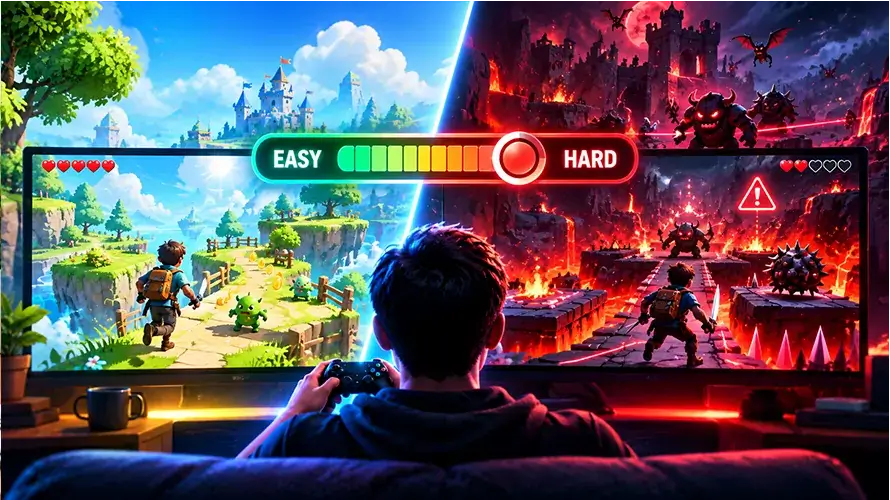
Game difficulty does more than decide how easily a player can reach the next level. It can change the way we think, which strategies we choose, how carefully we explore a game, and even how long we remain interested in playing. The same game can feel relaxed on an easier setting, demanding on a harder one, and almost like a completely different experience when every mistake has a serious consequence.
Understanding game difficulty is useful because difficulty is not simply a measure of how hard a game is. It is part of the game’s design language. Enemy behavior, puzzle complexity, available resources, time limits, checkpoints, penalties, and even the amount of information given to the player can all influence how challenging a game feels.
Difficulty Changes the Decisions Players Make
Imagine playing an action game where enemies deal little damage and healing items are plentiful. You can experiment, move quickly, and take risks because mistakes are inexpensive. Increase enemy damage and reduce available resources, and your behavior may change immediately. Suddenly, positioning matters more, attacks need to be considered carefully, and avoiding unnecessary encounters becomes a useful strategy.
This is one of the most important effects of difficulty: it changes the value of different decisions. A strategy that works perfectly at one difficulty level may become inefficient or dangerous at another.
- Low pressure: Players can experiment and learn through trial and error.
- Moderate pressure: Planning and execution become more important.
- High pressure: Resource management, precision, timing, and risk assessment can dominate the experience.
As a result, changing difficulty can encourage players to interact with familiar mechanics in completely different ways rather than simply making the same actions harder.
Easy Modes Can Be Valuable Learning Spaces
An easier setting is sometimes misunderstood as an option designed only for inexperienced players. In reality, reducing pressure can create a useful environment for learning a game’s systems.
Consider a strategy game with several resources, unit types, upgrades, and tactical mechanics. A new player may struggle to understand all of these systems while simultaneously trying to survive. Lower difficulty can reduce the punishment for mistakes, giving the player more time to understand what each mechanic does.
The same principle applies to puzzle and arcade games. When failure is less costly, players may test unusual approaches instead of repeating the safest known solution. That freedom can help them discover mechanics that would otherwise remain hidden behind frustration.
An easier setting can therefore serve several purposes:
- Learning controls and basic mechanics.
- Understanding enemy patterns.
- Experimenting with different strategies.
- Exploring environments without constant pressure.
- Experiencing a game’s story or atmosphere with fewer mechanical demands.
Harder Difficulty Often Creates a Different Kind of Attention
When mistakes become expensive, players tend to pay closer attention to information that might have been ignored previously. An enemy animation, a sound cue, a limited supply of ammunition, or a small change in the environment can become strategically important.
Hard difficulty can turn background details into decision-making tools. Instead of simply asking, “What should I do next?” a player may begin asking, “What information do I have, what resources remain, and what could go wrong if I choose this option?”
This can make familiar gameplay feel fresh. A level that was previously approached at full speed might suddenly require observation and preparation. Players may memorize layouts, recognize patterns, or develop routines that are unnecessary at lower settings.
Good difficulty does not only increase punishment. It can make the player notice more of the game.
How Difficulty Affects Different Types of Games
Difficulty does not work the same way across genres. A demanding puzzle game challenges the player’s reasoning, while a difficult arcade game may focus on timing and repetition. Understanding those differences helps explain why some difficulty systems feel satisfying while others feel frustrating.
| Game type | What difficulty may change | How players often respond |
|---|---|---|
| Action | Enemy damage, aggression, accuracy, health, or encounter complexity | Players improve positioning, timing, and combat efficiency |
| Puzzle | Clue availability, puzzle complexity, time limits, or penalties | Players spend more time analyzing patterns and testing possibilities |
| Arcade | Speed, reaction windows, enemy frequency, or lives | Players rely on repetition, memorization, and precise inputs |
| Strategy | Opponent intelligence, resource availability, starting conditions, or economic pressure | Players plan further ahead and optimize resource use |
| Adventure | Combat pressure, navigation assistance, puzzle support, or survival resources | Players may focus more heavily on exploration, story, or problem solving |
Because each genre emphasizes different skills, a difficulty slider does not always represent a simple scale from easy to hard. It can determine which skills receive the most attention.
Difficulty Can Change How Players Explore
Exploration is strongly influenced by risk. If a game allows players to recover easily after an encounter, they may investigate optional rooms, experiment with unfamiliar paths, and search for hidden items without much hesitation.
When failure can erase significant progress, exploration becomes a calculation. A player might ask whether an optional area contains something valuable enough to justify the risk. This can make a game world feel more dangerous, but it can also discourage curiosity if the penalties are excessive.
This creates an interesting design balance. Difficulty can make exploration meaningful because danger gives choices weight, but too much punishment can make players avoid optional content altogether.
The Role of Failure in Learning
Failure is not automatically a negative part of gaming. In many well-designed games, failure provides information. A missed jump shows the required timing. An enemy attack reveals a pattern. A failed strategy demonstrates that a particular resource cannot be spent too early.
The important factor is whether the player can understand why they failed.
When the cause of failure is clear, players can adjust their behavior and try again. When failure feels random or unexplained, increasing difficulty may produce frustration instead of meaningful learning.
Games can make repeated attempts more useful by providing:
- Clear visual or audio feedback.
- Predictable enemy patterns.
- Reasonable checkpoints.
- Consistent rules.
- Enough information to understand mistakes.
This is why a difficult challenge can sometimes feel fair while a supposedly easier challenge can feel frustrating. The number of failures is only part of the experience; the player’s ability to learn from them matters just as much.
When Higher Difficulty Improves Replayability
A game can become more interesting after a player understands its basic systems. Once the controls, enemies, maps, or puzzles are familiar, a higher difficulty setting can create a new objective: mastery.
Instead of discovering what the game does, the player starts asking how efficiently they can perform. They may attempt to finish a stage without losing health, complete a challenge using fewer resources, solve a puzzle more quickly, or defeat an opponent without relying on a previously comfortable strategy.
This can give replay value to mechanics that would otherwise become predictable. However, difficulty alone does not guarantee replayability. The challenge needs to remain understandable and provide meaningful opportunities for improvement.
Difficulty Is Not the Same as Complexity
A common mistake is treating a complex game as automatically difficult. Complexity refers to how many systems, rules, choices, or interactions a game contains. Difficulty describes how demanding those systems are for the player.
A game can have dozens of mechanics but provide generous assistance, forgiving checkpoints, and plenty of resources. Another game can have a very small set of mechanics but demand extremely precise timing.
This distinction matters when choosing games. If you enjoy learning complicated systems, a complex strategy game may appeal to you even if its difficulty is moderate. If you prefer simple rules with demanding execution, an arcade game with only a few controls may provide a much greater challenge.
Choosing a Difficulty That Fits Your Goal
There is no universal difficulty setting that works best for every player or every gaming session. The right choice depends on what you want from the experience.
- Choose a lower setting if you want to learn unfamiliar mechanics, explore freely, or focus on story and atmosphere.
- Choose a middle setting if you want the game’s mechanics to matter without making every mistake heavily punishing.
- Choose a higher setting if you enjoy optimization, precision, tactical planning, or learning through repeated attempts.
- Consider changing the setting if the current difficulty is preventing you from learning or enjoying the game’s core systems.
Changing difficulty is not necessarily giving up. In many games, it is simply a way to adjust the experience to match your current goal, available time, or familiarity with the genre.
Difficulty Settings Are Only One Part of the Challenge
Some games provide extensive difficulty options, while others use a fixed challenge and expect players to adapt. Even without a traditional easy or hard selector, developers can influence difficulty through checkpoints, tutorials, enemy placement, resource distribution, optional objectives, and assist features.
This means that two games with identical difficulty labels can feel completely different. One may be demanding because it requires fast reactions, while another may be demanding because it expects careful planning. The label tells you relatively little without understanding what the game is asking you to do.
For players looking for a new game, it can be more useful to ask what kind of challenge does this game provide? rather than simply asking whether it is easy or hard.
Common Difficulty Problems and What to Do About Them
The Game Feels Too Easy
Try increasing the difficulty if you understand the core mechanics and rarely need to make meaningful decisions. You can also create personal challenges, such as limiting certain resources or attempting optional objectives without assistance.
The Game Feels Overwhelming
Lowering the difficulty can give you room to learn. Focus on one mechanic at a time instead of trying to master every system immediately.
You Keep Failing Without Improving
Look for patterns rather than simply repeating the same attempt. Ask what specifically caused the failure and change one part of your approach on the next try.
The Game Is Difficult Because of Unclear Rules
This is different from a demanding but understandable challenge. Revisit tutorials, descriptions, or practice areas if available. If the rules remain unclear, experimentation may be more useful than simply selecting a higher difficulty.
Frequently Asked Questions
Does higher game difficulty make a game better?
Not automatically. Higher difficulty can create a stronger sense of mastery for players who enjoy demanding challenges, but a lower setting may be more appropriate for someone who wants exploration, experimentation, or a more relaxed experience.
Why do games feel harder after changing difficulty?
Higher settings often change more than enemy health. They may reduce resources, improve enemy behavior, shorten reaction windows, increase penalties, or introduce additional tactical pressure.
Can an easy difficulty still teach good gaming skills?
Yes. An easier setting can provide a low-pressure environment for learning controls, mechanics, positioning, resource management, and decision-making before those skills are tested under greater pressure.
Why can a difficult game feel satisfying?
A challenging game can feel satisfying when its rules are consistent and failures provide useful information. Improvement becomes visible because successful actions result from learning rather than simply receiving an easier challenge.
Should I change the difficulty if I am stuck?
If the current setting is preventing you from enjoying or understanding the game, changing it can be reasonable. The goal is to find a level of challenge that keeps the experience engaging without turning every attempt into unnecessary frustration.
Final Thoughts
Game difficulty shapes much more than the number of times a player fails. It influences risk, exploration, attention, strategy, learning, and the way players interact with a game’s mechanics. A well-chosen challenge can make familiar systems feel deeper because it changes what decisions matter.
When choosing a difficulty setting, think less about whether you should play on easy or hard and more about the kind of experience you want. The most useful setting is the one that gives you enough pressure to stay engaged while leaving enough room to learn, experiment, and enjoy the game.