A game does not need a huge world, a complicated story, or hundreds of mechanics to keep someone playing. Sometimes, all it takes is a clear challenge: reach the next platform, beat a time limit, solve a difficult puzzle, survive another wave, or improve a previous score. That simple structure helps explain why challenge games remain appealing across browser games, arcade titles, puzzle games, action games, and strategy experiences.
The attraction is not simply difficulty. A good challenge gives players a goal they can understand, a way to measure progress, and a reason to try again. When the difficulty feels fair, even failure can become useful because it shows the player what to change on the next attempt.
The Real Appeal Is the Feeling of Progress
One of the strongest features of a challenge-based game is that progress is easy to recognize. A player might survive ten seconds longer, finish a level with fewer mistakes, solve a puzzle faster, or finally defeat an obstacle that previously seemed impossible.
This creates a satisfying connection between effort and improvement. The game provides the problem, while the player gradually develops the timing, knowledge, planning, or coordination needed to solve it.
Importantly, progress does not always mean completing more content. In some games, improvement means becoming more efficient at something the player has already done. Beating a level for the first time may feel rewarding, but completing it more quickly or with fewer mistakes can create a completely different goal.
Why Failure Can Make Players Want Another Attempt
Failure usually becomes frustrating when it feels random or meaningless. Challenge games can turn failure into motivation when the player understands why the attempt went wrong.
Consider a platforming level where the player repeatedly misses the same jump. After several attempts, the player may learn the correct timing. In a puzzle game, an unsuccessful solution can reveal which assumption was incorrect. In a strategy game, losing a match may expose a weakness in resource management or planning.
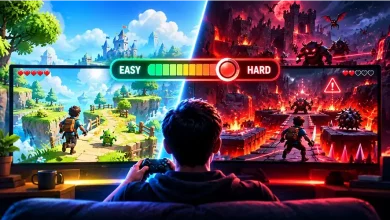
The important distinction is between unfair difficulty and learnable difficulty. A difficult game can remain enjoyable when players believe that better decisions or better execution will improve the result.
- Unclear challenge: The player does not understand what caused the failure.
- Learnable challenge: The player can identify a mistake and adjust.
- Predictable challenge: The rules remain consistent from attempt to attempt.
- Rewarding challenge: Improvement produces a noticeable result.
Challenge Games Give Players Clear Short-Term Goals
Large games can offer enormous freedom, but that freedom is not always what a player wants. Sometimes the appeal of a game is knowing exactly what needs to happen next.
A short arcade challenge might ask the player to survive for one minute. A puzzle may provide a single problem to solve. An action game can present a difficult enemy or obstacle. These goals reduce the amount of decision-making outside the actual challenge and let players concentrate on the task.
This structure also works particularly well for short gaming sessions. Someone with only a few minutes can attempt a level, solve a puzzle, or beat a score without committing to a long play session.
Different Types of Challenge Create Different Experiences
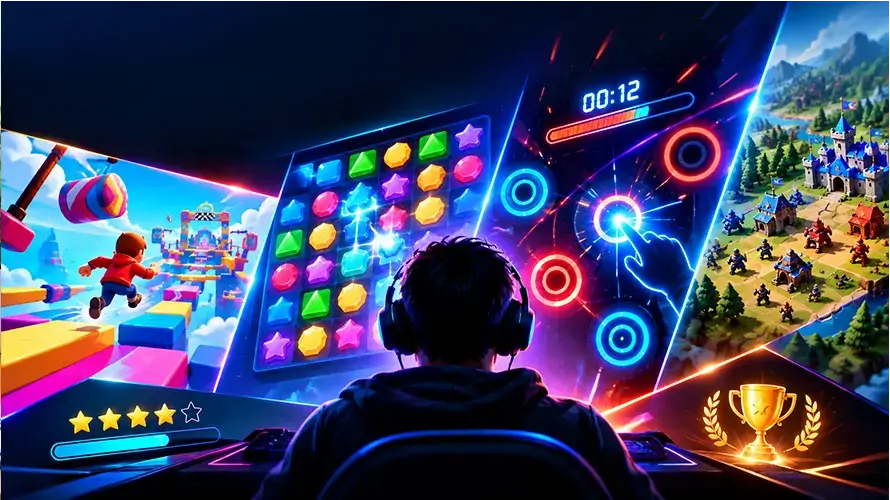
Not every challenge tests the same ability. Understanding the type of challenge can help explain why different players prefer different genres.
| Challenge Type | What It Tests | Common Examples |
|---|---|---|
| Reaction | Timing and quick responses | Arcade and action games |
| Precision | Control and accuracy | Platformers and aiming games |
| Logic | Pattern recognition and reasoning | Puzzle games |
| Planning | Long-term decisions and resource management | Strategy games |
| Endurance | Consistency over repeated tasks | Survival and score-based games |
| Knowledge | Memory and understanding of game systems | Trivia and strategy-focused games |
A player who enjoys solving problems may find a difficult puzzle more satisfying than a fast reaction test. Another player may prefer repeating an arcade sequence until their timing becomes precise. The common element is the opportunity to improve through interaction.
Replayability Comes Naturally From Good Challenges
A game can have limited content and still offer substantial replay value if its core challenge remains interesting. When players know that another attempt could produce a better result, the same level can feel different without requiring completely new content.
Score-based games demonstrate this particularly well. The first objective might be simply to finish. After that, the player may start looking for cleaner movement, faster routes, higher combos, or fewer mistakes.
Replayability also grows when players discover alternative solutions. A strategy game may allow several approaches to the same objective, while a puzzle may reward players who recognize a more efficient solution.
Competition Adds Another Layer of Motivation
Challenge does not have to be completely personal. Scores, completion times, leaderboards, multiplayer matches, and friendly competitions can give players additional goals.
For some players, competition is about beating another person. For others, it is simply a convenient way to measure improvement. A player might compare today’s score with yesterday’s score rather than focusing on another player’s result.
This is one reason simple games can remain engaging for long periods. Once the basic mechanics are understood, competition can create a new objective without requiring the game to introduce an entirely new system.
What Makes a Difficult Game Feel Fair?
Difficulty alone is not enough. Players are more likely to accept demanding gameplay when the rules are understandable and the game provides reasonable opportunities to learn.
Consistent Rules
If the same action produces the same result, players can build reliable expectations. Consistency allows mistakes to become lessons rather than mysteries.
Readable Feedback
Visual, audio, or gameplay feedback can help players understand what happened. Good feedback makes it easier to connect an action with its consequence.
Room for Improvement
A challenge should leave players with something they can work on. Better timing, smarter positioning, stronger planning, or greater knowledge can all provide a path forward.
Appropriate Difficulty
A challenge that is trivial may lose its appeal quickly, while one that feels impossible can discourage experimentation. The most engaging difficulty often sits in the space where success requires attention but still feels achievable.
Why Short Challenge Games Work So Well in Browsers
Browser gaming is particularly suited to compact challenges because many players arrive looking for something they can start quickly. A game with a straightforward objective can communicate its purpose within moments.
Short sessions also make challenge-based mechanics practical. A player can complete an attempt, leave, and return later without needing to remember a complicated storyline. The next session can begin with the same simple question: can I do better this time?
This makes arcade challenges, quick puzzles, reaction tests, and compact strategy experiences natural fits for online gaming environments.
How to Choose a Challenge Game That Fits You
If you enjoy difficult games but often stop playing after a few attempts, the problem may not be difficulty itself. The type of challenge may simply not match what you find satisfying.
- Choose reaction-based games if you enjoy speed, timing, and immediate feedback.
- Choose puzzle challenges if you prefer thinking through problems without relying heavily on reflexes.
- Choose strategy challenges if you enjoy planning several moves ahead and managing limited resources.
- Choose precision games if mastering movement or accuracy is satisfying to you.
- Choose score-based games if you enjoy competing against your own previous results.
- Choose progression-focused challenges if you prefer gradually unlocking harder tasks.
It is also worth considering the length of each attempt. A game built around short rounds may be ideal for quick sessions, while longer challenges can be more suitable when you want a deeper commitment.
Common Reasons Players Stop Enjoying a Challenge
Not every difficult game produces the satisfying loop of attempt, learning, and improvement. Several design problems can interrupt that experience.
The Challenge Feels Random
If success appears to depend mostly on luck rather than decisions or skill, repeated attempts may stop feeling meaningful.
The Game Punishes Experimentation Too Heavily
Players often need to test ideas to understand a game’s mechanics. Excessive penalties can discourage that process.
There Is No Sense of Progress
Even a difficult game benefits from visible signs that the player is learning. New levels, better scores, improved times, or simply greater consistency can provide that evidence.
The Difficulty Changes Without Explanation
A sudden and unexplained jump in difficulty can make a game feel disconnected from the player’s previous experience. Gradual escalation usually gives players more opportunities to adapt.
Why Mastery Can Be More Satisfying Than Completion
Completion answers the question, “Did I finish it?” Mastery asks a different question: “How well can I do it?” That distinction is important for challenge-focused games.
A player who has completed a level may still have reasons to return. They might want to reduce their completion time, discover a safer route, improve accuracy, or attempt a higher difficulty setting.
This creates an open-ended form of progression. The game does not necessarily need to add new content because the player has created a new objective from the existing mechanics.
Frequently Asked Questions
What are challenge games?
Challenge games are games built around tasks that test skills such as timing, precision, logic, memory, planning, reaction speed, or endurance. They can appear in many genres rather than belonging to one specific category.
Why do people enjoy difficult games?
Difficulty can make success feel meaningful when players understand the rules and can improve through practice. The satisfaction often comes from overcoming a problem rather than from difficulty by itself.
Are challenge games suitable for beginners?
Yes. Beginner-friendly challenge games usually introduce mechanics gradually and provide clear feedback. Players can also choose simpler difficulty levels or shorter challenges while learning.
What makes a challenge game replayable?
Replayability can come from score improvement, faster completion times, multiple solutions, increasing difficulty, competitive play, or mechanics that remain enjoyable to practice.
Can challenge games improve gaming skills?
They can provide practice in areas such as reaction time, spatial awareness, problem solving, planning, and precision. The specific skill depends on the game’s mechanics and the type of challenge involved.
Final Thoughts
The popularity of challenge games comes from a straightforward relationship between action, feedback, and improvement. A well-designed challenge gives players something understandable to attempt, enough information to learn from mistakes, and a meaningful reason to try again.
That formula works across puzzles, arcade games, action titles, strategy games, and short browser experiences. The most important question is not simply how difficult a game is, but whether its challenges give the player a satisfying path from “I can’t do this yet” to “I know how to do it now.”