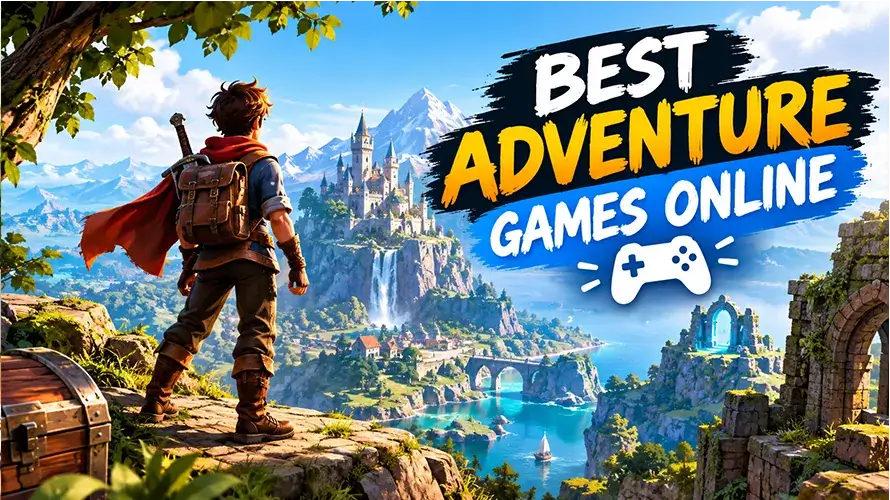
Adventure games are at their best when the player has a reason to keep moving forward. That might mean exploring an unfamiliar world, solving a strange puzzle, finding a hidden path, completing a quest, or simply seeing what happens next. The best adventure games online make that sense of discovery work within the limits of a browser or lightweight gaming session.
Not every adventure game offers the same experience. Some focus on puzzles and exploration, while others mix platforming, action, storytelling, or strategy into the formula. This guide explains the different types worth trying and how to choose one that matches the kind of gaming session you want.
What Makes an Online Adventure Game Worth Playing?
A good adventure game does more than place the player in an interesting setting. It gives exploration a purpose and makes progress feel meaningful. Even a simple browser adventure can be satisfying when its challenges are clear, its controls are responsive, and its world gives you a reason to investigate what is around the next corner.
When choosing an online adventure, look for a combination of these qualities:
- Exploration: The game rewards curiosity instead of simply moving the player from one objective to another.
- Interesting challenges: Puzzles, obstacles, quests, or environmental problems provide reasons to think and experiment.
- Accessible controls: Keyboard, mouse, or touch controls should be easy to understand without a long tutorial.
- Good pacing: The game gives you enough time to explore without making every section feel unnecessarily slow.
- Clear progression: New areas, abilities, objectives, or discoveries should make the experience feel like it is moving forward.
Choose Your Adventure Style
The phrase “adventure game” covers a surprisingly wide range of experiences. Knowing which style you prefer can save time when browsing a large collection of online games.
Story and Exploration Adventures
These games put discovery and narrative progression at the center. You may explore different locations, interact with characters, collect objects, or solve problems that gradually reveal more of the game world.
They are a good choice when you want a calmer session where curiosity matters more than reaction speed.
Puzzle Adventures
Puzzle-focused adventures turn exploration into a series of problems to solve. The challenge may involve recognizing patterns, finding useful objects, remembering clues, or understanding how different parts of an environment interact.
These games are particularly suitable for players who enjoy taking their time and figuring things out without relying entirely on fast reflexes.
Platform Adventure Games
Platform adventures combine exploration with movement challenges. Jumping across platforms, avoiding hazards, reaching hidden areas, and timing movements can become just as important as discovering the environment.
If you prefer active gameplay but still want a sense of exploration, this is often a natural middle ground.
Action Adventures
Action-adventure games add combat or fast-paced challenges to exploration. The player may need to fight enemies, avoid attacks, collect upgrades, and make quick decisions while progressing through different areas.
This style works well for players who want adventure mechanics without giving up the immediate feedback of action gameplay.
Casual Adventure Games
Casual adventures are designed around shorter sessions and straightforward mechanics. They can be useful when you want something entertaining without learning a complicated control system or spending a long time understanding the game’s rules.
A Quick Guide to Finding the Right Adventure
| What you want | Adventure style to consider | What to look for |
|---|---|---|
| A relaxing session | Story or casual adventure | Simple controls, exploration, steady pacing |
| Mental challenges | Puzzle adventure | Clues, environmental puzzles, item combinations |
| Fast gameplay | Action adventure | Responsive controls, combat, movement challenges |
| Movement-based challenges | Platform adventure | Jumping, timing, obstacles, hidden routes |
| Discovery | Exploration adventure | Multiple areas, secrets, collectibles, optional paths |
There is no requirement to stick to one category. A game can combine several styles, and those combinations are often what make an adventure memorable. For example, a platforming game may include puzzle rooms, while an action game may use exploration and environmental clues to control progression.
Features That Make Exploration More Enjoyable
Exploration is more rewarding when the game gives the player useful feedback. A locked door might suggest that another route exists. An unusual object might become important later. A visible area that cannot be reached immediately can create a reason to return after discovering a new ability.
Small details can also make a difference. Optional paths, hidden rooms, collectible items, environmental clues, and alternate solutions give curious players something to investigate beyond the main objective.
Good adventure design does not necessarily require a huge game world. A compact level with meaningful choices can feel more interesting than a large map filled with empty space.
How to Approach Puzzle-Based Adventures
When a puzzle stops your progress, randomly trying every possible interaction is usually inefficient. Start by examining the environment and identifying what has changed since you entered the area.
- Inspect the surroundings. Look for unusual objects, markings, pathways, switches, or items that appear out of place.
- Review what you already know. A clue found several minutes earlier may become relevant in a new location.
- Test simple interactions first. Try obvious combinations before assuming the solution requires a complicated sequence.
- Think about purpose. Ask what the puzzle is preventing you from reaching or what new information it is trying to reveal.
- Take a short break if necessary. Returning with a fresh perspective can make a previously confusing pattern much easier to recognize.
The goal is not to solve every puzzle instantly. A well-designed puzzle adventure should give you enough information to reason toward a solution without making every answer obvious.
Making Browser Adventures More Enjoyable
Online games can vary considerably in control schemes and performance. Before starting a longer session, check whether the game is designed primarily for keyboard and mouse, touch controls, or a combination of inputs.
If movement feels difficult, avoid immediately blaming your skill level. Browser performance, an unfamiliar control layout, or a crowded interface can affect how comfortable a game feels. Adjusting the browser window, closing unnecessary tabs, or checking the game’s control instructions may solve the problem.
For games that rely heavily on timing, stable performance is especially useful. If the game consistently feels delayed or unresponsive, choosing a lighter adventure may provide a better experience than repeatedly fighting against technical limitations.
Common Mistakes Players Make
Rushing Through Every Area
Adventure games often hide useful information away from the most obvious route. Moving directly toward the next objective can mean missing clues, optional paths, or items that make later sections easier.
Ignoring the Environment
In exploration-focused games, the environment itself can communicate information. Objects, unusual layouts, repeated symbols, and changes in scenery may be part of the game’s puzzle language.
Assuming Every Item Has an Immediate Purpose
Some games deliberately introduce objects before explaining why they matter. If an item does not appear useful immediately, remember where you found it rather than assuming it is meaningless.
Choosing a Game Without Considering Session Length
A detailed adventure can be a poor fit when you only have a few minutes available. For short breaks, a compact casual or arcade-style adventure may be more satisfying than a game built around lengthy exploration.
Tips for Getting More From Adventure Games
- Explore optional areas when the game rewards curiosity.
- Pay attention to recurring symbols, objects, and environmental patterns.
- Learn the controls before attempting difficult movement sections.
- Keep track of important clues when a puzzle involves several locations.
- Do not rush simply because the next objective is visible.
- Try a different adventure style if a particular game feels repetitive.
- For browser games, choose experiences that match your device and available play time.
Frequently Asked Questions
What are adventure games online?
Adventure games online are games played through the internet that typically emphasize exploration, puzzles, quests, discovery, storytelling, platforming, or a combination of these elements. They can range from simple browser games to more complex online experiences.
Are adventure games suitable for short gaming sessions?
Yes. Casual and puzzle-based adventures can work particularly well for short sessions, while story-heavy or exploration-focused games may be better when you have more uninterrupted time.
Do adventure games always include puzzles?
No. Some adventure games focus mainly on exploration, action, platforming, quests, or storytelling. Puzzle mechanics are common but are not required for a game to fit the broader adventure category.
What should beginners look for in an online adventure game?
Beginners can start with clear controls, simple objectives, moderate difficulty, and straightforward progression. Games that introduce mechanics gradually are often easier to understand than experiences that provide many systems at once.
Can adventure games be played without fast reflexes?
Many can. Puzzle, exploration, story-driven, and casual adventures often place more emphasis on observation and decision-making than rapid reactions. Platform and action adventures generally demand more precise timing.
Final Thoughts
The best adventure game depends on what you want from the session. If you enjoy solving problems, look toward puzzle adventures; if discovery matters most, choose an exploration-focused experience; and if you want more immediate action, platform and action adventures can provide a faster pace.
Rather than choosing a game simply because it is labeled an adventure, consider its controls, difficulty, pacing, and main gameplay loop. That small amount of thought can make it much easier to find an online adventure that fits both your interests and the time you have available.