Playing more games does not automatically mean getting better at them. A player can spend hours repeating the same mistakes, relying on familiar habits, and making very little progress. Effective practice is different: it gives you a specific skill to work on, a way to recognize mistakes, and enough repetition to turn improvements into reliable habits.
If you want to learn how to practice gaming skills, the most useful approach is to treat each session as a small training exercise rather than simply another gaming session. The right method depends on the type of game, but the basic principles are remarkably consistent across browser games, arcade titles, puzzles, action games, strategy games, and competitive experiences.
Start by Identifying the Skill You Actually Need to Improve
“Getting better” is too broad to be a useful practice goal. Before starting a session, identify the particular ability that is limiting your performance.
For example, an action game may expose a problem with aiming, movement, reaction timing, or positioning. A puzzle game may reveal weaknesses in pattern recognition or planning. A strategy game may require better resource management rather than faster reactions.
Watch what happens immediately before a mistake. If you repeatedly lose because you react too late, practice reaction timing. If you make good moves but run out of resources later, work on planning and resource management instead of simply playing more matches.
A useful practice target should be specific enough that you can recognize improvement during the session.
- Instead of “play better,” focus on avoiding unnecessary mistakes.
- Instead of “be faster,” practice completing a particular action smoothly.
- Instead of “win more,” focus on improving one decision that repeatedly causes losses.
- Instead of “learn the game,” identify one mechanic and understand when it should be used.
Use Short, Focused Practice Sessions
Long sessions are not necessarily productive sessions. After repeated attempts, attention can decline and mistakes can become automatic. A shorter session with a clear objective can produce more useful practice than several unfocused hours.
Try dividing your gaming time into three parts: preparation, focused practice, and normal play. Preparation can take only a few minutes. Focused practice should target one skill, while normal play lets you test whether that skill works when other decisions are happening at the same time.
For example, if movement is your weakness in an action game, spend part of the session concentrating specifically on positioning and avoiding unnecessary movement errors. Later, play normally and see whether the new habit remains useful when you are also managing objectives, opponents, or other mechanics.
The goal is not to make every minute of gaming feel like work. The goal is to make at least part of your playing time deliberately useful.
A Simple Practice Cycle That Works Across Different Games
You do not need an elaborate training system. A repeatable cycle of observation, focused repetition, testing, and adjustment is enough for most players.
- Observe: Identify a mistake or skill that needs attention.
- Isolate: Find a situation where that skill can be practiced without too many distractions.
- Repeat: Perform the action several times while paying attention to technique rather than the final result.
- Test: Return to normal gameplay and see whether the skill transfers to a realistic situation.
- Review: Decide what improved and what still causes problems.
- Adjust: Choose the next small target instead of trying to fix everything at once.
This cycle prevents practice from becoming endless repetition. Each session has a purpose and produces information that can guide the next one.
Match the Practice Method to the Type of Game
Different games reward different forms of practice. A technique that works well for an arcade game may be inefficient for a strategy title, while a puzzle game may require almost no mechanical repetition at all.
| Game Type | Useful Practice Focus | Example Training Approach |
|---|---|---|
| Arcade | Timing, reactions, movement | Repeat difficult sequences until the required timing becomes familiar |
| Action | Movement, aiming, positioning | Practice one mechanic at a time before combining several skills |
| Puzzle | Pattern recognition, planning | Study why a solution works rather than memorizing a single answer |
| Strategy | Decision-making, planning, resource use | Review important choices and compare alternative decisions |
| Platformer | Precision, rhythm, route knowledge | Break difficult sections into smaller sequences and repeat them |
| Casual games | Rules, efficiency, consistency | Experiment with different approaches and identify reliable habits |
The common principle is simple: practice the underlying skill rather than merely accumulating playtime.
Turn Mistakes Into Practice Material
A mistake is much more valuable when you understand its cause. Instead of immediately restarting after an error, take a few seconds to ask what happened.
Suppose you fail a difficult platforming section. The useful question is not simply “Why did I lose?” It might be “Did I jump too early, misjudge the distance, change direction too late, or become impatient?” Each answer points toward a different form of practice.
The same idea applies to strategy and puzzle games. If a decision produces a poor result, examine the information that was available when you made it. Sometimes the problem is not the decision itself but a missed clue, rushed choice, or incorrect assumption.
Keeping a simple mental or written record of recurring mistakes can also reveal patterns. If the same type of error appears several times, it deserves more attention than an unusual mistake that happened only once.
Practice Accuracy Before Chasing Speed
Trying to perform everything faster can make learning harder. Speed is usually more useful after the underlying movement, decision, or sequence is reliable.
Imagine learning a difficult input sequence. Performing it quickly while making frequent errors creates inconsistent results. Performing it more slowly and correctly gives your brain a clearer pattern to repeat. Once the movement becomes comfortable, you can gradually increase the pace.
This principle applies beyond controls. In a strategy game, making decisions quickly is less valuable if those decisions are consistently based on incomplete information. In a puzzle game, solving several problems carefully can teach more than rushing through them.
Accuracy creates a foundation; speed can then be added without sacrificing control.
Use Deliberate Repetition Instead of Mindless Repetition
Repetition is useful only when you are paying attention to what you are repeating. If you perform the same action incorrectly dozens of times, you may simply become more comfortable with the wrong technique.
During deliberate practice, give yourself a small point of attention. You might concentrate on keeping your character at a particular distance, recognizing a visual cue earlier, choosing an escape route, or checking available resources before making a decision.
Once that behavior becomes more natural, move your attention to another part of the skill. Over time, several small improvements can combine into a much more reliable performance.
Increase Difficulty Gradually
Practice should challenge you without becoming so difficult that you have no idea why you are failing. If every attempt ends immediately, there may not be enough opportunity to learn from the situation.
A useful progression is to begin with a manageable version of the skill, increase the difficulty once performance becomes consistent, and then introduce additional pressure.
- Level one: Learn the basic action without worrying about speed.
- Level two: Repeat it under normal game conditions.
- Level three: Add movement, time pressure, or another mechanic.
- Level four: Apply the skill during complete gameplay.
This progression is especially helpful for games that combine several mechanics. Learning everything simultaneously can make it difficult to determine which part is causing the problem.
Separate Learning Sessions From Performance Sessions
Not every gaming session needs the same objective. Sometimes you should experiment and make mistakes. At other times, you should simply use what you already know.
A learning session is the right place to test unfamiliar strategies, practice difficult mechanics, and deliberately explore alternatives. A performance session is more useful when you want to see how consistently you can apply those skills without stopping to analyze every decision.
Keeping these purposes separate can reduce frustration. Experimenting during a session focused entirely on winning can make normal mistakes feel more significant than they really are.
Know When a Practice Method Is Not Working
Good practice should produce information, even when it does not immediately produce better results. If you have repeated the same drill for a long time without understanding what is going wrong, change the approach.
Ask yourself whether the exercise is actually isolating the problem. You may be practicing the wrong mechanic, working at a difficulty level that is too high, or repeating an action without paying attention to the relevant feedback.
Another warning sign is frustration that consistently overwhelms concentration. Taking a short break can be more productive than continuing while mentally exhausted. Rest does not replace practice, but it can prevent low-quality repetition from dominating a session.
Build a Personal Practice Routine
You can turn these principles into a simple routine without making gaming feel like a formal training program.
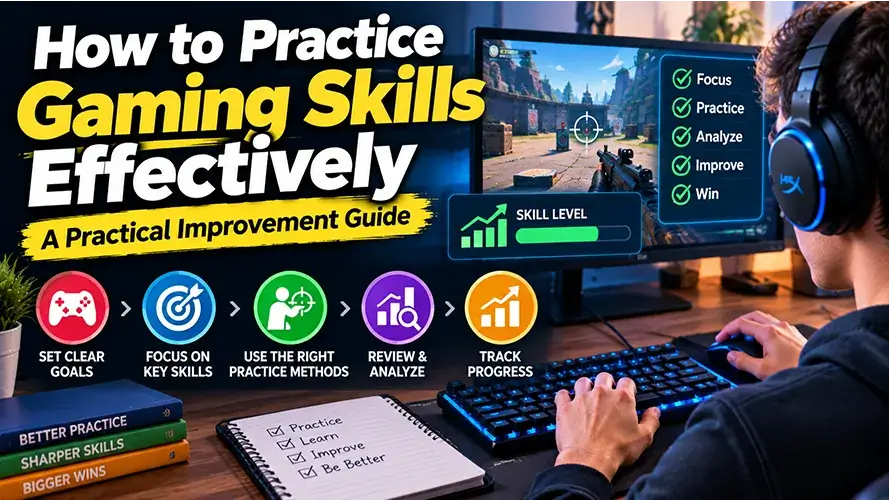
- Choose one skill: Pick the most obvious weakness from your recent games.
- Set a narrow objective: Define what successful practice should look like.
- Practice slowly: Focus on correct execution before adding pressure.
- Increase complexity: Introduce normal gameplay conditions.
- Test the skill: Play normally and observe whether the improvement carries over.
- Review the result: Keep the same target if it still needs work or move to the next skill.
For casual players, this routine can fit into a small portion of a normal gaming session. More serious players can expand each stage and keep more detailed notes.
Common Practice Mistakes to Avoid
Several habits can make gaming practice less effective even when you are putting in plenty of time.
- Trying to improve everything at once: Too many goals divide your attention.
- Only practicing when frustrated: Emotional reactions can make it harder to identify the real problem.
- Focusing exclusively on wins: A win does not necessarily mean every decision was good.
- Repeating mistakes without analysis: Repetition alone does not guarantee improvement.
- Increasing speed too early: Fast execution is difficult to build on inconsistent technique.
- Ignoring game knowledge: Mechanical ability cannot always compensate for misunderstanding the rules or objectives.
- Never testing skills in normal play: A skill practiced in isolation must eventually work under realistic conditions.
How to Tell Whether You Are Actually Improving
Improvement is not always visible through wins or high scores. Look for smaller changes that show greater consistency.
You may notice that a difficult sequence requires fewer attempts, that you recognize important situations earlier, or that you make fewer avoidable mistakes. In a strategy game, improvement may appear as better decisions under pressure rather than an immediate increase in victories.
Compare similar situations over time instead of judging yourself from one unusually good or bad session. Consistency is often a better indicator of progress than a single impressive result.
When to Stop Practicing and Just Play
Practice is a tool, not a requirement for every gaming session. Once a skill has become reasonably reliable, continuing to isolate it indefinitely may provide less value than playing normally.
At that point, use real gameplay to expose new weaknesses. You may discover that the skill works well by itself but becomes difficult when combined with movement, time pressure, resource management, or other mechanics.
This creates a natural loop: practice a weakness, apply the improvement, discover the next weakness, and repeat.
Frequently Asked Questions
How long should I practice gaming skills each day?
There is no universal session length. A focused period in which you actively work on one skill can be more useful than a much longer session spent playing without a specific goal. Choose a duration that allows you to stay attentive and stop when practice quality drops.
Should I practice one skill at a time?
Usually, yes. Focusing on one major weakness makes it easier to identify whether your practice is helping. Once the skill becomes reliable, combine it with other mechanics during normal gameplay.
Is playing more games enough to improve?
Playing provides experience, but improvement depends on what you do with that experience. If you repeatedly make the same decisions without examining them, additional playtime may reinforce existing habits rather than correct them.
Should I focus on speed or accuracy first?
For most skills, establish reliable and accurate execution first. Once the technique becomes consistent, gradually increase speed or add pressure while trying to maintain the same level of control.
How can I practice if a game does not have a training mode?
Look for situations within normal gameplay that allow you to repeat the skill safely. You can also create simple personal drills by choosing a particular mechanic or decision to focus on during several rounds.
Final Thoughts
Learning how to practice gaming skills effectively is mainly about replacing unfocused repetition with deliberate improvement. Identify a specific weakness, isolate it when possible, practice accurate execution, test the skill in real gameplay, and use recurring mistakes to decide what deserves attention next.
You do not need every session to be highly structured. Even one clearly defined practice goal can make your gaming time more purposeful while helping you build skills that remain useful across different types of games.