Starting a new game can feel harder than it actually is. The controls may seem unfamiliar, the objectives may not be obvious, and experienced players can appear to understand mechanics that take a while to discover on your own. The fastest way to improve is not to memorize everything at once. It is to identify the small number of things you need to understand first, then build your knowledge through focused practice.
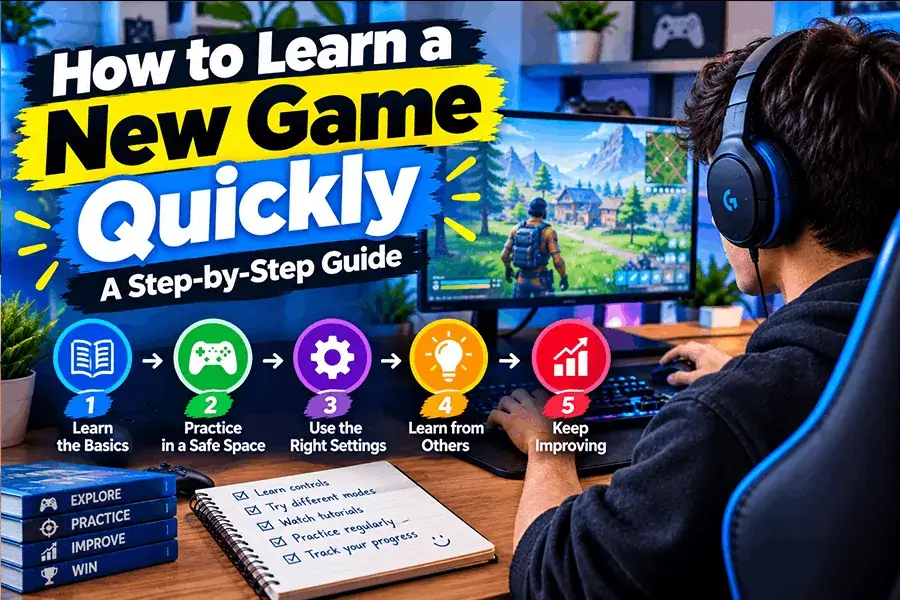
If you want to know how to learn a new game quickly, use a simple progression: understand the objective, learn the essential controls, identify the core gameplay loop, practice one mechanic at a time, and review your mistakes. This approach works across browser games, puzzle games, arcade titles, action games, strategy games, and many other genres.
Start With the Game’s Main Objective
Before worrying about advanced techniques, find out what the game actually wants you to accomplish. A complicated game often becomes much easier to understand once its main objective is clear.
Ask yourself three questions:
- What am I trying to achieve?
- What actions help me reach that objective?
- What actions cause me to lose progress, time, health, resources, or points?
For example, a puzzle game may revolve around solving increasingly difficult challenges, while an arcade game may reward quick reactions and efficient movement. A strategy game may require managing resources and making decisions over a longer period. The controls can be similar, but the priorities are completely different.
Knowing the objective gives every new mechanic a purpose. Instead of trying to remember a long list of features, you can ask whether a feature actually helps you progress.
Learn Only the Controls You Need First
One of the most common beginner mistakes is trying to memorize every button, menu, shortcut, and ability before actually playing. That creates unnecessary mental overload.
Start with the controls required for basic movement and interaction. Depending on the game, this might mean learning how to move, jump, attack, select an object, rotate a piece, use an ability, or interact with the environment.
Once those actions feel comfortable, add secondary controls gradually. If a shortcut or advanced command is rarely needed during the early stages, there is little reason to memorize it immediately.
A simple control-learning method
- Identify the controls needed for basic movement or interaction.
- Use them repeatedly in a safe or low-pressure situation.
- Add one important secondary action.
- Repeat the process until the controls become familiar.
This method is particularly useful for browser games because many can be started quickly without requiring a long setup period. You can focus on the gameplay instead of trying to understand every option before your first meaningful attempt.
Understand the Core Gameplay Loop
Most games have a repeating cycle of actions. Understanding that cycle can teach you more than memorizing isolated features.
A simple gameplay loop might look like this:
- Perform an action.
- Receive a result or reward.
- Use that result to unlock another opportunity.
- Repeat the process with greater difficulty or a new challenge.
In a strategy game, the loop could involve gathering resources, making decisions, expanding your options, and responding to opponents. In a puzzle game, it could involve observing a problem, testing a move, learning from the result, and trying another solution.
Once you recognize the loop, unfamiliar features become easier to place within the overall system. You no longer see individual mechanics as disconnected rules.
Use the First Few Attempts as Practice
Your first attempts do not need to be successful. Their purpose is to reveal how the game behaves.
Instead of concentrating entirely on winning, pay attention to what happens when you make different decisions. Notice which actions produce useful results and which ones repeatedly create problems.
For example, if you repeatedly run out of resources, do not simply restart without thinking. Ask what caused the shortage. If you keep missing attacks, determine whether the problem is timing, positioning, distance, or unfamiliar controls.
This changes practice from random repetition into deliberate learning.
Focus on One Skill at a Time
Trying to improve everything simultaneously makes it difficult to identify what is actually holding you back. Pick one skill that has a noticeable effect on your performance and concentrate on it.
Depending on the genre, that might be:
- Movement and positioning
- Timing
- Aiming or accuracy
- Resource management
- Pattern recognition
- Decision-making
- Map awareness
- Understanding enemy behavior
- Planning several actions ahead
Suppose you are learning an action game and frequently lose because your character is poorly positioned. Spending an entire session learning advanced attacks may not solve the real problem. Practicing movement and positioning first can make later mechanics much easier to use.
Learn From Mistakes Instead of Just Repeating Them
Repetition only works when you understand what you are repeating. If you make the same mistake ten times without changing your approach, you may simply become more familiar with the mistake.
After an unsuccessful attempt, pause briefly and identify the most important error. Keep the question specific: What caused that result?
Useful questions include:
- Did I misunderstand a rule?
- Did I react too slowly?
- Did I choose the wrong action?
- Did I overlook information on the screen?
- Did I use a resource too early?
- Was the problem caused by poor positioning?
You do not need to analyze every mistake. Find the one that had the greatest effect and work on correcting it during the next attempt.
When Should You Use a Guide or Tutorial?
External guides can accelerate learning, but using them for every small problem can prevent you from understanding the game yourself.
A useful approach is to experiment first when the answer is easy to discover. If you have tried several reasonable approaches and still cannot understand a mechanic, then look for a focused explanation.
Good reasons to consult a guide include:
- A rule is unclear.
- A mechanic is poorly explained.
- You cannot determine why an action failed.
- A progression system is confusing.
- You need an explanation of a specialized mechanic.
When using a guide, search for the specific problem rather than consuming everything available. Learning one mechanic that is blocking your progress is usually more useful than reading a complete advanced guide before you understand the basics.
Build a Simple Learning Routine
You do not need marathon sessions to learn a game efficiently. Short, focused sessions can be more useful because they give you a clear learning objective.
Try dividing a session into three stages:
- Warm-up: Spend a few minutes becoming comfortable with the controls.
- Focused practice: Work on one specific skill or mechanic.
- Application: Play normally and see whether the skill improves your decisions.
For example, if timing is your weakness, spend the practice portion concentrating on timing rather than trying to win at all costs. During normal play afterward, observe whether the improved timing changes your results.
This approach gives each session a purpose and makes progress easier to recognize.
Different Genres Require Different Learning Priorities
There is no single learning method that works perfectly for every type of game. The most useful early skill depends heavily on the game’s design.
| Game Type | Early Learning Priority | Useful Practice Focus |
|---|---|---|
| Puzzle | Rules and patterns | Recognizing possible moves and consequences |
| Arcade | Controls and timing | Reaction speed, movement, and repeated patterns |
| Action | Movement and combat basics | Positioning, timing, and recognizing threats |
| Strategy | Objectives and resources | Planning, prioritization, and decision-making |
| Casual | Core rules and progression | Understanding the main loop without overcomplicating it |
The table is a starting point rather than a strict rule. A particular game may place much greater emphasis on a different skill, so pay attention to what actually determines success.
Use the Game’s Difficulty Settings Wisely
If a game offers multiple difficulty levels, choosing the easiest option can be useful when your immediate goal is learning mechanics rather than testing your ability.
A lower difficulty can give you more time to understand movement, menus, enemies, puzzles, or resource systems. Once those mechanics become familiar, increasing the difficulty can create a better challenge.
However, difficulty should serve a purpose. If the easiest setting removes an important mechanic that you need to understand, it may not prepare you for the experience you actually want. Choose the setting that gives you enough room to learn without removing the systems you are trying to master.
Keep Your Learning Process Simple
When learning a complicated game, separate information into three categories: must know now, useful later, and optional details.
Must-know information includes the objective, basic controls, important rules, and actions required to make progress. Useful-later information might include advanced strategies, specialized techniques, or deeper systems. Optional details can wait until you become interested in them.
This prevents information overload. You are not trying to understand the entire game at once; you are building enough knowledge to take the next meaningful step.
Common Mistakes That Slow Down New Players
Trying to master advanced mechanics immediately
Advanced techniques make more sense after the basic systems are comfortable. Learning them too early can create confusion rather than improvement.
Changing strategies after every mistake
One failed attempt does not necessarily mean your entire approach is wrong. Give a reasonable strategy enough attempts to determine whether the problem is execution or strategy.
Ignoring the game’s feedback
Games often communicate useful information through sounds, animations, visual effects, damage indicators, menus, or score changes. Paying attention to these signals can reveal why an action succeeded or failed.
Comparing your progress with experienced players
A player who already understands the game’s systems has a major knowledge advantage. Use experienced gameplay as a source of ideas, not as a reason to expect identical performance immediately.
Learning without a specific goal
If every session becomes an attempt to improve everything, it becomes difficult to measure progress. Choose one meaningful objective and evaluate whether you moved closer to it.
A 20-Minute Method for Learning an Unfamiliar Game
When you want to understand a new game quickly, try this compact approach:
- Minutes 1–3: Identify the objective, controls, and basic rules.
- Minutes 4–8: Explore the core gameplay loop without worrying about perfect performance.
- Minutes 9–14: Practice the mechanic that seems most important to success.
- Minutes 15–18: Play normally and apply what you practiced.
- Minutes 19–20: Identify one mistake and one skill to work on next.
The exact timing is not important. The value comes from separating exploration, practice, application, and review instead of treating the entire session as uncontrolled trial and error.
How to Tell When You Are Ready to Move Beyond the Basics
You do not need perfect performance before exploring advanced strategies. A useful sign that you are ready is when the basic controls no longer consume most of your attention.
You may also notice that you can explain the main objective, recognize common situations, recover from simple mistakes, and make decisions without constantly checking instructions. At that point, advanced guides and techniques become more useful because you have enough context to understand why they work.
Progression should feel like adding layers rather than replacing everything you previously learned.
Frequently Asked Questions
What is the fastest way to learn a new game?
Learn the objective and essential controls first, then identify the core gameplay loop. Practice one important mechanic at a time and review the cause of your mistakes instead of simply repeating unsuccessful attempts.
Should I play on an easy difficulty when learning?
Easy difficulty can be useful when you need more time to understand mechanics or controls. Once the basics become comfortable, a higher difficulty can provide a more demanding test of those skills.
Is watching experienced players a good way to learn?
Yes, particularly when you already understand the basics. Watching experienced play can reveal positioning, decision-making, timing, and strategies that may not be obvious during your own early attempts.
How long does it take to become good at a new game?
There is no universal time because games differ greatly in complexity and skill requirements. A better measure is whether you are consistently understanding more situations, making fewer basic mistakes, and making deliberate decisions.
Should I use a guide immediately?
Use a guide when you encounter a specific problem that experimentation does not resolve. For simple mechanics, discovering the answer yourself can help you build a stronger understanding of how the game works.
Final Thoughts
Learning a new game quickly is mainly about controlling the amount of information you absorb at once. Start with the objective, become comfortable with essential controls, understand the core gameplay loop, and then use focused practice to solve one problem at a time.
Once the fundamentals become automatic, you can move naturally toward advanced strategies, deeper mechanics, and more challenging play. The goal is not to know everything immediately; it is to make each session teach you something useful.