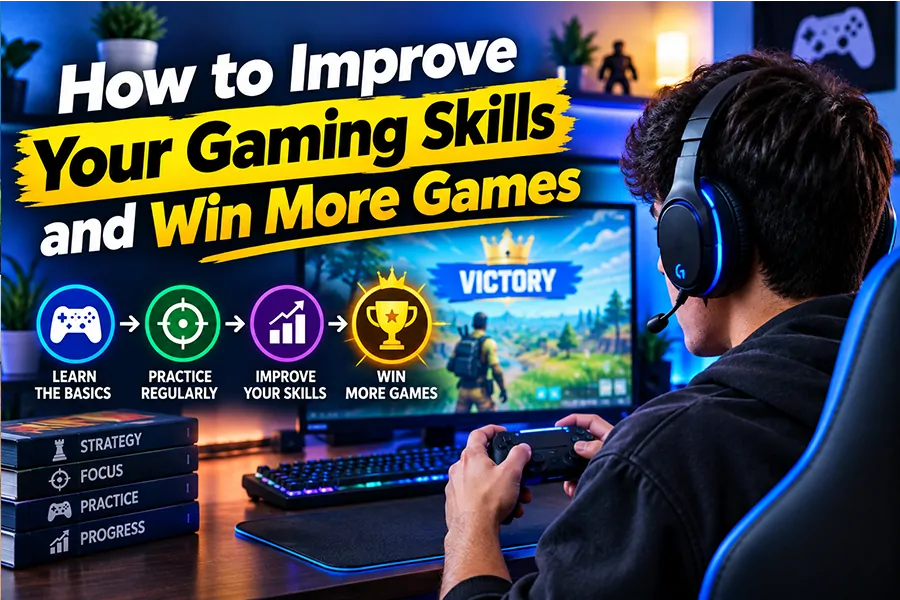
Whether you spend your time on browser games, arcade challenges, puzzle games, action titles, strategy games, or competitive online games, the same principle applies: improve gaming skills by practicing with a purpose. Better reactions can help in fast games, but awareness, timing, planning, positioning, and decision-making often matter just as much.
Start by Identifying the Skill That Is Holding You Back
The first mistake many players make is trying to improve everything at once. If you lose because you react too slowly, changing your strategy may not solve the problem. If you make poor decisions under pressure, playing faster can actually make your results worse.
After a difficult match or failed attempt, ask yourself one simple question: What specifically caused me to lose? Look for a repeatable problem rather than blaming the opponent, the level, or bad luck.
- Frequent missed opportunities: You may need better awareness or game knowledge.
- Slow reactions: Short reaction and timing exercises may help.
- Repeated strategic errors: Study the game’s mechanics and review your decisions.
- Poor positioning: Focus on movement, spacing, and where you stand before an important action.
- Rushed decisions: Practice pausing briefly to evaluate your options when the game allows it.
- Inconsistent performance: Fatigue, distractions, or overly long sessions may be affecting your concentration.
Once you have identified one weakness, make it the focus of your next few sessions. A specific goal is much easier to measure than simply deciding to “play better.”
Use a Simple Practice Loop
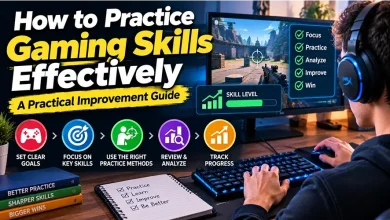
Effective practice is not just repetition. A useful session has a cycle: play, notice, adjust, repeat.
- Choose one skill. Pick something specific, such as aiming, timing, map awareness, resource management, or puzzle recognition.
- Play normally. Give yourself enough time to encounter situations where that skill matters.
- Identify mistakes. Notice exactly when the problem appears.
- Test one adjustment. Change one part of your approach rather than completely changing your play style.
- Repeat. Check whether the adjustment produces more consistent results.
This method prevents practice from becoming mindless repetition. It also makes improvement easier to notice because you have a clear skill and a clear adjustment to evaluate.
Separate Mechanical Skills From Decision-Making
Gaming ability is often a combination of different skills. A player can have excellent reflexes and still lose because of poor decisions. Another player may have average reaction speed but consistently succeed because they understand patterns, positioning, and timing.
| Skill area | What it involves | Useful practice |
|---|---|---|
| Reaction | Responding quickly to visual or audio cues | Short, focused timing exercises and fast game modes |
| Precision | Controlling movement, aiming, or inputs accurately | Repeat the same mechanical action while focusing on consistency |
| Awareness | Tracking important information around you | Regularly scan the environment instead of focusing on one object |
| Decision-making | Choosing the most useful action from several options | Pause after mistakes and consider what information you missed |
| Game knowledge | Understanding rules, mechanics, patterns, and systems | Study mechanics and learn from repeated situations |
| Adaptability | Changing your approach when circumstances change | Experiment with different strategies instead of relying on one routine |
Knowing which category needs work can make practice considerably more efficient. A player who spends all their time training reactions may see little improvement if their main weakness is actually decision-making.
Learn to Recognize Patterns Instead of Reacting to Everything
Many games become easier when you stop treating every situation as completely new. Enemies may attack in recognizable sequences, puzzle pieces may follow useful patterns, opponents may repeat habits, and levels may contain predictable hazards.
Pattern recognition reduces the amount of information your brain needs to process in real time. Instead of asking what to do after every event, you begin to recognize the situation and prepare for the likely next step.
Try asking these questions while playing:
- What usually happens immediately before I make this mistake?
- Does the same situation appear repeatedly?
- What action does the game reward most often in this situation?
- Am I reacting to the current event or anticipating what comes next?
This is especially useful in strategy, puzzle, rhythm, arcade, and action games where repeated patterns can become an important part of successful play.
Slow Down When the Game Allows It
Playing faster is not automatically playing better. In games that give you time to think, rushing can lead to unnecessary mistakes because you act before checking the available information.
Before making an important decision, develop a short mental check. Look at your objective, available resources, immediate threats, and possible consequences. The process might take only a few seconds, but it can prevent an impulsive decision that creates a much larger problem.
This does not mean you should hesitate during every action. The goal is to recognize which moments require speed and which moments reward careful evaluation.
Turn Mistakes Into Specific Lessons
Losing a game is useful only if you learn something from it. Saying “I played badly” does not provide enough information to improve. A better review identifies the exact decision or action that created the problem.
For example, instead of thinking, “I always lose this level,” try identifying a more precise observation such as, “I lose because I use my limited resources too early and have nothing available for the final section.”
The second statement gives you something to test. On the next attempt, you can deliberately conserve those resources and see whether the outcome changes.
Keep post-game analysis short. You do not need to examine every second of every match. Find one meaningful mistake, understand why it happened, and carry that lesson into the next session.
Use Short, Focused Gaming Sessions
Long sessions can feel productive because they contain many matches, but quantity does not guarantee useful practice. Concentration can decline when you become tired, frustrated, or distracted.
A focused session can have a simple structure:
- Spend a few minutes getting comfortable with the controls and mechanics.
- Choose one improvement goal.
- Play several focused rounds.
- Review one or two recurring mistakes.
- Finish after your concentration has clearly dropped instead of continuing automatically.
Shorter sessions are particularly useful when training a mechanical skill. They let you repeat an action while your attention remains focused on accuracy rather than simply accumulating playtime.
Adjust Your Strategy to the Type of Game
There is no universal training method that works equally well for every genre. The skill that matters most depends on the game’s design.
Action and Arcade Games
Focus on timing, movement, reaction speed, positioning, and recognizing recurring enemy or level patterns. Repeating difficult sections can be more useful than repeatedly restarting from the beginning.
Puzzle Games
Work on pattern recognition, planning, and evaluating consequences before committing to a move. When possible, explain to yourself why a solution works rather than memorizing a single sequence.
Strategy Games
Pay attention to resource management, priorities, timing, and long-term consequences. After a loss, identify which decision changed the direction of the game rather than focusing only on the final outcome.
Competitive Online Games
Focus on awareness, positioning, communication, decision-making, and consistency. Reviewing repeated situations can reveal habits that are difficult to notice while concentrating on the action itself.
Casual and Browser Games
Progress often comes from understanding the scoring system, recognizing patterns, improving timing, and learning how the game’s mechanics reward different actions. Because these games are often quick, you can experiment with different approaches without committing to lengthy sessions.
Do Not Change Too Many Things at Once
Suppose you change your controls, sensitivity, strategy, character choice, play style, and training routine simultaneously. If your performance changes, you will not know which adjustment caused it.
Instead, change one meaningful variable at a time whenever practical. Give the adjustment enough attempts to produce useful evidence, then decide whether it helped.
This approach is particularly valuable when experimenting with controls. A setting that feels unusual at first is not necessarily worse, but constantly changing settings prevents you from developing consistency with any of them.
Protect the Basics: Sleep, Breaks, and Concentration
Gaming performance depends partly on your ability to concentrate. When you are tired or distracted, mistakes that normally seem easy can become frequent.
Take regular breaks during longer sessions, especially when you notice that frustration is replacing focused decision-making. A short break can also prevent the common cycle of making mistakes, becoming annoyed, playing more aggressively, and making even more mistakes.
Good performance does not require turning every gaming session into serious training. Sometimes the most useful decision is to stop practicing when you are no longer learning effectively.
A Practical Seven-Session Improvement Plan
If you are unsure where to begin, use this simple progression. Each session has a different purpose, which prevents you from repeating the same routine without thinking about what you are learning.
| Session | Focus | Goal |
|---|---|---|
| 1 | Observation | Identify your three most common mistakes |
| 2 | One weakness | Practice the most frequent problem deliberately |
| 3 | Game knowledge | Learn mechanics or patterns related to that weakness |
| 4 | Application | Use the new approach during normal play |
| 5 | Adaptation | Test how the approach works in different situations |
| 6 | Review | Compare your decisions with earlier sessions |
| 7 | Consistency | Play normally while maintaining the improved habit |
The purpose of this plan is not to guarantee a particular win rate. It gives you a structured way to determine whether your practice is actually changing how you play.
Common Habits That Slow Improvement
Playing on Autopilot
If you repeatedly play without paying attention to your decisions, you may reinforce the same habits rather than correct them.
Blaming Every Loss on Luck
Random events genuinely exist in some games, but not every poor result is caused by them. Look for decisions you could control before deciding that the outcome was entirely outside your influence.
Copying Advanced Players Without Understanding Why
Watching skilled players can teach useful ideas, but copying an action without understanding its purpose may not transfer to your own situation. Pay attention to the reasoning behind the decision.
Changing Your Strategy After Every Loss
One bad result does not prove that an approach is ineffective. Give a strategy enough attempts to determine whether the problem is the strategy itself or how you are applying it.
Practicing Only What You Already Do Well
Comfortable skills improve less when they receive all of your attention. Spend some practice time on weaknesses that regularly affect your results.
How to Know If You Are Actually Improving
Wins are an obvious measurement, but they are not the only one. In some games, a stronger player can still lose because of randomness, difficult matchmaking, or a single mistake.
Track improvements that are directly connected to your chosen skill. For example, you might notice that you make fewer unnecessary moves, recognize hazards earlier, manage resources more effectively, or remain calmer when a match becomes difficult.
Look for consistency rather than one exceptional performance. A new skill is becoming useful when you can apply it repeatedly in different situations without having to think consciously about every step.
Frequently Asked Questions
How long does it take to improve gaming skills?
There is no universal timeline. Improvement depends on the game, your starting ability, the skill being trained, and the quality of your practice. Focused repetition with feedback is generally more useful than simply increasing the number of hours played.
Is playing more games the best way to get better?
More playtime can provide useful experience, but only when you are paying attention to what you are learning. If you repeatedly make the same mistakes without reviewing them, additional games may reinforce those habits.
Should I focus on speed or accuracy first?
When the game allows it, accuracy and consistency are usually a useful foundation. Once an action becomes reliable, you can gradually increase the speed at which you perform it.
Can casual games help improve gaming skills?
Yes. Different games can exercise different abilities, including timing, spatial awareness, pattern recognition, planning, memory, and decision-making. The useful skill depends on the game’s mechanics.
What should I do when I keep losing?
Stop treating the entire result as the problem. Identify one recurring mistake, choose one adjustment, and test it over several attempts. If frustration is affecting your concentration, take a break before continuing.
Final Thoughts
The fastest path to becoming a more consistent player is not necessarily playing longer. It is learning to recognize what is limiting your performance and practicing that specific weakness with a clear purpose.
Choose one skill, observe your mistakes, make one adjustment, and test it repeatedly. Over time, better awareness, decision-making, mechanics, and consistency can turn individual lessons into habits that carry across many different types of games.