Getting stuck on the same game level can turn a challenging experience into a frustrating one. You may know the basic controls, understand the objective, and still fail because one small mistake keeps repeating. The solution is usually not to play harder or faster. It is to identify what is actually causing the failure and change your approach.
Learning how to beat difficult game levels is largely about turning an apparently impossible challenge into a series of smaller problems. Once you know what to observe, what to practice, and when to change tactics, difficult levels become much easier to understand.
Stop Repeating the Same Attempt
One of the most common mistakes is restarting a level immediately after every failure and then doing almost exactly the same thing. Repetition only helps when each attempt teaches you something new.
After a failed attempt, pause for a few seconds and identify the specific reason you lost. Did you move too early? Miss an important pattern? Run out of time? Waste a limited ability? Enter a dangerous area without enough resources?
Instead of thinking, “I almost had it,” turn the failure into a specific observation such as, “I lose health during the second obstacle because I rush the jump.” That gives your next attempt a clear purpose.
Break the Level Into Smaller Problems
A difficult level often feels overwhelming because the player thinks about the entire challenge at once. A better approach is to divide it into sections and solve them individually.
For example, an action level might contain an opening movement sequence, an enemy encounter, a platforming section, and a final challenge. You do not need to master all four parts simultaneously.
- First section: Learn the safest route and basic timing.
- Second section: Identify dangerous attacks or obstacles.
- Third section: Practice movement without worrying about the ending.
- Final section: Save enough health, time, or abilities to handle the last challenge.
Once each section becomes familiar, combining them into one complete run becomes considerably easier.
Learn the Level Before Trying to Master It
Some levels reward immediate action, while others become much easier after a short period of observation. If enemies follow predictable patterns, obstacles appear in fixed positions, or platforms move according to a cycle, watching those patterns can be more valuable than making another rushed attempt.
On an early attempt, focus less on winning and more on gathering information. Notice where threats appear, when safe opportunities occur, and which areas give you room to recover.
This is especially useful in puzzle and strategy games. A failed move can reveal how the level reacts, which may give you information needed for the next attempt.
Change One Variable at a Time
When several things go wrong, changing everything at once makes it difficult to understand what actually improved your performance. Instead, make one meaningful adjustment and test it.
If you keep missing a jump, change your timing first. If that does not work, change your approach angle. If the problem continues, consider whether the intended route is different.
This method creates a simple feedback loop: attempt, observe, adjust, test. It is much more effective than randomly changing controls, routes, or strategies after every failure.
Use a Different Strategy When the Current One Fails
A strategy can be perfectly reasonable and still be wrong for a particular level. Difficult games often require players to adapt rather than rely on one preferred playstyle.
For example, constantly attacking may work in an easy combat section but become inefficient against an enemy with strong counterattacks. Defensive movement, patience, positioning, or waiting for an opening may produce better results.
The same principle applies to puzzle games. If trying to solve a puzzle by making moves immediately is not working, stop moving and first identify the objective, available resources, and restrictions.
Ask yourself what the level appears to reward:
- Speed or patience?
- Exploration or direct progression?
- Aggression or defensive positioning?
- Precision or rapid reactions?
- Experimentation or careful planning?
Matching your strategy to the level’s actual demands is often more important than simply improving your reaction speed.
Protect Your Limited Resources
Many difficult levels become harder because players spend valuable resources too early. These resources might include health, ammunition, lives, special abilities, time, energy, moves, or temporary power-ups.
Before using something valuable, consider whether it solves an immediate problem or simply makes the current moment more comfortable.
A useful habit is to separate resources into three categories:
| Resource | Common Mistake | Better Approach |
|---|---|---|
| Health | Taking unnecessary damage while rushing | Use safer positioning and avoid avoidable hits |
| Special abilities | Using them against minor threats | Reserve them for sections where they provide significant value |
| Time | Spending too long on low-value actions | Learn which actions actually advance the objective |
| Lives or attempts | Repeating an unchanged strategy | Use each attempt to test a specific adjustment |
| Moves | Making actions without considering later consequences | Think several steps ahead when the game allows it |
For Puzzle Games, Work Backward From the Goal
Puzzle levels can become much easier when you stop asking, “What move can I make now?” and instead ask, “What needs to happen immediately before the goal?”
Working backward can reveal dependencies that are difficult to see when you only think about the next move. If the final position requires a particular object, determine where that object needs to be before the final move. Then work backward again.
Also look for restrictions. A puzzle may not be difficult because there are too many possible moves; it may be difficult because only a small number of moves preserve a solution.
When possible, identify moves that are reversible and moves that permanently change the level. Experiment more freely with reversible actions and think carefully before committing to irreversible ones.
For Action Games, Practice Movement Separately
In action games, players often try to improve everything simultaneously: aiming, movement, attacks, dodging, positioning, and decision-making. That makes practice unnecessarily complicated.
If movement is causing most of your failures, practice movement without worrying about completing the level. Learn how far the character moves, how quickly they stop, how long a dodge lasts, and which actions can be performed while moving.
Once movement becomes predictable, combat decisions become easier because less attention is being spent on basic control.
The same principle applies to browser games and arcade games where a small timing error can repeatedly cause failure. Isolate the mechanic that causes the most problems and practice that mechanic deliberately.
Recognize When the Problem Is Timing
Some levels are not asking you to react as quickly as possible. They are asking you to react at the correct moment.
Fast reactions can actually make certain challenges harder if the player acts before an opening appears. Look for visual, audio, or movement cues that indicate when an action is safe.
If an obstacle moves in a repeating pattern, count the rhythm. If an enemy pauses before attacking, use that pause as a signal. If platforms appear at predictable intervals, learn the sequence instead of guessing each jump.
Once you recognize a consistent cue, the challenge changes from pure reaction to prediction. Prediction generally makes repeated attempts more controlled and less stressful.
Use Checkpoints as Practice Opportunities
A checkpoint is more than a place to recover after failure. It can also be used as a training point.
If a game lets you repeatedly restart near a difficult section, focus your practice there rather than repeatedly replaying everything that came before it. Your goal is to make the difficult section familiar enough that reaching it no longer feels like an event.
When you can consistently pass a troublesome section, combine it with the previous section. This creates a gradual progression from isolated practice to full-level completion.
Know When to Take a Short Break
Frustration can make a familiar challenge feel harder than it actually is. After many failed attempts, players often rush inputs, ignore obvious patterns, or become overly focused on the previous mistake.
A short break can reset your attention. You do not need to stop playing for a long period. Even stepping away briefly and returning with a specific goal can make the next attempts more productive.
The important distinction is between productive repetition and frustrated repetition. If you are no longer learning anything from your attempts, continuing immediately may not be useful.
A Simple Recovery Plan for Being Completely Stuck
If you have tried several approaches and still cannot progress, use this reset sequence instead of continuing to repeat the same attempt.
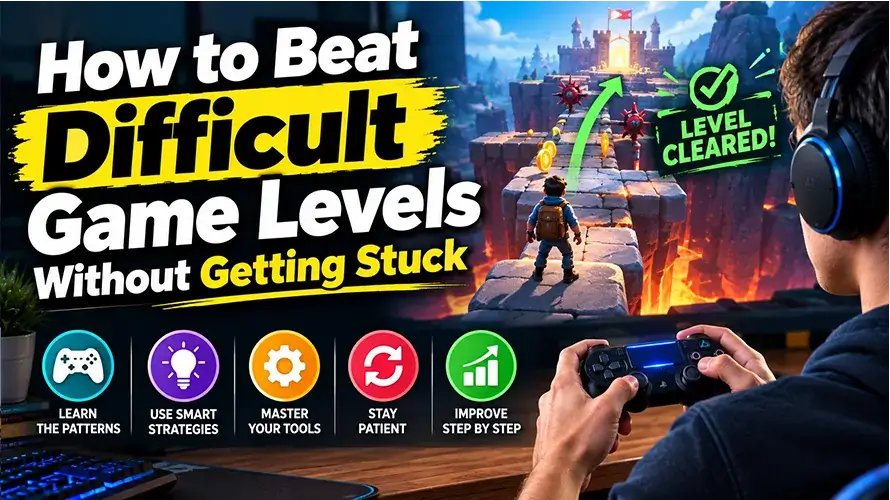
- Identify the exact failure point. Do not describe the whole level as difficult. Find the moment where your run consistently breaks down.
- Watch the pattern. Spend an attempt observing rather than trying to win.
- Choose one change. Alter your timing, route, positioning, equipment, or strategy.
- Practice the difficult section. Use checkpoints or safe areas whenever the game allows it.
- Protect resources. Enter the difficult section with enough health, time, moves, or abilities to complete it.
- Combine the sections. Once the problem area is manageable, practice completing it as part of a full run.
This approach turns a vague problem into a sequence of manageable decisions.
Common Mistakes That Make Hard Levels Feel Impossible
Rushing After a Failure
Trying to immediately compensate for a mistake often creates another mistake. Slow down enough to understand what caused the original failure.
Changing Too Many Things at Once
If you change your route, controls, equipment, timing, and strategy simultaneously, you cannot tell which change helped. Test adjustments individually when possible.
Ignoring the Level’s Patterns
Repeated enemy behavior, obstacle cycles, and environmental cues are often information rather than decoration. Learn to recognize them.
Saving Nothing for the Hardest Section
Reaching the final challenge with no useful resources can make an otherwise manageable level unnecessarily difficult. Think about resource distribution before starting a serious attempt.
Assuming More Speed Means Better Performance
Some challenges reward precise timing rather than fast inputs. A controlled action at the right moment is often more reliable than several rushed actions.
When Should You Look for a Guide?
Using a guide is not always necessary, but it can be useful when the problem is knowledge rather than execution. For example, you may understand the controls perfectly but have no idea which objective the level expects you to complete.
Before searching for a solution, identify what information you actually need. A complete walkthrough may reveal much more than necessary, while a short explanation of one mechanic could be enough to get you moving again.
For puzzle games especially, consider trying your own solution first and using a hint only when you have exhausted reasonable possibilities. This preserves the problem-solving experience while still preventing a single obstacle from stopping your progress entirely.
How to Tell Whether You Are Actually Improving
Progress is not always measured by completing the level. Look for smaller signs that your understanding is improving.
- You reach the difficult section with fewer mistakes.
- You recognize dangerous patterns before they cause damage.
- You use fewer resources to reach the same checkpoint.
- You recover from mistakes instead of immediately losing.
- You can explain why a previous attempt failed.
- You can reproduce a successful action rather than succeeding by accident.
These improvements matter because reliable performance usually comes before successful completion. Once the important decisions become consistent, finishing the level becomes much less dependent on luck.
Frequently Asked Questions
What should I do when I keep failing the same game level?
Stop repeating the exact same attempt. Identify the specific point where you fail, observe what happens there, and change one part of your strategy. Treat the next attempt as a test rather than simply another try.
How can I get better at difficult puzzle levels?
Start by identifying the goal and the restrictions. Consider working backward from the final move, especially when actions have permanent consequences. Experiment with reversible moves before committing to irreversible ones.
Why do I perform worse after playing a difficult level for a long time?
Repeated frustration can reduce attention and encourage rushed decisions. If your attempts stop producing useful information, take a short break and return with one specific problem to solve.
Should I use a walkthrough when I am stuck?
Use one when you need information that experimentation cannot reasonably provide, such as an unclear objective or hidden mechanic. If you want to preserve the challenge, look for a small hint rather than a complete solution.
How do I beat difficult game levels without relying on luck?
Learn recurring patterns, practice the sections that cause failures, control your resources, and make deliberate adjustments after each attempt. The more of the level you can predict, the less your success depends on chance.
Final Thoughts
Beating a difficult level is rarely about forcing yourself to make more attempts. The real improvement comes from making those attempts more informative. Observe the level, isolate the problem, adjust one variable, and practice until the successful action becomes repeatable.
Once you approach difficult challenges as problems to analyze rather than walls to overcome, even frustrating levels become easier to break down. The objective is not simply to try harder, but to understand what the game is asking you to do and respond with a deliberate strategy.