If you are wondering how to get better at games, start by treating improvement as a process rather than a race. The approach that works for a competitive action game will not be identical to the one that helps with a puzzle, strategy, arcade, or browser game, but the underlying principles are surprisingly similar.
This guide explains how to identify your weaknesses, practice efficiently, learn from mistakes, build better game sense, and avoid habits that make improvement harder than it needs to be.
Start by Identifying What Is Actually Holding You Back
A common beginner mistake is trying to improve everything at once. If your performance is inconsistent, you might assume that you need faster reactions, better aim, stronger memory, smarter decisions, and more experience simultaneously. That makes practice unfocused.
Instead, pay attention to what happens immediately before you make a mistake. Look for patterns rather than isolated failures.
- Frequently losing fights: Your positioning, timing, aim, or understanding of the game’s combat system may need work.
- Making good moves but losing later: You may need to improve planning, resource management, or long-term decision-making.
- Reacting too slowly: You may benefit from learning common situations so you recognize them before a reaction is required.
- Performing well sometimes and badly at other times: Consistency, concentration, or decision-making under pressure may be the main issue.
- Getting stuck on the same level: The problem may be a specific mechanic, puzzle pattern, route, or strategy rather than your overall skill.
For your next few sessions, choose one weakness to observe. You do not need sophisticated statistics or expensive equipment. Simply knowing what caused a mistake is often enough to make your next practice session more productive.
Learn the Game Before Trying to Master It
Strong players often appear fast because they recognize situations quickly. What looks like an impressive reaction can actually be knowledge built through experience.
For example, a player who already understands an opponent’s common attack may begin moving before the attack is fully visible. A strategy player may know which resource is important several minutes before a beginner realizes it is becoming a problem. In a puzzle game, an experienced player may immediately recognize a familiar pattern.
Spend some time learning the basic rules, objectives, controls, maps, mechanics, scoring systems, or win conditions of the game you are playing. Understanding why something works is generally more useful than memorizing a sequence without knowing its purpose.
When you encounter a new mechanic, ask three simple questions:
- What does this mechanic allow me to do?
- When is it useful?
- What mistake would make using it ineffective?
Those questions turn passive information into practical game knowledge.
Practice One Skill at a Time
Deliberate practice is more effective when the goal is specific. Instead of deciding that you will “play better” during a session, choose an objective that you can actually observe.
For an action game, your goal might be keeping better positioning. In an arcade game, it could be learning to control movement more precisely. In a strategy game, you might focus on managing resources without wasting them. In a puzzle game, you could practice recognizing patterns before making a move.
A simple practice session can look like this:
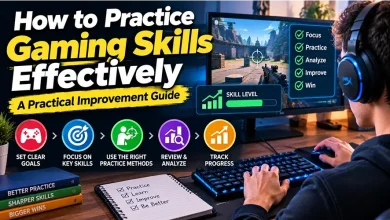
- Choose one skill. Pick the weakness that currently has the biggest effect on your performance.
- Define what success looks like. Make the goal observable, such as avoiding unnecessary mistakes or maintaining better positioning.
- Play with that goal in mind. Do not worry if your overall score temporarily drops while you learn.
- Review mistakes. Identify two or three moments where the chosen skill mattered.
- Repeat. Keep the same focus until the behavior starts becoming natural.
This approach prevents practice from turning into endless repetition without feedback.
Stop Treating Every Loss as the Same
Losing does not automatically tell you what to improve. Two losses can have completely different causes.
Imagine you lose three rounds. In the first, you made an aggressive move without enough information. In the second, you understood the situation but executed poorly. In the third, you were already behind because of an earlier resource-management mistake.
Calling all three losses “bad gameplay” gives you very little useful information. Breaking them down gives you something to work on.
| What happened? | Possible problem | Useful response |
|---|---|---|
| You knew what to do but executed poorly | Mechanical skill | Practice the movement, timing, aiming, or control involved |
| You acted without understanding the situation | Game knowledge | Learn the mechanic, pattern, map, or opponent behavior |
| You chose the wrong action despite having information | Decision-making | Review the alternatives and identify the safer or more effective choice |
| You repeatedly make the same mistake | Habit or lack of awareness | Create a simple reminder and deliberately watch for that situation |
The objective is not to avoid every mistake. The objective is to make fewer repeated mistakes.
Improve Your Game Sense, Not Just Your Reactions
Reaction speed matters in some games, but it is only one part of performance. Anticipation can often compensate for an ordinary reaction time because knowing what is likely to happen reduces the amount of time you need to process a situation.
Game sense means understanding what is happening, what is likely to happen next, and which options are available to you. It develops through observation and experience.
During a match or level, periodically ask yourself:
- What is the immediate objective?
- What information do I currently have?
- What information am I missing?
- What is the opponent, level, or game system encouraging me to do?
- What could go wrong if I choose the obvious option?
- What is my safest useful alternative?
These questions are especially valuable in strategy, tactical, competitive, and decision-heavy games. They encourage you to think one step ahead rather than simply reacting to whatever appears on the screen.
Make Your Controls Comfortable
Mechanical skill becomes harder to develop when your controls constantly get in the way. You should not change settings every few minutes, but you should make reasonable adjustments so that the controls feel predictable and comfortable.
Depending on the game, this could mean adjusting sensitivity, key bindings, controller settings, mouse positioning, display options, or audio levels. The important point is consistency.
Once you find a setup that feels comfortable, give yourself enough time to adapt before changing it again. Constantly switching settings can make it difficult to develop reliable muscle memory.
Comfort also matters outside the game itself. A stable sitting position, sensible screen distance, and regular breaks can make longer sessions easier to manage. If your hands, eyes, or posture are becoming uncomfortable, continuing to play is unlikely to produce high-quality practice.
Use Short, Focused Sessions Instead of Endless Grinding
More playing time does not automatically mean more improvement. When concentration drops, players often begin making careless decisions and reinforcing bad habits.
A focused session can be relatively short. You might spend part of the session warming up, play several games with a specific objective, and then spend a few minutes thinking about what happened.
If you notice that you are repeatedly making obvious mistakes, becoming frustrated, or playing automatically, taking a break can be more useful than immediately starting another round.
Rest is particularly important for games that demand sustained concentration. Improvement depends on the quality of practice, not simply the number of hours shown on a playtime counter.
Learn From Better Players Without Copying Everything They Do
Watching skilled players can reveal possibilities that you might not discover on your own. However, copying their actions without understanding the reasoning behind them can create another problem.
When watching gameplay, focus on decisions rather than impressive moments. Notice where the player positions themselves, when they choose to attack or retreat, what information they check, how they manage resources, and how they respond when their original plan stops working.
After seeing an interesting decision, ask yourself: What information made that decision sensible? This question is more useful than simply asking what button the player pressed.
Also remember that strategies can depend on the specific game version, mode, map, rules, or skill level involved. A tactic that works in one situation may be ineffective in another.
Common Beginner Habits That Slow Improvement
Some habits feel productive because they involve playing a lot, but they can quietly prevent progress.
Changing strategies after every failure
If you abandon an approach immediately after one bad result, you never give yourself enough repetitions to determine whether the approach actually works. Give a reasonable strategy enough time to evaluate it, then change it based on evidence.
Blaming everything except your decision
Connection problems, teammates, matchmaking, unfamiliar opponents, and random events can genuinely affect a game. However, focusing exclusively on external factors removes useful information from the experience. Ask what was still under your control.
Playing while tilted
Frustration can make players rush decisions, repeat risky behavior, and stop paying attention. If you notice that you are trying to recover a previous loss rather than playing the current situation intelligently, take a break.
Trying advanced techniques too early
Advanced mechanics are attractive, but fundamentals usually provide a stronger foundation. Learn movement, positioning, objectives, resource management, and basic decision-making before filling your practice time with complicated techniques.
Comparing yourself with highly experienced players
A skilled player may have thousands of repetitions of situations that you have encountered only a handful of times. Compare your current performance with your own previous performance instead of expecting beginner results to immediately resemble expert play.
A Simple Progression Plan for New Players
If you want a practical way to start improving, use a progression that moves from understanding to execution and then to decision-making.
| Stage | Main focus | Question to ask |
|---|---|---|
| 1. Understand | Rules and mechanics | Do I know what the game expects me to do? |
| 2. Control | Movement and basic mechanics | Can I perform the basic actions consistently? |
| 3. Recognize | Patterns and situations | Can I identify what is happening early enough? |
| 4. Decide | Choosing between options | Which available action makes the most sense here? |
| 5. Review | Learning from mistakes | What caused my last unnecessary error? |
| 6. Adapt | Handling unfamiliar situations | Can I adjust when my normal plan stops working? |
You do not need to complete these stages in a strict order. Good players continue developing all of them. The framework simply gives beginners a way to understand what they are practicing.
How to Improve Across Different Types of Games
The exact skill you should prioritize depends heavily on the type of game you are playing.
Action and arcade games
Prioritize movement, timing, positioning, pattern recognition, and consistent execution. Repeating a difficult section can be useful when you focus on one specific mechanic instead of simply trying to finish it.
Puzzle games
Slow down your decision-making. Look for recurring patterns, consider multiple possibilities, and avoid making a move simply because it is immediately available. Reviewing why a solution works can help you recognize similar situations later.
Strategy games
Focus on priorities and resource management. Learn which actions support your main objective and which ones consume resources without producing enough value. Reviewing decisions several minutes before a loss can be particularly useful.
Competitive multiplayer games
Work on positioning, information gathering, communication, consistency, and decision-making under pressure. Do not judge your entire performance from one match because individual games can contain unusual situations.
Casual and browser games
Improvement can be as simple as learning the scoring system, recognizing level patterns, understanding power-ups, or discovering which actions produce the most reliable results. Because these games are often easy to start, experimenting with different approaches can be an effective learning method.
When You Are Stuck, Change the Question
One of the most useful habits you can develop is replacing “Why am I so bad at this?” with a more specific question.
Ask “What exactly happened?” Then ask “What could I have done differently?”
Suppose you repeatedly lose the same type of encounter. Instead of concluding that the opponent is simply better, identify the sequence. Perhaps you enter the situation with too few resources. Perhaps you commit too early. Perhaps you do not recognize a warning sign until it is too late.
Once the problem has a specific description, it becomes possible to practice it. This is the point where frustration can become useful information.
Build a Better Practice Routine
You do not need a complicated training schedule. A simple routine can keep your sessions focused without turning gaming into a chore.
- Warm up: Spend a few minutes getting comfortable with the controls and basic mechanics.
- Choose a focus: Pick one skill or recurring mistake.
- Play normally: Apply the skill in real situations instead of practicing it in isolation forever.
- Review: Identify one thing that worked and one thing that needs improvement.
- Repeat: Keep the same focus until you see more consistent results.
After a few sessions, you can change your focus. If you are improving, raise the difficulty gradually rather than changing everything at once.
Frequently Asked Questions
How long does it take to get better at games?
There is no universal timeline. Improvement depends on the game, your starting skill level, the quality of your practice, and how consistently you play. Focusing on specific weaknesses generally gives you more useful progress than simply increasing playtime.
Do I need fast reflexes to become good at games?
Not necessarily. Reflexes are important in some genres, but anticipation, game knowledge, positioning, planning, pattern recognition, and decision-making can be equally important. Many situations become easier when you recognize what is about to happen before you need to react.
Should beginners play against stronger players?
Playing against stronger opponents can expose weaknesses and show you techniques you have not considered. However, if the skill gap is so large that you cannot understand what is happening, games against similarly skilled opponents can provide more useful practice.
Is watching gaming videos a good way to improve?
It can help when you actively study the decisions being made. Pay attention to positioning, timing, priorities, and responses to unexpected situations rather than watching only for entertaining plays.
Why do I sometimes play well and then suddenly get worse?
Performance can change because of fatigue, frustration, loss of concentration, unfamiliar situations, or inconsistent decision-making. If mistakes become frequent after a long session, taking a break and returning later may be more productive than continuing to grind.
What should I practice first as a complete beginner?
Start with the game’s basic controls, objectives, and core mechanics. Once those feel comfortable, identify one recurring mistake and work specifically on that problem. Building a strong foundation is usually more useful than immediately attempting advanced techniques.
Final Thoughts
Getting better at games is largely a matter of turning vague frustration into specific problems you can solve. Learn the rules, build reliable fundamentals, focus on one weakness at a time, and review mistakes instead of simply repeating them.
Most importantly, measure progress by the quality of your decisions and your ability to recognize situations, not only by wins and losses. When you understand why something went wrong, you have already found the starting point for improving it.